- Sep 2, 2026
Kenya has established itself as one of the world's most dynamic digital financial hubs, earning global recognition for pioneering mobile payment adoption and mobile-first economic frameworks. For millions of Kenyans living across North America, Europe, and the United Kingdom, sending money to Kenya is a routine necessity to support family members, pay school fees, settle medical bills, invest in real estate, or fund local commercial enterprises. However, despite the advanced digital ecosystem existing on the ground in East Africa, sending capital internationally through conventional commercial banks remains an expensive, sluggish, and opaque process. Traditional international wire transfers rely on legacy banking rails that were designed decades ago, subjecting users to unpredictable processing times and hidden financial markups. Understanding the mechanical differences between legacy bank wires and modern local clearing architectures is essential for anyone seeking an efficient, low-cost, and secure method to transfer funds to Kenya.
Table of Contents
- 1. The Structural Inefficiencies of Traditional Bank Wires to Kenya
- 2. How Peer-to-Peer Matching and Local Clearing Eliminate Border Friction
- 3. Kenya's Domestic Ecosystem: M-Pesa, Mobile Money, and Major Banking Channels
- 4. Step-by-Step Guide: Executing a Fast, Transparent P2P Money Transfer to Kenya
- 5. Financial Security, Regulatory Compliance, and Identity Verification
- 6. Conclusion: Take Control with Real-Time Rate Simulations
1. The Structural Inefficiencies of Traditional Bank Wires to Kenya
When individuals send money to Kenya through traditional brick-and-mortar financial institutions, the funds navigate the complex international correspondent banking network known as SWIFT. The SWIFT system does not actually move liquidity; rather, it transmits administrative messages between participating financial entities. Because a commercial bank in London, Toronto, or New York rarely maintains a direct account relationship with a local Kenyan bank, the transaction must pass through multiple intermediary correspondent banks before reaching its final destination.
Each intermediary institution along this path imposes its own handling charges, processing commissions, and administrative fees. These deducted amounts represent significant hidden bank fees that quietly erode the total value of the remittance. Consequently, the recipient in Kenya frequently receives a reduced net amount, forcing senders to make secondary transfers to cover unexpected shortfalls. Furthermore, because each correspondent entity operates under its own batch-processing schedules and regional business hours, traditional cross-border wires routinely take anywhere from three to five business days to clear, creating frustrating delays during financial emergencies.
The most substantial hidden cost of legacy bank transfers lies in the foreign exchange markup. Commercial banks seldom provide retail customers with access to the live interbank exchange rate—the actual market mid-rate at which major financial institutions swap currencies globally. Instead, banks apply an arbitrary markup or exchange rate spread on the Kenyan Shilling (KES). This currency conversion markup functions as an invisible tax on the sender's hard-earned funds. To understand how modern fintech infrastructures bypass these legacy bank traps, explore this detailed guide on network architectures comparing SWIFT, SEPA, and P2P matching.
2. How Peer-to-Peer Matching and Local Clearing Eliminate Border Friction
To overcome the friction, delays, and excessive transfer fees inherent in correspondent banking, next-generation financial marketplaces utilize Peer-to-Peer (P2P) currency matching architectures. Platforms such as CashSwap Club operate on a straightforward technical premise: money never physically crosses international borders. By eliminating transborder currency flows, the platform entirely bypasses international correspondent networks and their associated overhead costs.
The marketplace maintains multi-currency digital wallets holding major global currencies, including Euro (EUR), US Dollar (USD), British Pound (GBP), and Canadian Dollar (CAD). Internal platform transactions execute exclusively between wallets denominated in the same currency. When a user wishes to convert funds for a transfer to Kenya, the marketplace algorithm automatically matches the order with a counterparty expressing an inverse currency requirement within the multi-currency liquidity pool. Local currency disbursements in Kenya are subsequently settled off-platform using fast domestic banking channels or mobile money networks.
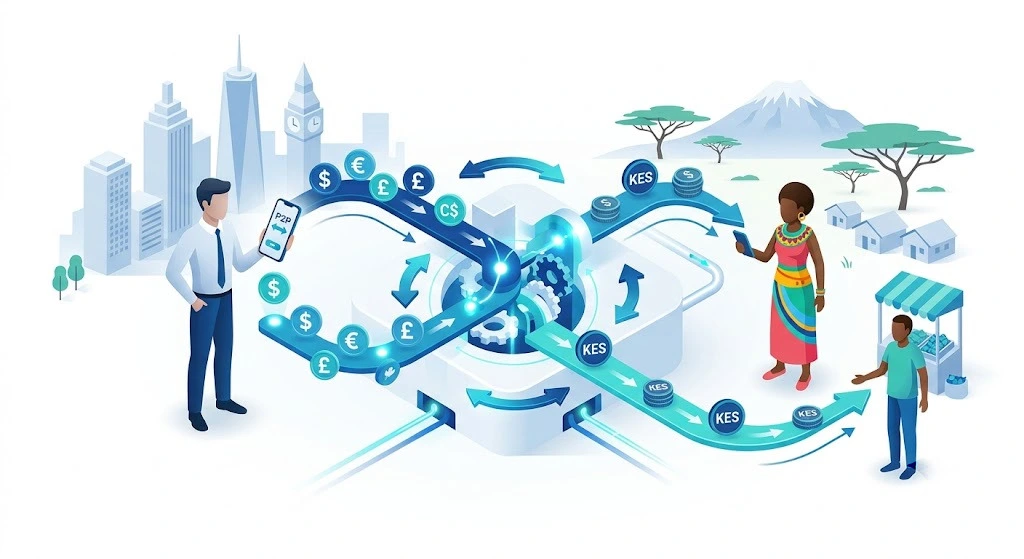
Because the conversion occurs via internal P2P matching, senders gain direct access to the real mid-market interbank exchange rate with zero hidden markups. The platform charges only minimal, transparent fixed fees that are explicitly displayed prior to transaction confirmation. To understand how mobile platforms are dismantling traditional remittance models globally, read this analysis on how mobile money transfer apps disrupt fintech. Users seeking to support a community-driven, fair financial framework can also consult the manifesto for transparent money exchange.
3. Kenya's Domestic Ecosystem: M-Pesa, Mobile Money, and Major Banking Channels
A crucial reason why local clearing vastly outperforms traditional bank wires in East Africa is Kenya's highly advanced domestic payment landscape. In Kenya, Mobile Money is not merely a payment option; it is the primary financial operating system for daily life. Safaricom's M-Pesa ecosystem dominates this landscape, serving as the default mechanism for paying household utility bills, rent, groceries, school fees, and peer-to-peer commerce. When a recipient receives funds via M-Pesa, the capital is immediately usable for daily economic activity without requiring a physical visit to a bank branch or currency exchange booth.
Beyond mobile wallets, Kenya boasts a robust, highly digitized commercial banking sector. Key national institutions include Kenya Commercial Bank (KCB), Equity Bank, and NCBA Bank, all of which maintain instant integration with local mobile clearing networks and domestic real-time gross settlement (RTGS) systems. When an international transfer is processed through local P2P clearing rather than an incoming SWIFT wire, the payout is delivered as an instant domestic bank transfer or a direct M-Pesa top-up.
By leveraging Kenya's domestic clearing rails, P2P marketplaces satisfy the primary search intent of diaspora senders: providing exact pricing clarity and delivering funds within minutes rather than days. To learn more about optimizing mobile payouts specifically for East Africa, review the comprehensive guide to sending money to Kenya via M-Pesa.
4. Step-by-Step Guide: Executing a Fast, Transparent P2P Money Transfer to Kenya
Executing an international transfer to Kenya using a P2P currency matching marketplace is designed to be a streamlined, fully transparent process. The platform provides clear answers regarding exact transfer fees and estimated arrival times from the outset:
- Account Creation and Identity Verification: The user registers on the platform and completes mandatory Know Your Customer (KYC) identity checks by uploading official government-issued identification and proof of address.
- Transfer Configuration: The sender selects the source multi-currency wallet (EUR, USD, GBP, or CAD) and specifies the target amount. The platform instantly displays the real live interbank exchange rate alongside a transparent fixed fee, showing the exact amount the beneficiary will receive in Kenya.
- Algorithmic Order Matching: The platform's matching engine pairs the exchange request with a corresponding order within the platform's multi-currency pool.
- Local Clearing and Payout: Once matched, local currency is disbursed off-platform directly to the recipient's M-Pesa mobile wallet or local bank account (such as KCB, Equity Bank, or NCBA). Payouts complete within a few minutes up to 24 hours depending on local bank clearing windows.
- Mandatory Mutual User Evaluation: Upon completion, both participating users evaluate the transaction. This mandatory double-sided review system ensures accountability, transparency, and high service quality across the community.
This systematic workflow removes the uncertainty associated with traditional wire methods. Senders can monitor order execution in real time using this guide to track money transfer status in real time.
5. Financial Security, Regulatory Compliance, and Identity Verification
Speed, efficiency, and competitive pricing must be backed by uncompromising financial security standards. Operating a compliant P2P matching marketplace requires strict adherence to global Anti-Money Laundering (AML) standards and Know Your Customer (KYC) regulations established by international monetary authorities and central banks.
Mandatory identity verification prevents identity theft, financial fraud, and unauthorized platform access, ensuring that all participants within the liquidity pool are verified individuals. Furthermore, because local currency disbursements in Kenya occur through licensed domestic banks (such as KCB, Equity Bank, or NCBA) or official mobile network operators like Safaricom M-Pesa, user capital remains fully protected throughout the settlement lifecycle.
Combined with bank-grade data encryption, multi-factor authentication, and mandatory double-sided user reviews, P2P marketplaces establish exceptional levels of trust and safety. For a detailed breakdown of processing timelines across different global corridors, consult this analysis on instant international wire real processing times.
6. Conclusion: Take Control with Real-Time Rate Simulations
For the Kenyan diaspora and international businesses, relying on traditional bank wire transfers means accepting unnecessary processing delays, hidden bank fees, and unfavorable exchange rate spreads. By replacing legacy SWIFT networks with local clearing and Peer-to-Peer currency matching, senders can ensure their funds reach Kenya quickly and economically.
Whether sending money to an M-Pesa mobile wallet for daily family expenses or transferring capital directly to accounts at KCB, Equity Bank, or NCBA Bank, local P2P clearing delivers maximum value, complete fee transparency, and robust financial security. Take control of your cross-border payments today: visit the CashSwap Club money transfer platform to test the live rate simulator and experience transparent, community-driven financial exchanges.
Frequently asked questions
Why is local clearing faster than a traditional bank wire when sending money to Kenya?
Traditional bank wires travel through multiple correspondent banks via the SWIFT messaging system, causing delays of three to five business days. Local clearing in a P2P marketplace bypasses international wires entirely; funds are matched internally and disbursed directly through Kenya's domestic payment channels like M-Pesa or local bank accounts, delivering payouts in minutes to 24 hours.
Can money be sent directly to an M-Pesa account in Kenya?
Yes. P2P marketplaces leverage local payout channels in Kenya, allowing funds to be credited directly to a recipient's Safaricom M-Pesa mobile wallet. This provides immediate access to capital for paying bills, rent, and everyday living expenses without needing to visit a bank branch.
Are there hidden exchange rate markups when using a P2P currency matching marketplace?
No. P2P marketplaces execute currency conversions at the real live mid-market interbank exchange rate. There are no hidden exchange rate spreads or added markups. Senders pay only a minimal, fully disclosed fixed transfer fee displayed before confirming the transaction.
Is identity verification (KYC) mandatory before sending money to Kenya?
Yes. International financial regulations and central bank anti-money laundering laws require all users to complete Know Your Customer (KYC) identity verification before conducting transfers. This requirement protects the community against fraud and ensures full legal compliance.

Peer-to-peer currency exchange, finally simple and fair.
Our peer-to-peer currency exchange and money transfer platform is currently under development. We are preparing a solution that will allow you to exchange currencies with a seamless and secure experience.
To be among the first to know and not miss anything about the launch, join the club by subscribing to our newsletter.
Visuals disclosure : In the interest of transparency, please note that the images illustrating this article were created using artificial intelligence (AI) generation tools.