The economic bridge connecting the Colombian diaspora in North America, Europe, and across the globe with their families back home represents a critical financial engine. Every year, billions of dollars flow into Colombia to cover essential household expenses, private educational tuition, urgent medical treatments, and property investments. However, navigating cross-border remittances to Colombia requires a deep understanding of local financial regulations, banking friction, and tax liabilities. Traditional money transfer avenues routinely penalize overseas senders through steep processing charges, opaque currency conversion spreads, and unexpected local financial movement taxes—most notably the Gravamen a los Movimientos Financieros (GMF), colloquially known as the 4x1000 tax. Minimizing these financial burdens is essential to ensure that recipients receive maximum value. This comprehensive guide evaluates the shortcomings of legacy bank transfers, explains how Peer-to-Peer (P2P) currency matching operates, demonstrates how to optimize transfers to popular local receiving channels like Nequi, DaviPlata, Bancolombia, Banco de Bogotá, Davivienda, and Efecty, and outlines strategies to legally bypass oppressive local transaction taxes.
For decades, individuals seeking to send money to Colombia relied on traditional wire transfers routed through correspondent banking networks under the SWIFT protocol. While SWIFT provides a standardized messaging structure across global financial institutions, its multi-layered routing process introduces severe operational delays and costs. International wire transfers pass sequentially through multiple intermediary institutions, with each entity deducting handling charges and processing surcharges. Consequently, the net amount credited to the recipient's bank account in Colombia is reduced unpredictably, creating shortfalls for families expecting exact amounts for living expenses.
Beyond explicit wire fees, commercial banks impose hidden costs through currency conversion markups. Rather than granting retail senders access to the live interbank exchange rate—the real market mid-rate—banks apply an arbitrary exchange rate spread on the Colombian Peso (COP). This currency markup inflates transfer overhead silently. Overseas senders looking to evaluate these pricing mechanics can review this detailed breakdown on spotting and avoiding hidden bank fees on global money transfers.
In addition to bank fees and exchange spreads, Colombian remittance recipients face a unique local tax hurdle: the Gravamen a los Movimientos Financieros (GMF), widely known as the 4x1000 tax. Established by the Colombian government, the GMF imposes a tax of 4 Pesos for every 1,000 Pesos withdrawn or transferred from local financial accounts. When international transfers land in traditional bank accounts or involve multiple internal bank hops, beneficiaries can see their money eroded by this financial tax. However, under Colombian tax law, specific accounts—including qualified digital wallets like Nequi and DaviPlata, or primary bank accounts up to statutory monthly thresholds—can be exempted from the GMF if properly designated. Utilizing optimized digital channels that route transfers through local domestic clearing rather than foreign wire deposits is essential to legally avoiding these tax penalties. For insights on choosing direct payout avenues, consult this guide on sending money to Colombia via the best direct deposit solutions.
To eliminate the steep overhead, hidden markups, and intermediary taxes of legacy wire channels, modern fintech marketplaces utilize Peer-to-Peer (P2P) currency matching architectures. Platforms such as CashSwap Club operate on a core technical model: capital never physically crosses international borders. By avoiding international wire transmission entirely, the marketplace bypasses correspondent banking chains and eliminates associated handling charges.
The marketplace manages multi-currency digital wallets holding major global currencies, including Euro (EUR), US Dollar (USD), British Pound (GBP), and Canadian Dollar (CAD), belonging to users. Internal platform transactions execute exclusively between wallets denominated in the same currency. When a user requests a currency exchange to send funds to Colombia, the platform's algorithmic engine matches the order with a counterparty expressing an inverse currency demand within the multi-currency liquidity pool. Local currency flows within Colombia are subsequently settled off-platform using fast domestic bank wire transfers or national mobile clearing rails.
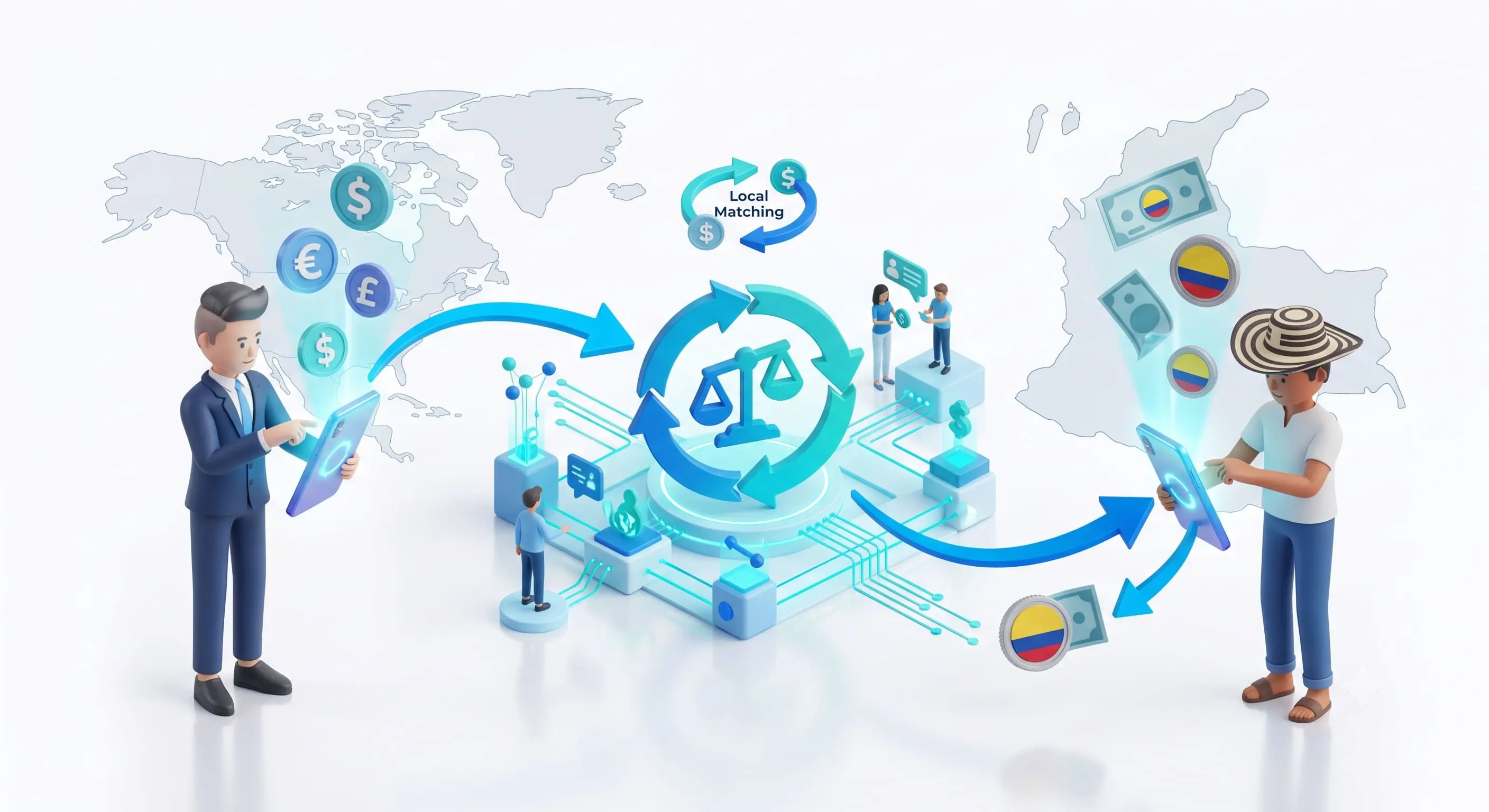
By conducting local clearing and internal matching, the P2P engine delivers direct access to the real mid-market interbank exchange rate with zero hidden spreads. Senders pay only minimal, fully disclosed fixed fees, ensuring total pricing transparency. To learn more about the technical advantages of local P2P clearing over legacy networks, explore this analysis on why choosing P2P for money transfers outperforms traditional banks. Users interested in supporting equitable financial systems can also review the manifesto for fair financial exchange.
Executing an international transaction to Colombia through a P2P currency matching marketplace is a streamlined process designed to give senders total clarity over fees, exchange rates, and delivery timeframes:
This structured workflow directly answers core end-user priorities: total fees remain fixed and transparent from the outset, and family members in Colombia receive exact amounts rapidly without unexpected bank deductions. To understand how market rates move, check out this article on why exchange rates fluctuate and how to beat the market.
Selecting the best transfer app or channel requires matching the payout mechanism to the beneficiary's local financial habits in Colombia. The country features a highly digitized, versatile receiving ecosystem across urban and regional areas:
By routing funds through P2P local clearing, senders ensure that whether money is directed to a Nequi wallet, a Bancolombia account, or an Efecty counter, conversions reflect the real interbank rate without hidden surcharges or unnecessary tax deductions.
Achieving transaction transparency and zero hidden costs requires absolute alignment with global and domestic financial safety standards. Financial security is maintained through mandatory compliance with Know Your Customer (KYC) protocols and Anti-Money Laundering (AML) regulations enforced by central banks and regulatory authorities worldwide.
Every platform participant must complete identity verification by uploading valid government photo identification and proof of address prior to executing currency exchanges. This mandatory verification layer protects the ecosystem against fraud, account takeover, and unauthorized access.
Because local currency disbursements execute through official domestic banking networks (such as Bancolombia, Banco de Bogotá, Davivienda) or authorized payment rails (Nequi, DaviPlata, Efecty), user capital remains fully protected against loss or regulatory holds. Combined with bank-level encryption and mandatory double-sided user ratings, P2P marketplaces establish exceptional safety standards for cross-border money management.
Supporting family members and managing financial commitments in Colombia should not be compromised by high bank wire charges, hidden exchange spreads, and local GMF (4x1000) tax penalties. By bypassing traditional SWIFT networks in favor of Peer-to-Peer currency matching, overseas senders ensure that more money reaches their loved ones.
The combination of real interbank exchange rates, minimal fixed fees, and flexible local clearing across mobile wallets (Nequi, DaviPlata), major commercial banks (Bancolombia, Banco de Bogotá, Davivienda), and cash pickup counters (Efecty) provides an unmatched money transfer experience. Take control of your international transfers today: visit the CashSwap Club main platform to test the live rate simulator and send money efficiently.
Transactions execute using the real live mid-market interbank exchange rate without hidden currency markups. The platform charges only a low, fixed transfer fee that is fully disclosed prior to transaction confirmation.
Once matched within the liquidity pool, local clearing is initiated immediately. Direct deposits to mobile wallets (Nequi, DaviPlata) or bank accounts (Bancolombia, Davivienda, Banco de Bogotá) typically complete within a few minutes up to 24 hours. Cash pickups at Efecty are available as soon as local processing clears.
By utilizing local clearing rails directly into primary bank accounts or mobile wallets (like Nequi or DaviPlata) that are officially registered as exempt from the GMF tax under Colombian law, recipients can legally avoid paying the 4x1000 tax on monthly amounts under statutory thresholds.
Yes. In compliance with international financial regulations and central bank anti-money laundering laws, all users must complete KYC identity verification before conducting currency transfers on the platform.

Our peer-to-peer currency exchange and money transfer platform is currently under development. We are preparing a solution that will allow you to exchange currencies with a seamless and secure experience.
To be among the first to know and not miss anything about the launch, join the club by subscribing to our newsletter.
Visuals disclosure : In the interest of transparency, please note that the images illustrating this article were created using artificial intelligence (AI) generation tools.
© CashSwap Club 2026 - All rights reserved
Designed with ❤️ in Paris • Made in France 🇫🇷
 Spanish