Executing a direct deposit to a bank account in South America requires navigating a complex landscape of international finance, varying regulatory frameworks, and fluctuating currencies. For individuals looking to send money to Colombia, the priority is clear: ensuring funds reach the recipient as quickly as possible, with maximum security, and at the lowest possible cost. Understanding the intricate mechanisms behind global remittances is essential to answering the fundamental questions: how much will it actually cost, and how soon will the recipient be able to access their funds? This comprehensive guide explores the evolution of international transfers, evaluates the structural flaws of legacy banking systems, and details how modern digital marketplaces are redefining the financial experience for the global diaspora.
To navigate the available options and select the most efficient route for capital distribution, refer to the following structured summary of this analysis:
Historically, moving capital across borders relied entirely on traditional institutional banking systems. The backbone of this infrastructure is the SWIFT network (Society for Worldwide Interbank Financial Telecommunication). While SWIFT provides a standardized messaging system for institutions globally, it is not a direct payment clearing system. Instead, it relies on a chain of correspondent banks. When an individual attempts to send money to Colombia via a traditional bank, the funds do not travel directly from the sender's local branch to the Colombian destination. They hop through multiple intermediary institutions.
Every node in this correspondent banking chain extracts a toll. These intermediaries charge processing fees, communication fees, and lifting fees. Consequently, the final amount deposited into the recipient's account is often significantly lower than the sender anticipated. For those analyzing the financial ecosystem, analyzing the marketplace versus bank dynamic uncovers the battle of hidden transfer fees, revealing that institutional banking models prioritize institutional profit margins over user value.
Beyond flat processing charges, the most insidious cost lies in the currency conversion process. Traditional banks rarely offer the mid-market or interbank exchange rate—the baseline rate at which banks trade currencies with one another. Instead, they apply a retail markup, effectively skimming a percentage off the top of the converted amount. This spread represents a hidden tax on the sender's capital. Therefore, learning to spot and avoid hidden bank fees on global money transfers is a critical financial reflex. By identifying these inflated exchange margins, individuals can protect their assets from silent depreciation. Furthermore, comparing a digital marketplace versus a local branch reveals real savings on money transfers, demonstrating that physical infrastructure overheads are directly subsidized by the consumer through inflated transfer fees.
The solution to the friction and cost of cross-border institutional banking lies in fundamentally restructuring how capital moves. CashSwap Club operates as a specialized money transfer marketplace built on Peer-to-Peer (P2P) matching. The core innovation of this business model is elegant in its simplicity: the money never actually crosses international borders.
Instead of relying on the slow and expensive SWIFT network, the platform manages secure, multi-currency wallets (supporting EUR, USD, GBP, and CAD) belonging to its users. The system functions by matching offsetting liquidity needs. If a user in Europe wishes to convert Euros into Colombian Pesos (COP) for a recipient in Bogotá, the algorithm locates another platform user with an inverse objective. The transaction is then executed entirely via local, domestic channels. The European user's Euros are matched with another Euro wallet on the platform, while the equivalent COP is transferred domestically within Colombia from a local liquidity provider or matched peer directly to the final recipient.
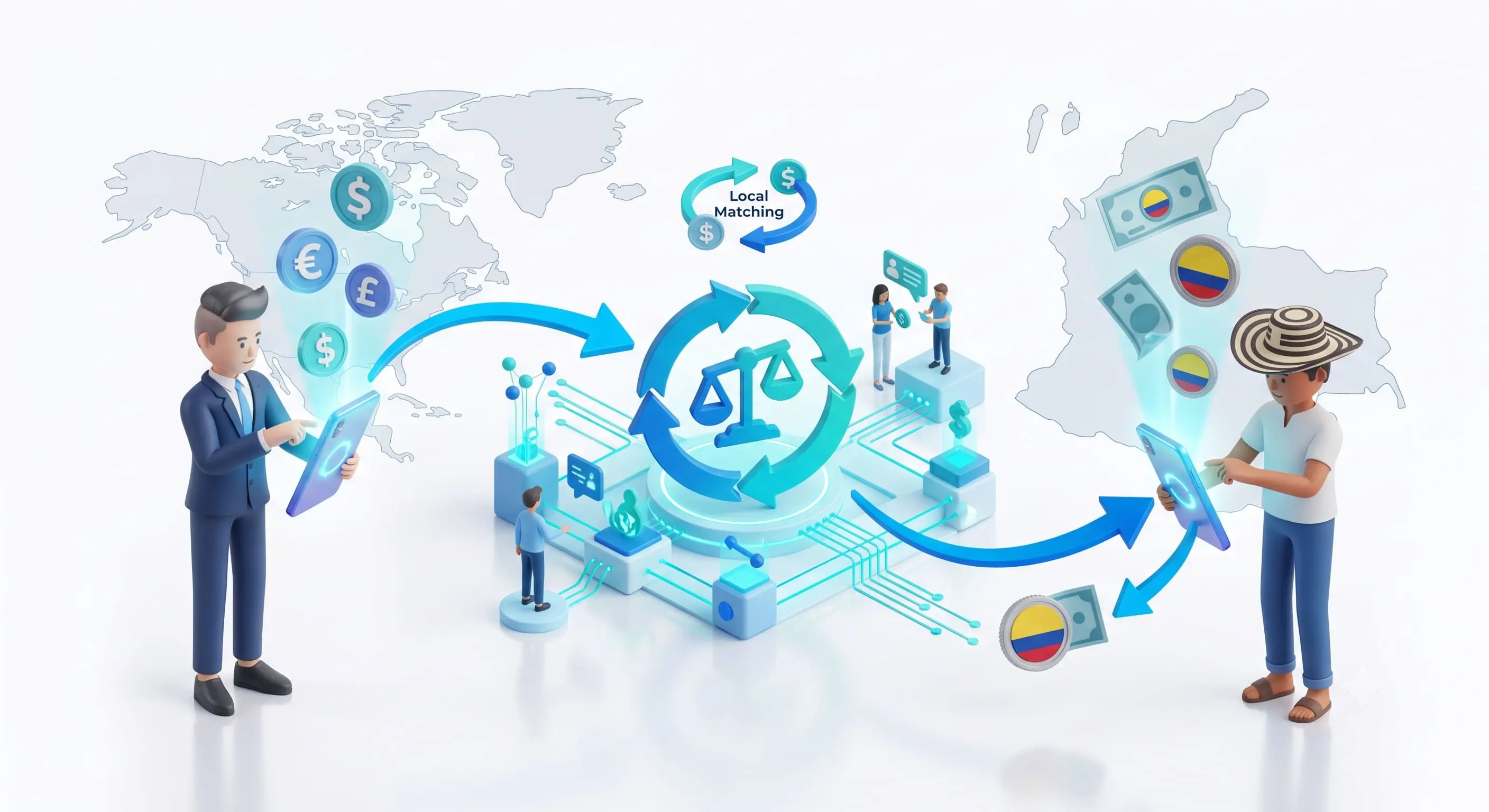
This localized clearing mechanism bypasses intermediary banks entirely, nullifying international wire charges and drastically reducing execution times. For those seeking deeper technical context, understanding why to choose P2P for money transfers highlights the structural efficiency of localized capital distribution. Because the platform simply matches existing supply and demand, it is able to offer the true, real-time market exchange rate without the predatory retail markups utilized by legacy institutions. In volatile macroeconomic climates, exploring why exchange rates fluctuate and how to beat the market becomes possible only when users have access to the unadulterated interbank rate provided by transparent matching platforms.
A critical pillar of the CashSwap Club ecosystem is community accountability. To ensure absolute transparency and build a high-trust environment, every completed transaction undergoes a mandatory dual-evaluation process. Both parties involved in the exchange must rate the transaction, fostering a self-regulating ecosystem where reliability is rewarded and operational friction is systematically eliminated.
To successfully execute a direct deposit to an account in Colombia, the platform must seamlessly integrate with the domestic financial infrastructure. The Colombian banking sector is dominated by major institutions such as Bancolombia, Banco de Bogotá, and Davivienda. Establishing direct clearing paths to these institutions ensures that large-volume transfers can be settled rapidly and securely.
However, the modern Colombian financial ecosystem is heavily digitized, with a massive shift toward mobile wallets and alternative financial applications. Applications like DaviPlata (backed by Davivienda) and Nequi (backed by Bancolombia) have revolutionized financial inclusion, allowing millions of Colombians to receive funds instantly using only their mobile phone numbers. A competitive remittance marketplace must classify as the best transfer app by offering seamless interoperability with these agile digital wallets, ensuring recipients in both urban centers and rural municipalities can access liquidity instantly without requiring traditional, heavy bank accounts.
Furthermore, for recipients requiring physical cash, the platform supports integration with established localized payout networks such as Efecty, ensuring nationwide coverage even in areas where digital banking penetration remains developing.
A highly specific and critical factor in the Colombian financial landscape is the Gravamen a los Movimientos Financieros (GMF), commonly referred to as the 4x1000 tax. This is a government levy where 4 pesos are taxed for every 1,000 pesos withdrawn or transferred from a financial account. The diaspora must navigate this tax carefully. By utilizing local domestic transfer networks through a P2P matching system, users can often optimize the flow of funds. Furthermore, certain accounts in Colombia, such as specific savings accounts or Nequi/DaviPlata wallets under specific monthly transaction thresholds, are exempt from the 4x1000 tax. Educating the recipient to maintain an exempt account, combined with utilizing a marketplace that relies on optimized domestic settlement, ensures the maximum possible amount of capital is preserved.
Executing a transfer via a P2P marketplace is designed to be frictionless, prioritizing both user experience and uncompromising security. The process of routing capital via CashSwap Club involves a structured, sequential workflow.
Step 1: Registration and Identity Verification
The user begins by creating an account on the platform. To comply with international financial regulations, the user must complete the identity verification process. This typically involves submitting a government-issued identification document and proof of address. This step creates a secure environment for all market participants.
Step 2: Wallet Funding and Demand Creation
Once verified, the user funds their multi-currency wallet via a standard local domestic transfer in their home currency (e.g., EUR, USD). With the wallet funded, the user creates a transfer request, specifying the exact amount to be converted into COP, the recipient's banking details (Bancolombia, Nequi, etc.), and locking in the interbank exchange rate.
Step 3: Algorithmic Matching and Local Execution
The platform's proprietary algorithm scans the marketplace to find an offsetting request. Once matched, the platform facilitates the exchange. The user's original currency is safely transferred within the platform's closed-loop wallet ecosystem, while the equivalent COP is dispersed from a local Colombian liquidity source directly to the recipient's DaviPlata, Nequi, or traditional bank account via the fastest available domestic rails.
Step 4: Mandatory Dual Evaluation
Upon confirmation that the funds have successfully settled in the recipient's Colombian account, the final phase is initiated. Both parties in the P2P match are required to evaluate the transaction. This mechanism ensures strict quality control and reinforces the community-driven ethos of the platform. By reviewing the core manifesto for financial transparency, users gain insight into why this peer accountability is fundamental to disrupting legacy banking models.
When migrating capital across digital platforms, the integrity of the infrastructure is paramount. A peer-to-peer matching marketplace operates under strict regulatory frameworks to prevent illicit activities and safeguard user funds. The cornerstone of this compliance is the KYC (Know Your Customer) and AML (Anti-Money Laundering) protocols. Every participant on CashSwap Club is subjected to rigorous identity vetting before being granted access to the liquidity pool.
Technologically, the platform utilizes advanced cryptographic protocols to secure data transmissions and protect sensitive financial metadata. During the matching process, funds are systematically safeguarded. The architecture guarantees that no capital is released to a matched peer until the corresponding local payout is verified and confirmed. This escrow-like mechanism eliminates counterparty risk, ensuring that users are never exposed to default scenarios.
Furthermore, cybersecurity is a shared responsibility. The platform continually educates its community on digital hygiene. By adopting the 5 reflexes to protect online financial transactions, users fortify their personal accounts against phishing attempts and unauthorized access, creating an impenetrable layer of security atop the platform's robust architecture.
The paradigm of cross-border remittances has shifted permanently. The reliance on slow, opaque, and expensive legacy banking channels is no longer necessary. By leveraging the power of Peer-to-Peer matching, CashSwap Club offers a technologically superior method to route direct deposits into Colombian bank accounts and mobile wallets. The elimination of cross-border money movement yields the pure interbank exchange rate and reduces transfer fees to an absolute, transparent minimum.
Whether routing funds to a major institution like Bancolombia or a digital Nequi wallet, the priority remains speed, security, and capital preservation. The era of hidden banking fees and manipulated exchange margins is ending, replaced by a community-driven, technologically resilient marketplace.
Experience the efficiency of localized matching firsthand. Utilize the live rate simulator on the application today to calculate the exact amount of COP the recipient will receive, entirely free of institutional spread.
Because the P2P matching system relies exclusively on domestic local transfers rather than slow international SWIFT wires, execution speeds are drastically reduced. Once a match is secured on the platform, the payout to Colombian institutions like Bancolombia, or digital wallets like Nequi and DaviPlata, typically occurs within hours, leveraging Colombia's rapid local clearing networks.
No. Traditional banks generate revenue by hiding margins within inflated exchange rates. The CashSwap Club marketplace fundamentally prevents this by connecting users directly, enabling the application of the true, real-time interbank exchange rate. The platform relies solely on minimal, clearly stated, fixed operational fees presented upfront before the transaction is initiated.
Security is maintained through strict regulatory compliance, mandatory KYC (Know Your Customer) identity verification for all users, and a secure internal ledger system. Funds are safeguarded within the platform's ecosystem during the match and are only finalized once the corresponding domestic transfer in the destination country is validated, completely eliminating counterparty risk.
The 4x1000 tax (Gravamen a los Movimientos Financieros) is a domestic Colombian tax on financial movements. While the transfer platform itself cannot rewrite local tax law, routing funds directly into specific accounts—such as designated, single-exempt savings accounts or Nequi/DaviPlata wallets operating below the monthly taxable threshold—allows the recipient to legally bypass this levy. Utilizing localized P2P payouts makes structuring these deposits highly efficient.

Our peer-to-peer currency exchange and money transfer platform is currently under development. We are preparing a solution that will allow you to exchange currencies with a seamless and secure experience.
To be among the first to know and not miss anything about the launch, join the club by subscribing to our newsletter.
Visuals disclosure : In the interest of transparency, please note that the images illustrating this article were created using artificial intelligence (AI) generation tools.
© CashSwap Club 2026 - All rights reserved
Designed with ❤️ in Paris • Made in France 🇫🇷
 Spanish