
The global remittance ecosystem serves as a fundamental pillar for economic stability, family support, and local entrepreneurship across West Africa. For the diaspora residing in Europe, North America, and other international hubs, the need to send money to Ivory Coast is a constant and vital requirement. Whether the objective is to cover urgent medical expenses in Abidjan, finance local real estate construction, pay academic tuition, or simply assist family members with daily utility bills, choosing the optimal financial corridor is an essential decision. Historically, cross-border financial movements have been heavily burdened by prohibitive intermediary costs, opaque processing systems, and frustratingly slow clearance times. Today, however, the convergence of advanced digital wallets and decentralized financial matching algorithms is entirely redefining how international liquidity is managed.
This comprehensive analysis breaks down the structural mechanics of international fund transfers directed toward Ivory Coast. It objectively evaluates the inherent flaws of legacy banking systems, explores the rapid expansion of domestic mobile money networks, and details the profound economic advantages of decentralized peer-to-peer (P2P) matching marketplaces. By thoroughly understanding operational margins, clearing speeds, and the underlying technology of modern fintech, global senders can make highly educated decisions that preserve the integrity of their capital and maximize the final amount received by their beneficiaries.
When executing international remittances, consumers often make the mistake of evaluating a financial service based exclusively on the advertised upfront transaction fee. This superficial assessment completely ignores the most lucrative revenue stream utilized by traditional financial institutions: the exchange rate markup. Retail banks and legacy money transfer operators rarely grant consumers access to the authentic interbank exchange rate—the dynamic, real-time baseline at which major global banks trade currencies. Instead, these institutions artificially inflate the conversion rate, applying a hidden spread that quietly siphons value from the transaction without requiring explicit disclosure to the sender.
For instance, when converting funds from Euros (EUR), US Dollars (USD), or British Pounds (GBP) into the West African CFA Franc (XOF), a conventional banking entity might embed a margin ranging from three to seven percent above the mid-market rate. This invisible tax directly penalizes the diaspora, drastically diminishing the purchasing power delivered to the recipient. To optimize these international flows, users must comprehend why exchange rates fluctuate and how to beat the market by leveraging specialized marketplaces that categorically refuse to implement these predatory margins.
Standard cross-border bank wires are heavily reliant on the Society for Worldwide Interbank Financial Telecommunication (SWIFT) network. Despite its global ubiquity, SWIFT does not physically transport capital; rather, it functions as a highly secure messaging system that instructs a chain of correspondent banks to adjust their respective ledgers. During a standard transfer from a North American or European account to a financial institution in Ivory Coast, the capital may be routed through several intermediary banks before arriving at its final destination.
Each intermediary institution within this chain independently extracts a processing fee, which is typically deducted directly from the principal transfer amount. This structural inefficiency creates significant unpredictability, making it nearly impossible to guarantee the exact final sum the beneficiary will receive. Additionally, this multi-step clearance process introduces severe operational delays, often requiring three to five business days for a transaction to fully settle. For individuals managing urgent financial situations, this lack of speed is a critical failure. Senders must learn to spot and avoid hidden bank fees on global money transfers to protect their liquidity from being systematically eroded by outdated infrastructure.
The cumulative weight of high flat-rate transfer fees, undisclosed exchange rate spreads, and unpredictable intermediary deductions heavily inflates the absolute cost of international capital transmission. When analyzing the broader landscape, these combined costs consume a disproportionate percentage of the principal, particularly penalizing lower-value, high-frequency remittances. A detailed examination of the modern digital economy—specifically looking at the marketplace vs bank: the battle of hidden transfer fees—clearly illustrates that centralized legacy systems are structurally misaligned with the economic realities and immediate needs of transnational communities.
To circumvent the inherent inefficiencies of the SWIFT network and traditional banking, next-generation fintech architecture relies on peer-to-peer (P2P) matching engines. At the foundation of this innovative model lies the multi-currency wallet infrastructure. Platforms such as CashSwap Club do not function as conventional money transmitters that push fiat currency across international borders. Instead, the marketplace operates highly secure, centralized accounts containing segmented digital wallets denominated in robust global currencies, including EUR, USD, GBP, and CAD.
Within this ecosystem, users maintain absolute sovereign control over their individual wallets. When a currency exchange is initiated, the transaction occurs exclusively between wallets holding the identical currency within the platform’s internal ledger. Because the balances simply change ownership between verified users inside the same currency pool, cross-border friction is mathematically eliminated. The capital remains geographically stable, secure, and entirely insulated from international wire delays.
The operational brilliance of this system relies on localized domestic clearing. The movement of local fiat currency—such as the XOF in Ivory Coast—takes place entirely outside the platform’s digital boundaries. When a sender from the diaspora wishes to exchange EUR for XOF, the matching algorithm pairs them with a local user who currently holds XOF and requires EUR. The diaspora user transfers EUR to the peer’s platform wallet, while the local counterpart executes a standard domestic mobile money or bank transfer directly to the sender’s beneficiary in Ivory Coast. International capital flight is thus replaced by highly efficient local liquidity synchronization.
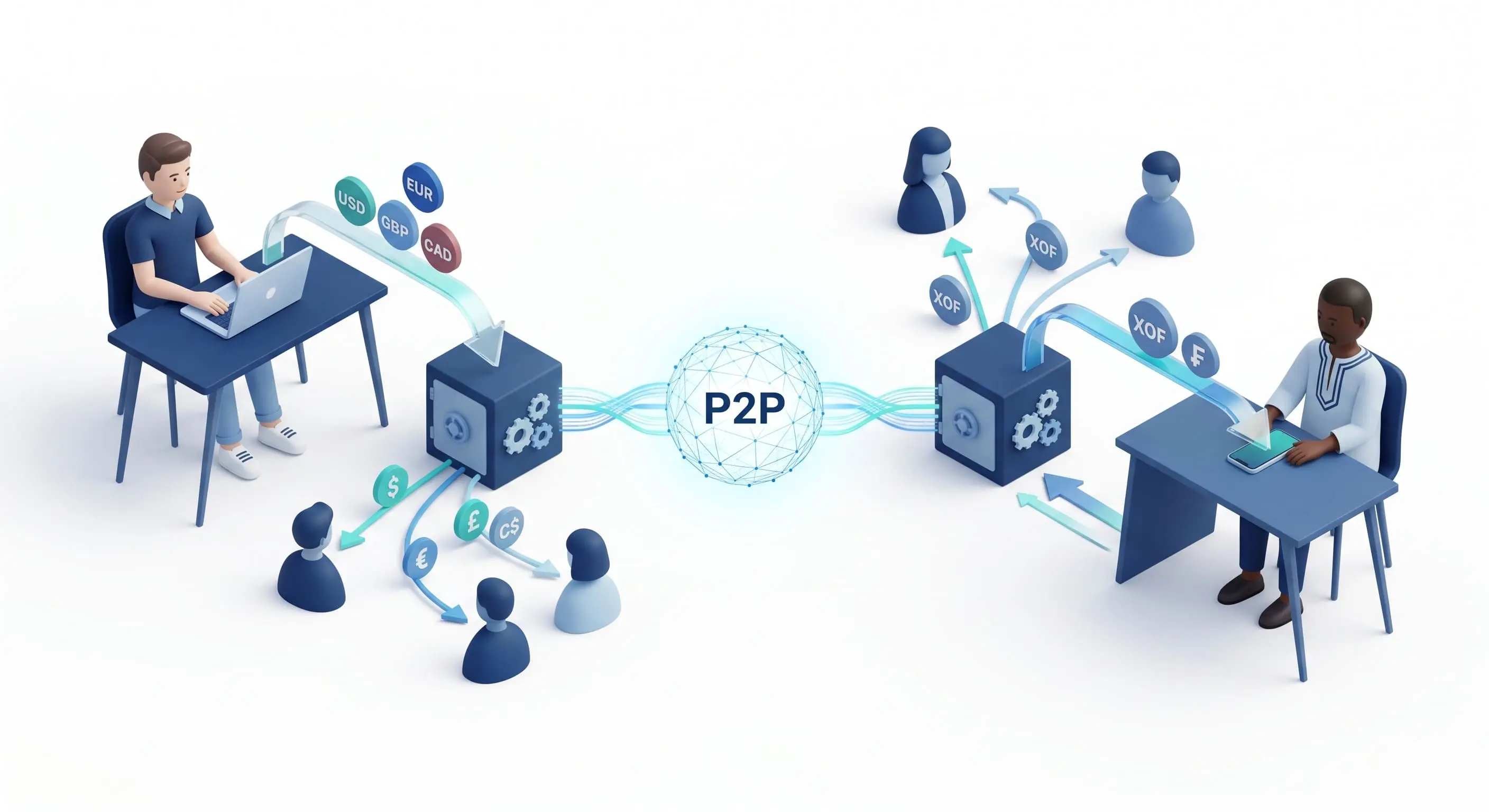
By effectively removing international banking intermediaries from the equation, a peer-to-peer marketplace destroys the primary justification used by traditional institutions to enforce exchange rate markups. Because the platform acts purely as a technological matching venue where supply seamlessly meets demand, participants are guaranteed access to the genuine interbank exchange rate. Rather than forfeiting significant value to institutional spreads, users benefit from a transparent environment where the conversion rate accurately reflects the global market equilibrium. The platform sustains its operations by charging only a minimal, transparent, and fixed transaction fee, ensuring total cost predictability. To grasp the broader macroeconomic benefits of this decentralized approach, users are encouraged to understand why choose P2P for money transfers to maximize their long-term financial efficiency.
Facilitating decentralized financial matching demands uncompromising mechanisms to ensure total transaction integrity and absolute user confidence. To achieve this, the CashSwap Club ecosystem enforces a strict double evaluation protocol at the conclusion of every single exchange. Once the algorithm generates a match and the external local currency distribution is executed in Ivory Coast, both the sender and the peer must explicitly verify the successful transfer within the application's interface. No internal wallet balances are permanently settled until both parties confirm that the funds have reached the final beneficiary. This mandatory dual-verification loop cultivates a highly accountable, self-regulating community where security, speed, and reliability are structurally guaranteed.
Ivory Coast possesses one of the most sophisticated and rapidly accelerating mobile money infrastructures in sub-Saharan Africa. Digital mobile wallets have evolved far beyond basic interpersonal transfers; they now serve as the primary engine for nationwide financial inclusion, connecting sprawling urban centers like Abidjan and Bouaké with the deepest rural provinces. When searching for the best transfer app, deep integration with these domestic mobile networks is non-negotiable for ensuring instant fund delivery.
The local landscape is driven by four primary telecom and fintech operators, each providing extensive agent networks and unique regional advantages:
While mobile money overwhelmingly dominates daily consumer transactions and micro-liquidity, commercial banking institutions remain indispensable for high-volume remittances, corporate payrolls, and real estate investments. Senders transmitting substantial capital frequently opt to route funds directly into established local banking accounts.
One of the most impactful advancements in modern remittance flows is the ability to bypass cash entirely in favor of targeted, utility-specific financial settlements. Historically, sending bulk cash to relatives for utility payments introduced logistical delays, physical travel risks, and the potential for fund misallocation. Today, precision routing allows senders to handle these obligations remotely.
In Ivory Coast, this is profoundly visible in the direct payment of essential services. Senders can utilize local P2P clearing to direct liquidity straight into a relative’s mobile wallet, empowering that relative to instantly settle electrical bills with the Compagnie d'Électricité (CIE) or water bills with the Société de Distribution d'Eau (SODECI). This direct-to-mobile capability eliminates traditional intermediaries, slashes associated transfer fees, and provides the diaspora with the ultimate reassurance that essential family infrastructure remains functional and fully funded.
To execute a transfer, users must first complete a secure registration process via the platform's web portal or mobile application. Upon successful account creation, the user gains access to a private multi-currency dashboard. The initial phase involves capitalizing the appropriate fiat wallet. For an individual based in Europe, this means executing a standard domestic SEPA bank wire to deposit funds directly into their secure EUR wallet on the platform. Because this deposit occurs locally within the European banking jurisdiction, it incurs absolutely no international transfer fees and clears rapidly, priming the account for the marketplace.
With the multi-currency wallet successfully funded, the user transitions to the active marketplace to configure their exchange order. The sender inputs the exact volume of origin currency (e.g., EUR or USD) and selects the required destination currency (XOF). The platform’s proprietary matching engine immediately scans the decentralized ledger to identify a complementary peer transaction. By matching users with perfectly opposing currency needs, the transaction is locked in at the true interbank exchange rate, actively bypassing any institutional spread. A transparent, fixed platform fee is displayed upfront, guaranteeing absolute financial clarity before execution.
Once the peer match is confirmed, the platform’s internal ledger temporarily secures the digital balances while external fulfillment commences. The counterpart, who possesses local liquidity in Ivory Coast, is instructed to execute a domestic transaction—such as a local push to a Wave, Orange Money, or MTN MoMo wallet, or a direct bank wire to SGCI or Ecobank—directly to the sender’s specified beneficiary. The recipient receives the funds instantly on their mobile device, rendering the capital immediately available for CIE or SODECI utility payments. Upon beneficiary confirmation, both marketplace users validate the transaction in the app, completing the double evaluation loop. The platform then permanently settles the internal multi-currency wallets, finalizing a frictionless, secure transfer.
Maintaining the integrity of a global financial matching ecosystem requires unwavering adherence to international compliance standards. To proactively neutralize fraud, identity theft, and illicit financial flows, CashSwap Club enforces a rigorous, mandatory Know Your Customer (KYC) onboarding protocol. Prior to initiating any transaction, every user must authenticate their identity by providing government-issued documentation, verified proof of residence, and completing a real-time biometric facial scan. This comprehensive verification process seamlessly integrates stringent legal compliance with an intuitive user experience, ensuring the marketplace remains a closed, trusted network of authenticated participants.
Beyond strict identity authentication, the platform utilizes institutional-grade security architecture to defend user data and capital assets against sophisticated cyber threats. All platform communications, external data transmissions, and internal ledger synchronizations are safeguarded by advanced AES-256 encryption standards. Furthermore, user fiat balances are held in segregated, legally ring-fenced accounts managed by tier-one global banking institutions, guaranteeing that user funds are perpetually isolated from corporate operational capital. As an added layer of defense, senders are strongly advised to adopt the 5 reflexes to protect online financial transactions, including the activation of multi-factor authentication (MFA) and the rigorous monitoring of active device sessions.
The transition of international remittances away from extractive legacy banking channels toward localized peer-to-peer marketplaces represents a monumental victory for global diaspora communities. By comprehensively understanding the operational mechanics of dominant mobile networks like Wave, Orange Money, and MTN MoMo, alongside institutional banks like SGCI and Ecobank, global senders are equipped to drastically optimize their financial corridors. The P2P matching model effectively neutralizes predatory exchange rate markups and systematically strips away hidden intermediary fees, guaranteeing that the maximum possible value is delivered securely and instantly to its intended destination in Ivory Coast.
Ultimately, utilizing an advanced decentralized marketplace transcends simple economic optimization; it represents a commitment to financial fairness that fortifies community resilience and directly fuels local economic development. Senders are invited to embrace a fairer, community-driven financial ecosystem by reading the core principles of transparent peer-to-peer finance. To witness this technological efficiency in action, users can access the platform’s live rate simulator today to secure the real-time interbank rate and perfectly optimize their next transfer to Ivory Coast.
Because the P2P matching architecture leverages localized domestic clearing instead of routing funds through the sluggish international SWIFT network, transactions are completed with exceptional speed. Once a match is algorithmically confirmed on the platform, local fulfillment via mobile money networks like Wave, Orange Money, or MTN MoMo is typically executed instantly or within a matter of minutes. Transfers directed to institutional bank accounts, such as SGCI or Ecobank, follow standard domestic clearing schedules, usually settling within the same business day.
Yes. Utilizing a peer-to-peer matching marketplace is entirely legal and highly secure, provided the platform operates under strict regulatory compliance frameworks. CashSwap Club strictly enforces global anti-money laundering (AML) directives and mandatory Know Your Customer (KYC) protocols to authenticate all users. Additionally, user capital is protected within legally segregated institutional accounts, and all platform interactions are secured by military-grade cryptographic encryption.
Absolutely. The platform’s highly flexible local clearing methodology accommodates both mobile money networks and traditional banking infrastructure. During the order creation process, senders can explicitly dictate whether the local counterpart should fulfill the exchange via an instant mobile wallet deposit or through a standard domestic bank wire directed to major financial institutions like Société Générale (SGCI), Ecobank, or NSIA Banque.
In stark contrast to traditional banking entities that conceal their profits within inflated exchange rate spreads, CashSwap Club operates on a model of absolute transparency. All peer transactions are executed strictly at the live, real-time interbank exchange rate, with zero hidden markups. The sender is only responsible for a minimal, clearly defined fixed transaction fee presented prior to execution, ensuring that families retain the maximum possible value of the transferred capital.

Our peer-to-peer currency exchange and money transfer platform is currently under development. We are preparing a solution that will allow you to exchange currencies with a seamless and secure experience.
To be among the first to know and not miss anything about the launch, join the club by subscribing to our newsletter.
Visuals disclosure : In the interest of transparency, please note that the images illustrating this article were created using artificial intelligence (AI) generation tools.
© CashSwap Club 2026 - All rights reserved
Designed with ❤️ in Paris • Made in France 🇫🇷
 French