- Aug 26, 2026
For the millions of Pakistani diaspora members living across Europe, North America, and the Middle East, maintaining financial ties with family back home is an absolute necessity. Whether providing routine financial support, covering daily household needs, fulfilling educational tuition fees, or making long-term investments in real estate, overseas Pakistanis regularly transfer capital to domestic bank accounts and mobile wallets. Historically, traditional commercial bank wires operated through international correspondent networks were the default mechanism for cross-border remittances. However, sending money to Pakistan through conventional banking rails often incurs excessive transfer fees, unpredictable intermediary deductions, and opaque currency conversion markups. Today, alternative financial architectures—specifically Peer-to-Peer (P2P) currency matching marketplaces—offer an efficient, transparent, and highly secure alternative. This comprehensive guide compares traditional bank wire transfers against modern digital channels, evaluates receiving mechanisms such as Habib Bank Limited (HBL) and mobile wallets like Easypaisa and JazzCash, and explains how overseas Pakistanis can maximize the net value delivered to their families.
Table of Contents
- 1. The Friction of Traditional Bank Wires to Pakistan
- 2. Modern P2P Currency Matching: How Borderless Local Clearing Works
- 3. Local Payout Ecosystem in Pakistan: HBL, Mobile Wallets, and Roshan Digital Accounts
- 4. Step-by-Step Guide to Transferring Funds via P2P Matching
- 5. Financial Security, KYC Standards, and Regulatory Compliance
- 6. Conclusion: Choosing the Best Transfer Strategy for Pakistan
1. The Friction of Traditional Bank Wires to Pakistan
When sending money to Pakistan via a conventional commercial bank, transactions are routed through the international SWIFT messaging network. This legacy structure relies on a chain of intermediary correspondent banks to pass funds between foreign financial institutions and Pakistani receiving banks. Every correspondent bank along the processing chain deducts arbitrary routing fees, handling charges, and administrative surcharges. Consequently, the net amount credited to the recipient's account in Pakistani Rupees (PKR) is frequently less than expected, causing unexpected deficits for families relying on exact remittance amounts.
Beyond explicit processing charges, the most substantial hidden cost of traditional bank wires lies in unfavorable exchange rate markups. Traditional commercial banks rarely grant retail customers access to the live interbank exchange rate. Instead, banks apply an internal currency spread—a hidden markup added on top of the mid-market rate when converting Euro (EUR), US Dollar (USD), British Pound (GBP), or Canadian Dollar (CAD) into PKR. To better analyze how legacy bank markups compare with modern marketplace pricing, senders can explore this detailed breakdown of marketplace vs bank hidden transfer fees.
Furthermore, processing timelines through traditional bank channels remain notoriously slow. A SWIFT wire transfer to Pakistan typically requires between three to five business days to clear, subject to cut-off times, international bank holidays, and manual clearing procedures. In urgent situations—such as medical emergencies or strict payment deadlines—multi-day delays create severe distress. Senders evaluating alternatives can review a comparative analysis on marketplace vs local branch real savings on money transfers.
2. Modern P2P Currency Matching: How Borderless Local Clearing Works
To eliminate the high overhead, hidden exchange markups, and delays of correspondent banking networks, modern financial platforms utilize Peer-to-Peer (P2P) currency matching architectures. CashSwap Club operates on a core technical model where money never physically crosses international borders. By avoiding international wire routing entirely, the marketplace bypasses correspondent banking chains and eliminates intermediary processing charges.
The platform maintains multi-currency digital wallets holding major global currencies, including EUR, USD, GBP, and CAD. Transactions on the platform execute exclusively between wallets denominated in the same currency. When a user wishes to send funds to Pakistan, the platform's algorithmic matching engine pairs the request with a counterparty needing the inverse currency pair within the multi-currency pool. Local currency flows are subsequently settled off-platform using fast, domestic bank clearing rails or national instant payment networks.
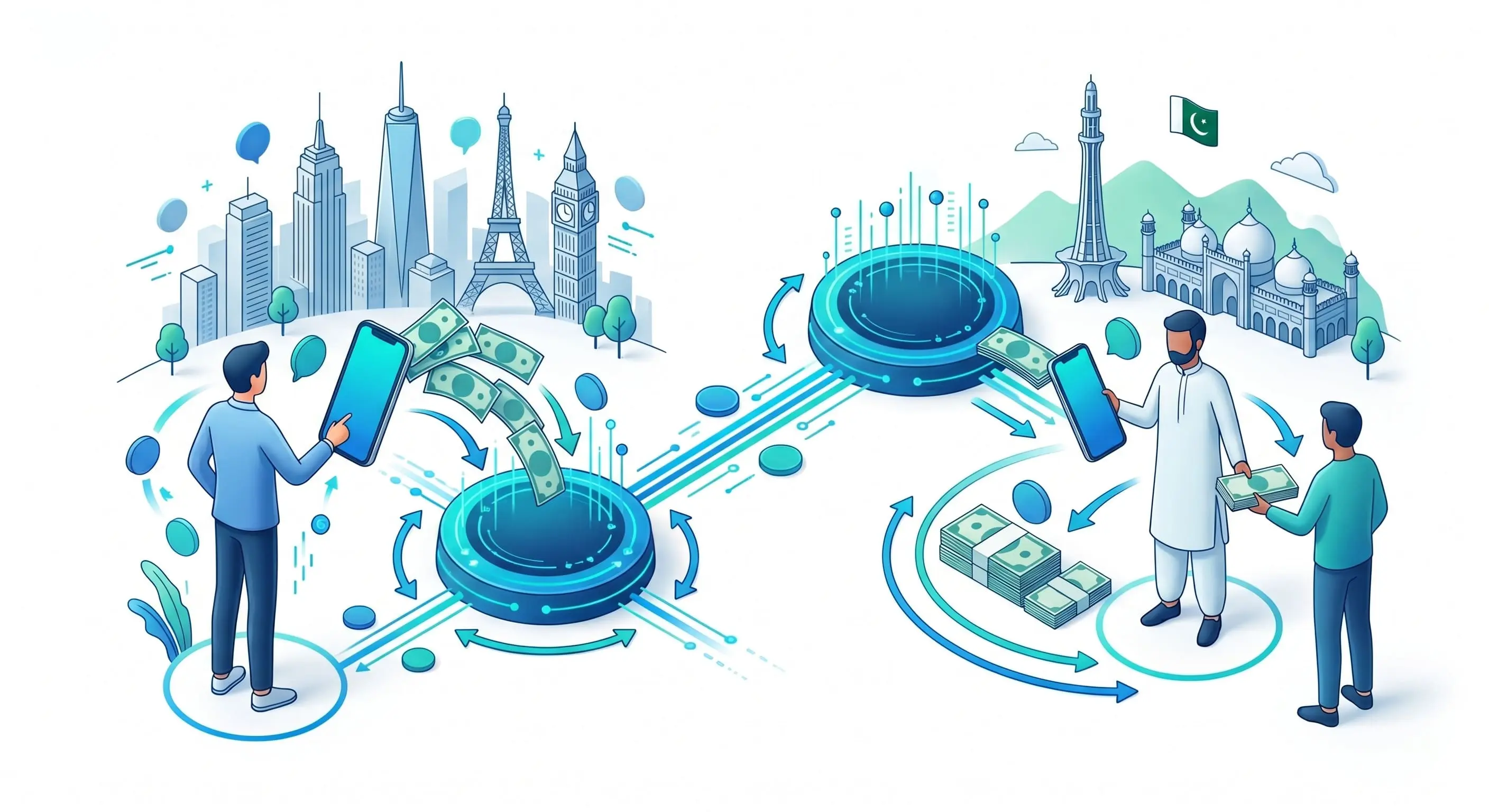
By conducting local clearing and internal matching, the marketplace grants users direct access to the real mid-market exchange rate with zero hidden markups. Senders pay only minimal, fully disclosed fixed transfer fees. To understand how P2P local clearing compares technically to legacy architectures, users can read about network architectures comparing SWIFT, SEPA, and P2P. Those interested in the values behind borderless financial inclusion can review the manifesto for fair financial exchange.
3. Local Payout Ecosystem in Pakistan: HBL, Mobile Wallets, and Roshan Digital Accounts
Selecting the best transfer method requires matching the payout mechanism to the beneficiary's local banking preferences in Pakistan. The Pakistani financial landscape offers several well-established receiving channels:
- Major Commercial Bank Accounts: Direct bank deposits can be made directly into leading national financial institutions, such as Habib Bank Limited (HBL), National Bank of Pakistan (NBP), and Allied Bank. Habib Bank Limited (HBL), as the country's largest commercial bank, offers extensive branch coverage and fast digital clearing for account holders.
- Instant Mobile Money Wallets: For unbanked beneficiaries or instant local access, mobile wallets such as Easypaisa and JazzCash allow recipients to receive funds directly on their mobile numbers. These funds can be used immediately for bill payments, peer transfers, or cashed out at thousands of local agent locations nationwide.
- Roshan Digital Accounts (RDA): Developed as a major government initiative by the State Bank of Pakistan, Roshan Digital Accounts allow non-resident Pakistanis (NRPs) to open and manage domestic bank accounts remotely. RDAs facilitate direct investment into Pakistani stock markets, Naya Pakistan Certificates (NPCs), and real estate, making efficient cross-border funding vital for overseas investors.
By using modern digital transfer platforms, senders can route funds to HBL bank accounts or mobile wallets effortlessly. To learn more about digital wallet integrations, consult this guide on sending money to Pakistan safely via mobile wallet.
4. Step-by-Step Guide to Transferring Funds via P2P Matching
Executing a cross-border transfer to Pakistan via a P2P currency marketplace is a streamlined process designed to answer two fundamental user concerns: exactly how much the transfer will cost and how fast the recipient will receive the money.
- Account Registration & Identity Verification: The sender registers an account and completes standard Know Your Customer (KYC) identity verification by submitting official identification documents.
- Setting Transfer Details: The user selects the source wallet (EUR, USD, GBP, or CAD) and enters the desired PKR target amount. The platform instantly displays the live interbank exchange rate alongside a fixed, transparent fee.
- Algorithmic Liquidity Matching: The platform's algorithm matches the exchange request with complementary counterparty demand within the multi-currency wallet pool.
- Local Settlement in Pakistan: Upon successful matching, funds are disbursed in local currency off-platform directly to the beneficiary's HBL account, RDA, or mobile wallet (Easypaisa/JazzCash) via local clearing channels.
- Mandatory Mutual User Evaluation: Once the transfer is complete, both participating users evaluate and rate the transaction, cementing trust within the community.
This structured workflow ensures complete pricing clarity from the outset while delivering funds directly to Pakistani recipients within minutes to a maximum of 24 hours. To explore how smartphone apps are revolutionizing international remittances, read about how mobile money transfer apps disrupt fintech.
5. Financial Security, KYC Standards, and Regulatory Compliance
Security is the primary consideration when transferring money internationally. P2P matching marketplaces enforce rigorous compliance standards aligned with global financial regulations, Anti-Money Laundering (AML) mandates, and central bank directives.
Mandatory Know Your Customer (KYC) identity verification ensures that all participating users in the currency pool are thoroughly authenticated before conducting exchanges. This verification protocol protects the community against fraud, account takeover, and illicit activity. Because local disbursements in Pakistan are handled through official domestic banking networks (like HBL) or licensed mobile wallet rails (Easypaisa and JazzCash), user capital remains fully protected throughout the clearing process.
In addition to regulatory safeguards, the mandatory double-sided rating system ensures that every completed transfer contributes to a transparent reputation system. Senders seeking real-time updates on their transactions can review this guide on how to track money transfer status in real time.
6. Conclusion: Choosing the Best Transfer Strategy for Pakistan
While traditional commercial bank wires to Pakistan suffer from high fees, unpredictable intermediary deductions, and unfavorable exchange rate spreads, modern P2P currency matching delivers a fast, transparent, and cost-effective alternative.
By leveraging domestic clearing rails, senders can deliver real interbank exchange rates directly to Habib Bank Limited (HBL) accounts, Roshan Digital Accounts, or mobile wallets like Easypaisa and JazzCash. To experience complete transfer transparency and calculate live conversion rates, visit the CashSwap Club money transfer platform today.
Frequently asked questions
How much does it cost to send money to Pakistan using a P2P matching marketplace?
Transactions execute at the real mid-market interbank exchange rate without hidden exchange spreads. Senders pay only a low, fixed transfer fee that is fully disclosed before confirming the transaction.
How fast will a recipient in Pakistan receive funds in their account or wallet?
Once matched within the platform, local clearing is initiated immediately. Direct deposits to bank accounts (such as HBL, NBP, or Allied Bank) or mobile wallets (Easypaisa or JazzCash) typically clear within a few minutes up to 24 hours, depending on domestic clearing windows.
Can money be sent directly to a Roshan Digital Account (RDA) via P2P clearing?
Yes. Funds disbursed via local banking channels in Pakistan can be credited directly into a beneficiary's Roshan Digital Account (RDA) at participating banks like HBL, allowing non-resident Pakistanis to fund domestic investments easily.
Is identity verification (KYC) required to transfer money to Pakistan?
Yes. To ensure complete financial security and comply with international regulations, all users must complete mandatory KYC identity verification before making currency transfers on the platform.

Peer-to-peer currency exchange, finally simple and fair.
Our peer-to-peer currency exchange and money transfer platform is currently under development. We are preparing a solution that will allow you to exchange currencies with a seamless and secure experience.
To be among the first to know and not miss anything about the launch, join the club by subscribing to our newsletter.
Visuals disclosure : In the interest of transparency, please note that the images illustrating this article were created using artificial intelligence (AI) generation tools.