
- Jun 17, 2026
The global remittance landscape is undergoing a monumental paradigm shift driven by digital acceleration and the widespread adoption of mobile financial services. For the Pakistani diaspora residing across Europe, North America, and the United Kingdom, sending financial support to families back home has historically been a process fraught with high expenses, administrative delays, and opaque pricing structures. Traditional corridors regularly penalize expatriates through extortionate conversion markups and multi-layered administrative overheads. However, the emergence of mobile wallets within Pakistan, combined with advanced decentralized financial technologies, has revolutionized how cross-border capital moves.
Modern microfinance and digital wallet ecosystems have completely altered the local financial architecture in Pakistan. Millions of unbanked and underbanked citizens who previously lacked access to conventional banking brick-and-mortar facilities now utilize secure mobile applications to manage daily transactions, pay utility bills, and receive international funds instantly. For international remitters, understanding how to leverage these local endpoints while circumventing the high tariffs imposed by legacy institutions is essential to maximizing the financial value delivered to recipients. This comprehensive analysis evaluates the structural inefficiencies of traditional remittance channels and provides an exhaustive operational blueprint for utilizing peer-to-peer matching networks to send money to Pakistan rapidly, securely, and cost-effectively.
Table of Contents
- 1. The Costly Realities of Traditional Banking Systems
- 2. The Peer-to-Peer Architecture: A Revolution in Remittance
- 3. Navigating Pakistan’s Financial Ecosystem: Mobile Wallets and National Banks
- 4. Step-by-Step Guide to Sending Money via CashSwap Club
- 5. Ensuring Compliance, KYC Standards, and Global Security
- 6. Embracing a Fairer Financial Future for Global Remittances
- Frequently Asked Questions
1. The Costly Realities of Traditional Banking Systems
For decades, conventional retail banks and legacy money transfer operators dominated the international remittance corridors. While these institutions provide a legacy sense of familiarity, their underlying operational frameworks are structurally inefficient, slow, and predatory toward consumer capital. When a remitter attempts to send money to Pakistan through a standard banking institution, the transaction typically transits through the Society for Worldwide Interbank Financial Telecommunication (SWIFT) network. This network does not physically move money; instead, it transmits secure payment orders between a web of correspondent banks. Each intermediary bank along the transactional chain exacts a processing fee, significantly reducing the final amount delivered to the beneficiary.
The most egregious expense associated with conventional financial institutions is not the upfront administrative charge, but the hidden margin embedded within the currency conversion process. Banks rarely offer retail consumers the mid-market exchange rate—the real interbank value at which financial institutions trade currencies between themselves. Instead, they apply a substantial percentage markup to the exchange rate, pocketing the spread as silent profit. This lack of transparency blinds consumers to the true cost of their transactions. A detailed evaluation reveals a stark contrast in a marketplace vs bank comparison regarding hidden transfer fees, exposing how legacy systems systematically erode the purchasing power of hard-earned diaspora funds through obscured operational costs and uncompetitive conversion structures.
Beyond the financial penalties, operational latency remains a critical vulnerability for traditional banking channels. Cross-border wire transfers regularly require three to five business days to clear, as transactions undergo manual reviews, clearinghouse settlements, and timezone dependencies. For families in Pakistan requiring immediate liquidity for medical emergencies, educational fees, or daily sustenance, such delays are unacceptable. Furthermore, conventional bank accounts require recipients to navigate complex physical infrastructure, supply extensive documentation, and endure long queues at local bank branches. This infrastructural barrier disproportionately excludes rural populations, emphasizing the urgent need for direct-to-wallet digital alternatives that bypass legacy systems entirely.
2. The Peer-to-Peer Architecture: A Revolution in Remittance
To eliminate the systemic friction inherent in legacy banking, modern fintech platforms have introduced decentralized peer-to-peer (P2P) matching models. CashSwap Club operates at the absolute vanguard of this technological evolution, utilizing a sophisticated marketplace system that matches complementary currency demands across international borders. The fundamental operational principle of CashSwap Club is revolutionary yet elegant: capital never physically crosses international borders. By eliminating cross-border wire routing, the platform completely evades the clearinghouse delays, SWIFT network overheads, and intermediary banking deductions that plague traditional systems.
The system functions through a network of multi-currency digital wallets managed directly on the platform. Users maintain balances in primary international denominations, specifically Euros (EUR), United States Dollars (USD), British Pounds (GBP), and Canadian Dollars (CAD). When an international sender intends to execute an exchange to send money to Pakistan, the platform automatically matches their transaction request with a corresponding user looking to exchange currency in the opposite direction. The matching engine aligns these independent transactions seamlessly, executing an instantaneous wallet-to-wallet transfer between accounts of the same currency denomination directly within the platform's ledger.
Because the internal platform transactions occur exclusively between identical currency wallets, no international conversion spread is generated. This allows CashSwap Club to provide users with the true interbank exchange rate, completely free from arbitrary corporate markups. To understand the underlying macroeconomic mechanics governing these systems, readers can review a comprehensive guide on understanding why exchange rates fluctuate and how to beat the market. By aligning individual liquidity pools globally, the marketplace ensures that users transact at authentic market rates, incurring only a nominal, fully disclosed fixed fee per transaction rather than losing percentages of their capital to hidden financial spreads.
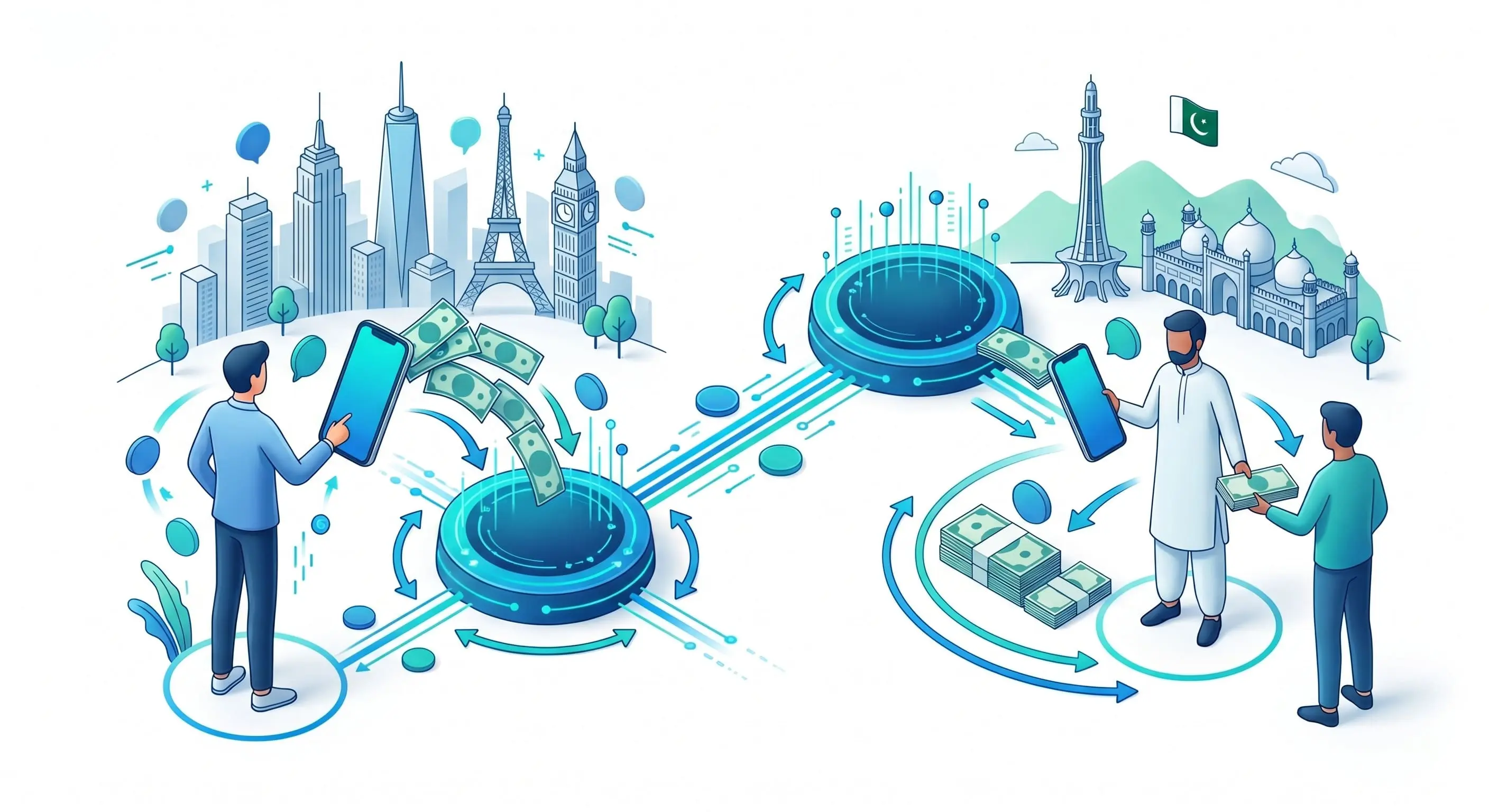
While the international matching and ledger settlement occur securely within the platform's multi-currency environment, the corresponding local currency flows transit entirely off-platform via highly efficient domestic payment rails. Once a peer-to-peer match is validated, the equivalent funds in Pakistani Rupees (PKR) are disbursed directly within the domestic borders through localized bank transfers or specialized mobile wallet interfaces. To maintain absolute systemic integrity, a mandatory mutual evaluation protocol is enforced. Upon the completion of every transactional exchange, both participating parties are required to rate their counterpart. This continuous feedback loop establishes a self-policing, high-trust ecosystem that rewards reliability and guarantees operational transparency. Senders seeking a deeper understanding of these structural ethics can explore the transparent matching protocol manifesto, which delineates the platform's core commitment to financial democratization and community-centric economic frameworks.
3. Navigating Pakistan’s Financial Ecosystem: Mobile Wallets and National Banks
To ensure a swift delivery when planning to send money to Pakistan, remitters must optimize the destination endpoint within the country's local financial infrastructure. The domestic landscape is distinctively split between traditional commercial banking entities and agile branchless banking mobile wallets. For speed, accessibility, and immediate liquidity, mobile wallets represent the optimal choice for modern consumers. The two dominant market leaders in Pakistan’s digital wallet sector are Easypaisa and JazzCash. These services have democratized financial access across the country, transforming every smartphone into a fully functional digital bank account.
Easypaisa, launched originally by Telenor Pakistan in partnership with Telenor Microfinance Bank, boasts an extensive network of hundreds of thousands of local agents spanning urban centers and remote rural territories. It enables instantaneous fund reception, allowing beneficiaries to withdraw physical cash easily or utilize the digital balance directly for point-of-sale purchases. Concurrently, JazzCash, operated by Mobilink Microfinance Bank, serves a massive user base across the nation. Both platforms provide real-time push notifications, robust mobile application interfaces, and instantaneous transaction settlement. When funds are routed through an optimized P2P architecture into Easypaisa or JazzCash, the domestic processing time drops from days to mere minutes, answering the critical user demand for immediate capital availability.
For larger transactional volumes or formalized wealth management, conventional national and commercial banks remain highly relevant. Prominent institutions such as Habib Bank Limited (HBL), the National Bank of Pakistan (NBP), and Allied Bank possess deep institutional liquidity and highly secure digital clearing capabilities. While standard international bank-to-bank transfers to these entities are routinely bottlenecked by external clearing delays, routing the transaction locally via domestic bank transfers completely bypasses international hurdles. Funds can be credited swiftly into standard checking or savings accounts held at HBL or NBP using local real-time clearing mechanisms like 1LINK or Raast, Pakistan's instant payment gateway.
Furthermore, non-resident Pakistanis must consider specialized regulatory frameworks designed specifically to facilitate diaspora investments. The Roshan Digital Account (RDA) initiative, launched by the State Bank of Pakistan, is a premier example of this strategic development. RDA allows overseas citizens to open fully un-repatriable or repatriable digital accounts in major Pakistani banks entirely online from abroad. These accounts act as sophisticated bridges, granting the diaspora direct access to local lifestyle banking, residential real estate financing, car loans, and high-yield government bonds like Naya Pakistan Certificates. Integrating peer-to-peer settlement infrastructure with Roshan Digital Accounts provides an incredibly powerful mechanism for expatriates to manage domestic investments and family support simultaneously without incurring structural capital losses.
4. Step-by-Step Guide to Sending Money via CashSwap Club
Executing an international transaction through a peer-to-peer marketplace requires a systematic adherence to specific operational steps designed to guarantee security, accuracy, and speed. Because the platform operates on an advanced matching engine, understanding the workflow ensures a seamless experience for both the sender abroad and the beneficiary in Pakistan. Below is the comprehensive step-by-step methodology to maximize efficiency and minimize processing times.
- Step 1: Account Registration and Identity Verification
The user creates an account on the secure application platform. To maintain institutional integrity and adhere to global financial mandates, the user must undergo a comprehensive identity verification process. This involves uploading a valid government-issued passport or national identity document alongside a real-time biometric verification check. - Step 2: Capital Provisioning of the Multi-Currency Wallet
Once verified, the remitter funds their preferred domestic multi-currency wallet (such as the EUR or GBP wallet) using standard local banking mechanisms. Senders utilize domestic bank transfers (like SEPA within the Eurozone or Faster Payments within the United Kingdom) to deposit capital into the platform without encountering cross-border transfer fees or conversion spreads. - Step 3: Creating the Remittance Order and Destination Configuration
The sender inputs the target volume of capital they intend to convert and specifies the exact payout endpoint in Pakistan. At this stage, the remitter inputs the recipient's precise mobile wallet details (JazzCash or Easypaisa mobile number) or traditional bank credentials (such as an International Bank Account Number - IBAN linked to Habib Bank Limited or Allied Bank). - Step 4: Automated Matching Engine Activation
The internal software marketplace identifies an optimal peer-to-peer match, aligning the sender's currency with a counterpart request. Because the exchange rate matches the authentic interbank rate, the transaction proceeds with absolute precision, protecting the sender from hidden currency devaluations. - Step 5: Domestic Local Settlement and Mutual Evaluation
The matched funds within the platform's multi-currency environment clear instantly. Simultaneously, the equivalent Pakistani Rupee (PKR) balance is dispatched via domestic rails directly into the recipient's configured mobile wallet or national bank account. Once the beneficiary confirms receipt, both platform users finalize the transaction by submitting their mutual ratings, reinforcing the security of the global marketplace community.
When executing digital financial transactions across distributed platforms, security mindfulness must remain an absolute priority for every user. While advanced encryption and secure ledgers form the bedrock of the infrastructure, user-side operational safety is critical to preventing unauthorized account access and mitigating digital threats. Senders are strongly encouraged to integrate essential reflexes to protect online financial transactions, which include activating multi-factor authentication (MFA), white-listing destination accounts, verifying cryptographic session credentials, and maintaining strict confidentiality regarding private security keys and transaction PINs.
5. Ensuring Compliance, KYC Standards, and Global Security
In the contemporary financial technology sector, operational security and legal compliance are not merely peripheral requirements; they are fundamental pillars that guarantee the longevity and stability of any remittance network. Operating a peer-to-peer currency matching marketplace necessitates strict adherence to international regulatory standards, specifically Anti-Money Laundering (AML) directives and Counter-Terrorism Financing (CTF) compliance frameworks. CashSwap Club institutes an institutional-grade security infrastructure engineered to shield user data and capital assets from malicious activities and systemic fraud.
The first line of defense within this secure ecosystem is the comprehensive Know Your Customer (KYC) onboarding protocol. Every participant entering the marketplace must have their real-world identity verified against official global databases. This process utilizes advanced automated document validation algorithms and biometric facial recognition software to prevent identity theft and account duplication. By ensuring that every account corresponds to a verified, authenticated individual, the platform eliminates anonymity, severely mitigating the risk of fraudulent actors exploiting the peer-to-peer network. Furthermore, transaction monitoring systems operate continuously, analyzing data patterns to flag unusual velocity changes or irregular capital movements, thereby protecting the platform's collective liquidity pool.
Data security is similarly managed through elite engineering protocols. All communications and financial records within the system are shielded by end-to-end cryptographic encryption layers, ensuring that sensitive financial parameters remain inaccessible to external interceptors. Furthermore, the segregation of user wallets ensures that capital reserves are maintained securely and are never co-mingled with operational corporate accounts. The inclusion of the peer-to-peer mutual rating protocol acts as an additional layer of behavioral security. By quantifying user reliability through continuous community feedback, the platform fosters a transparent, high-integrity environment where security is maintained through both cryptographic engineering and community accountability.
6. Embracing a Fairer Financial Future for Global Remittances
The era of accepting exorbitant transfer fees, hidden conversion spreads, and multi-day clearing delays as the necessary cost of international remittance is officially over. The combination of Pakistan's advanced mobile wallet infrastructure, including JazzCash and Easypaisa, alongside the innovative peer-to-peer matching architecture of modern fintech platforms, has democratized cross-border financial flows. Senders can now support their families back home with absolute certainty that every unit of currency transferred retains its maximum value, landing directly in the hands of beneficiaries without being systematically drained by legacy banking intermediaries.
By keeping capital flows localized and matching complementary currency demands at the authentic interbank exchange rate, CashSwap Club offers a structural alternative to predatory corporate banking practices. It restores transparency, fosters community solidarity, and provides an optimized user experience that perfectly balances velocity with security. Senders are invited to break free from the traditional financial constraints of old. Take control of your international remittances today by visiting the live platform interface to experience a transparent, fair, and community-driven financial ecosystem: explore the real-time metrics and evaluate your savings by utilizing the live interbank exchange rate simulator on the platform now.
Frequently asked questions
How much does it cost to send money to Pakistan via CashSwap Club?
Unlike traditional commercial banks that charge hidden conversion markups on the exchange rate, CashSwap Club provides the real interbank mid-market exchange rate. The platform eliminates variable percentage losses, applying only a transparent, minimal fixed administrative fee per transaction that is disclosed upfront prior to execution.
How fast will the beneficiary receive the money in their mobile wallet?
Transactions routed via the peer-to-peer matching network settle with extreme rapidity. Once the internal matching engine pairs the order and the localized domestic clearing validates the transfer, funds are deposited into local mobile wallets such as JazzCash or Easypaisa instantly, often arriving within minutes of final approval.
Is it legal and secure to use a peer-to-peer platform for remittances to Pakistan?
Yes, the operation is completely legal and engineered to meet top-tier security standards. The platform enforces rigorous Know Your Customer (KYC) identity checks and complies fully with global Anti-Money Laundering (AML) regulations, utilizing end-to-end cryptographic encryption and an integrated mutual rating system to safeguard all transactions.
Can funds be sent directly to major Pakistani bank accounts or Roshan Digital Accounts?
Yes. In addition to direct-to-wallet mobile routing for Easypaisa and JazzCash, the localized settlement network connects directly with major national financial institutions including Habib Bank Limited (HBL), National Bank of Pakistan (NBP), and Allied Bank, enabling efficient funding of standard accounts and specialized Roshan Digital Accounts (RDA).

Peer-to-peer currency exchange, finally simple and fair.
Our peer-to-peer currency exchange and money transfer platform is currently under development. We are preparing a solution that will allow you to exchange currencies with a seamless and secure experience.
To be among the first to know and not miss anything about the launch, join the club by subscribing to our newsletter.
Visuals disclosure : In the interest of transparency, please note that the images illustrating this article were created using artificial intelligence (AI) generation tools.