
For millions of families and professionals in the diaspora, finding a reliable method to send money to Egypt remains a critical monthly necessity. Historically, navigating international borders meant relying on outdated financial infrastructure, leading to slow processing times and opaque pricing structures. Today, the landscape of global remittances is undergoing a profound transformation. Thanks to the rise of Peer-to-Peer (P2P) matching platforms like CashSwap Club, supporting loved ones abroad has never been more transparent, community-driven, or technologically advanced. This comprehensive guide explores the mechanics of P2P transfers, the integration with local Egyptian banking networks, and how modern systems are permanently eliminating excessive intermediary costs.
Table of Contents:
The traditional banking system relies heavily on the SWIFT network to move funds across borders. While SWIFT has historically been the backbone of international finance, it involves a complex chain of correspondent banks. Every time money passes through one of these intermediary institutions, it incurs operational costs, commonly referred to as correspondent bank fees. Consequently, when individuals attempt to send money to Egypt using conventional wire transfers, the final amount received is often significantly diminished by these compounding charges.
Furthermore, legacy institutions frequently apply an undisclosed margin to the currency conversion process. Instead of providing the mid-market rate—the true, real-time value at which banks trade currencies with one another—retail customers are often given a skewed rate. This hidden margin is a secondary, less visible fee that drastically impacts the purchasing power of the transferred funds. Grasping the intricacies of global financial markets is essential for anyone sending remittances. A deeper understanding of these macroeconomic factors can clarify why exchange rates fluctuate and how to beat the market when executing cross-border financial operations.
For the Egyptian diaspora, these inefficiencies translate into lost capital that could otherwise support family businesses, education, or essential daily needs. The unpredictability of these transfer fees makes financial planning exceptionally difficult. The pressing need for an alternative has paved the way for decentralized, matching-based financial technologies that prioritize user equity over institutional profit.
The fundamental innovation of the CashSwap Club ecosystem is the implementation of a Peer-to-Peer (P2P) matching marketplace. In stark contrast to traditional wire transfers, money never actually crosses physical borders within a P2P architecture. Instead, the platform facilitates a seamless domestic exchange by utilizing multi-currency digital wallets. Users can hold funds in various major currencies, including EUR, USD, GBP, and CAD. Transactions on the platform occur strictly between wallets holding the exact same currency, completely bypassing the international clearing friction.
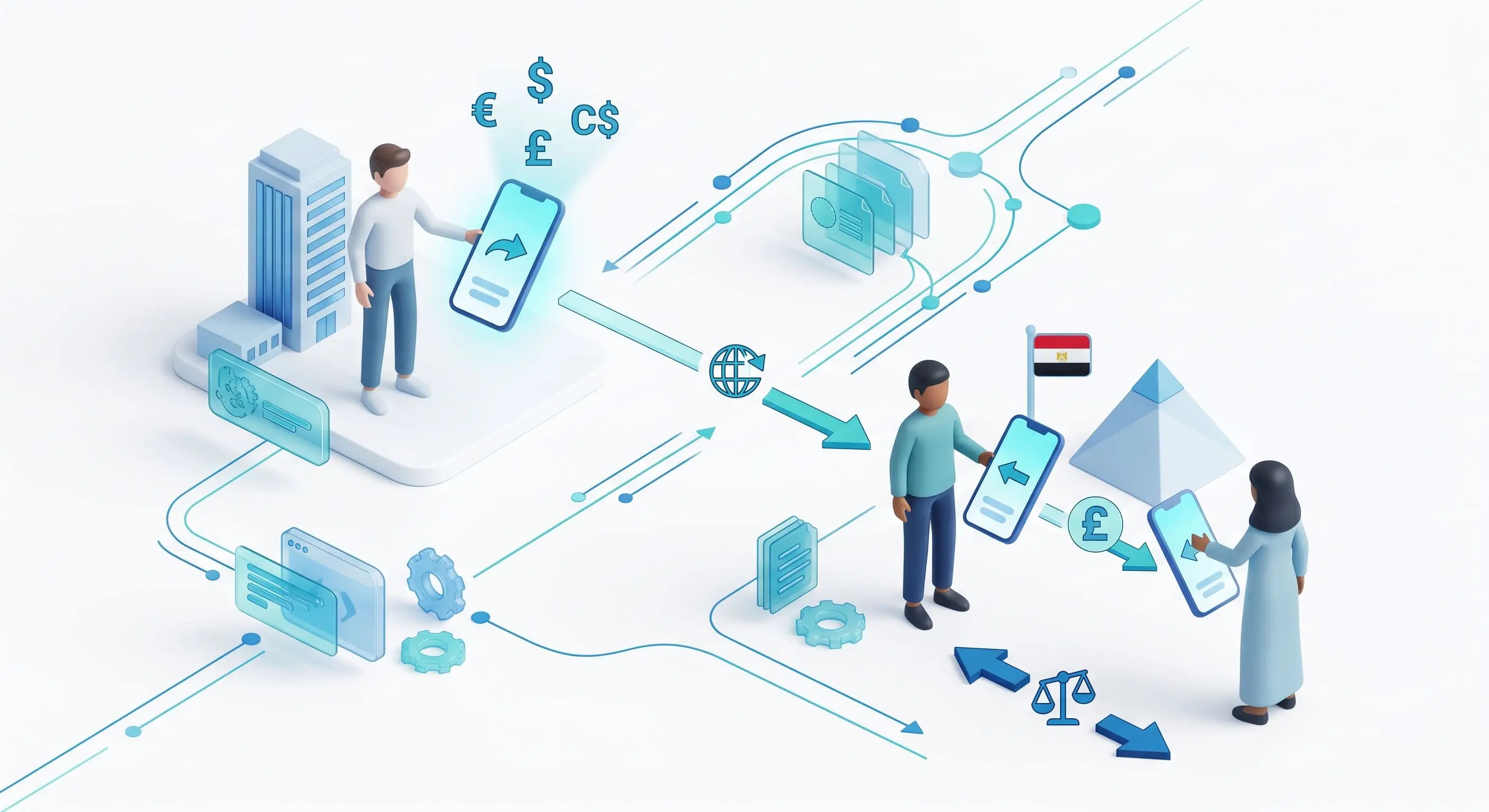
When a user wants to execute an exchange, the algorithm matches their offer with another user who has opposing currency needs. For example, if a user in Europe wishes to convert Euros to Egyptian Pounds, the system matches them with someone looking to convert Egyptian Pounds to Euros. The Euro transaction happens instantly within the platform's closed-loop Euro wallets, while the equivalent local currency flow is executed via domestic bank transfers or local mobile money solutions outside the platform. This elegant structural separation is precisely why individuals choose P2P for money transfers, as it neutralizes the necessity for international correspondent banks.
By eliminating the cross-border movement of capital, the P2P matching system guarantees the real interbank exchange rate without any hidden margins. Users only pay a minimal, highly transparent fixed fee for the platform's matchmaking and escrow services. This model fosters a strong sense of community solidarity, as diaspora members directly facilitate liquidity for one another, resulting in mutual financial benefit.
To fully benefit from a decentralized marketplace, understanding the local financial infrastructure in the destination country is crucial. Egypt boasts a rapidly modernizing digital economy with several robust options for receiving domestic currency flows seamlessly. When the local leg of the P2P matching is executed, funds can be routed into several highly accessible channels.
Firstly, mobile wallets have become ubiquitous across the nation. Vodafone Cash is arguably the most prominent player, allowing recipients to receive funds instantly on their mobile devices. This is particularly advantageous for individuals residing outside major metropolitan areas, as it removes the need to physically travel to a bank branch or stand in long queues at exchange bureaus. The funds are immediately available for everyday transactions, utility payments, or local withdrawals.
Secondly, the Central Bank of Egypt's instant payment network, accessed via the InstaPay application, has revolutionized domestic liquidity. InstaPay allows for real-time, 24/7 transfers between Egyptian bank accounts, rendering the local settlement of a P2P match virtually instantaneous. Whether the recipient holds an account at the National Bank of Egypt (NBE), Banque Misr, or the Commercial International Bank (CIB), the domestic transfer settles without the standard delays associated with international clearing.
For the diaspora, this domestic routing ensures exceptional stability. Securing the official rate via P2P matching, combined with the reliability of local institutions like CIB or NBE, creates a fortified pipeline for remittances. It bypasses the volatility and bottlenecks of traditional remittance corridors, delivering purchasing power exactly when and where it is needed.
Transitioning to a P2P marketplace is designed to be highly intuitive. To leverage what many consider the best transfer app for global remittances, users simply follow a structured, secure pathway that prioritizes transparency at every stage.
Step 1: Account Creation and Wallet Funding
Users begin by creating an account on the CashSwap Club platform and completing the necessary identity verification. Once verified, the user deposits funds into their multi-currency wallet via a standard, zero-fee domestic bank transfer in their country of residence (e.g., funding the EUR wallet via a SEPA transfer).
Step 2: Initiating the Swap
The user defines the amount they wish to exchange and the target currency. The platform's algorithm immediately begins scanning the community pool to find a reciprocal match. Because the system utilizes the real market exchange rate, the user is presented with a clear, exact calculation of the funds to be matched, alongside the minimal fixed platform fee.
Step 3: The Domestic Settlement
Once matched, the foreign currency (e.g., EUR) is transferred instantly between the users' respective platform wallets. Simultaneously, instructions are provided for the local Egyptian leg of the transaction. The local funds are sent domestically—for instance, via InstaPay or to a Vodafone Cash account—ensuring rapid settlement.
Step 4: Mandatory Evaluation
To finalize the transaction, CashSwap Club enforces a mandatory mutual evaluation system. Both users must confirm the successful receipt of funds and rate their counterpart. This step is non-negotiable; it builds a public trust score for every participant, ensuring maximum transparency, accountability, and security within the community ecosystem.
Navigating digital finance requires absolute confidence in the platform's security architecture. P2P matching marketplaces like CashSwap Club operate under rigorous regulatory frameworks to prevent fraud, money laundering, and illicit activities. The foundation of this security is the KYC (Know Your Customer) protocol. Before any user can access the matching engine or fund a wallet, they must undergo a strict identity verification process involving government-issued documentation and biometric checks.
Furthermore, the internal wallet architecture utilizes institutional-grade encryption to protect user data and financial assets. While the platform inherently secures the infrastructure, maintaining personal vigilance is equally important. Users are encouraged to adopt robust cybersecurity practices, such as implementing multi-factor authentication and mastering the 5 reflexes to protect online financial transactions to safeguard their accounts from external phishing attempts.
The mandatory mutual rating system acts as an additional layer of behavioral security. Bad actors are swiftly identified by the community and permanently restricted from the platform. This combination of strict legal compliance, advanced cryptography, and community-driven accountability creates a fortified environment for international capital matching.
By stepping away from legacy banking and embracing decentralized matching, users reclaim control over their financial assets. To understand the broader vision of a decentralized, community-driven financial future, explore the core principles driving this new economic paradigm and discover how P2P networks are empowering diasporas worldwide.
Because P2P matching eliminates cross-border wire routing, the transfer speed is dictated solely by the matching algorithm and domestic banking systems. Finding a match can take anywhere from a few minutes to a few hours depending on market liquidity. Once matched, the local Egyptian transfer via InstaPay or mobile wallets like Vodafone Cash settles almost instantly.
Yes. Traditional banks hide costs in poor currency conversion margins and variable correspondent fees. P2P matching platforms utilize the real mid-market exchange rate and charge a single, minimal fixed fee for the technological service of matching the two parties. The exact cost is displayed clearly before any transaction is initiated.
Modern P2P marketplaces enforce strict institutional security protocols, including mandatory KYC (Know Your Customer) identity verification for all users before they can participate. Additionally, the escrow-style wallet system and mandatory post-transaction evaluations ensure that funds are handled safely and bad actors are permanently excluded from the community.
While having an account with major institutions like the National Bank of Egypt (NBE) or Banque Misr is beneficial, it is not strictly required. The local leg of the transaction can easily be routed to highly accessible mobile wallets, ensuring that even unbanked individuals can receive remittances safely and instantly.

Our peer-to-peer currency exchange and money transfer platform is currently under development. We are preparing a solution that will allow you to exchange currencies with a seamless and secure experience.
To be among the first to know and not miss anything about the launch, join the club by subscribing to our newsletter.
Visuals disclosure : In the interest of transparency, please note that the images illustrating this article were created using artificial intelligence (AI) generation tools.
© CashSwap Club 2026 - All rights reserved
Designed with ❤️ in Paris • Made in France 🇫🇷
 French