
The global economic landscape relies heavily on the constant movement of capital, and for the African continent, remittances represent a vital lifeline. Every year, billions of dollars flow into West Africa, supporting families, funding small businesses, and driving local economic development. Among these financial corridors, the route to West Africa's largest economy is particularly crucial. The diaspora community is deeply committed to ensuring their loved ones receive financial support efficiently. However, the traditional financial systems designed to facilitate these cross-border movements are often deeply flawed, inefficient, and expensive. When individuals seek to send money to Nigeria, they are frequently met with a complex web of intermediaries, opaque currency valuation systems, and slow processing times that erode the true value of their hard-earned capital.
As the digital economy matures, innovative financial technologies are stepping in to dismantle these archaic structures. The emergence of specialized matching marketplaces has introduced a new paradigm where capital does not need to physically cross borders to reach its intended destination. By leveraging decentralized models and multi-currency digital wallets, modern platforms are completely redefining the remittance experience. This comprehensive guide explores the structural inefficiencies of traditional banking, the revolutionary mechanics of peer-to-peer (P2P) matching systems, and how the diaspora can optimize every single transaction to ensure maximum value delivery to local Nigerian bank accounts and mobile wallets.
For decades, international money transfers have been dominated by legacy banking institutions relying on the SWIFT (Society for Worldwide Interbank Financial Telecommunication) network. While SWIFT provides a globally recognized messaging system for institutions, it was never designed for retail, consumer-level remittance speed or affordability. When a sender initiates a transfer from Europe or North America to Lagos or Abuja, the money does not travel in a straight line. Instead, it hops between multiple correspondent banks. Each banking institution involved in this routing process takes a fraction of the capital as a processing fee. This multi-layered intermediary system is the primary reason why traditional transfers are notoriously expensive and slow, often taking anywhere from three to five business days to clear.
Beyond the structural delays, the most significant financial drain comes from opaque pricing models. Traditional institutions often advertise "zero fee" transfers, masking their true profit margins within heavily marked-up exchange rates. The rate shown to the consumer is rarely the mid-market or interbank rate—the true value of the currency on the global market. Instead, banks apply a spread, pocketing the difference. For individuals sending Naira (NGN), this spread can consume a staggering percentage of the total transfer value. This systemic lack of transparency makes it incredibly difficult for senders to calculate the exact amount their recipients will eventually withdraw. To fully grasp the magnitude of these hidden costs, it is highly recommended to explore detailed analyses analyzing the true cost of institutional cross-border transactions, which break down exactly how these institutional margins erode the purchasing power of the diaspora.
Furthermore, traditional brick-and-mortar remittance agencies impose their own set of burdens. Operating physical branches requires significant overhead, including rent, security, and staffing. These operational costs are invariably passed down to the consumer in the form of elevated, fixed transfer fees. While physical agencies offer the benefit of cash-in/cash-out services, the financial penalty for this convenience is severe. In a digitized world, paying premium rates to cover corporate overhead is no longer a necessary evil. Users seeking to maximize their capital are increasingly comparing digital marketplaces with physical remittance agencies to understand how migrating to fully digital ecosystems instantly eliminates these legacy overhead charges, resulting in significantly more Naira delivered to the end recipient.
The solution to the archaic cross-border banking system lies in fundamentally changing how money is routed. The modern approach, championed by platforms like CashSwap Club, is built on a Peer-to-Peer (P2P) matching marketplace model. In this innovative ecosystem, the fundamental premise is that money never actually crosses international borders. Traditional cross-border liquidity provisioning is replaced by localized matching. The platform operates a sophisticated multi-currency wallet system—supporting major fiat currencies like the Euro (EUR), US Dollar (USD), British Pound (GBP), and Canadian Dollar (CAD). These wallets belong exclusively to the users on the platform.
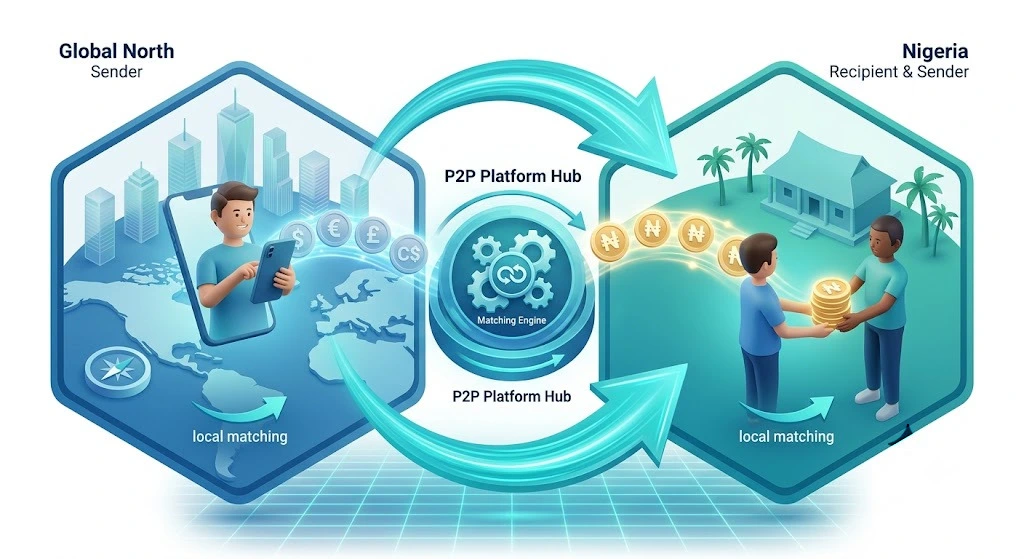
Here is the mechanical breakdown of this process: User A, located in Europe, holds Euros in their platform wallet and wishes to send Naira to a family member in Nigeria. Simultaneously, User B, located in Nigeria (or a Nigerian business), possesses Naira locally and needs Euros in Europe to pay for imported goods or services. The marketplace's algorithm identifies this complementary need and matches the two users. User A transfers their Euros directly to User B's Euro wallet within the closed-loop, secure environment of the platform. In exchange, User B executes a domestic, local bank transfer of Naira directly to User A's designated recipient in Nigeria. Because both transactions—the Euro movement inside the platform and the Naira movement within the domestic Nigerian banking system—are entirely local, international routing fees, SWIFT delays, and correspondent bank margins are completely bypassed.
This closed-loop matching engine is precisely what allows users to access true market exchange rates. By directly connecting supply and demand without institutional middlemen, the ecosystem organically settles at the fairest possible valuation. The platform's revenue model shifts from exploiting currency spreads to charging a minimal, transparent, and fixed matching fee. This architectural shift empowers users significantly, making it evident discovering the structural benefits of decentralized matching systems is essential for anyone engaged in regular international transactions. To ensure absolute integrity within this trustless environment, the system mandates mutual evaluations. After every successful match and local settlement, both parties must rate the transaction. This creates a powerful, decentralized ledger of behavior, heavily incentivizing speed and honesty. For a deeper understanding of how these safeguards operate, users can benefit from understanding how mutual evaluation mechanisms ensure ecosystem security.
Understanding the destination ecosystem is just as critical as optimizing the sending mechanism. The Nigerian financial sector is one of the most dynamic and rapidly evolving landscapes on the African continent, characterized by a unique blend of traditional banking giants and agile fintech disruptors. When executing a domestic local payout through a P2P matching marketplace, the funds must land in a reliable local institution. Historically, major commercial banks have dominated this space. Institutions such as Zenith Bank, Access Bank, United Bank for Africa (UBA), and GTBank possess massive infrastructural footprints and remain the primary custodians of wealth for millions of citizens and businesses.
However, the traditional banking tier in Nigeria is frequently subject to complex regulatory shifts and macroeconomic volatility. The Central Bank of Nigeria (CBN) regularly updates monetary policies to manage the fluctuating value of the Naira against global reserve currencies. These fluctuations often create severe disparities between official banking rates and the parallel market. For the diaspora, sending foreign currency directly into a traditional Nigerian domiciliary account can sometimes result in forced conversions at unfavorable, artificially suppressed official rates. This is precisely why a P2P model—where the local leg of the transaction is purely a domestic NGN-to-NGN transfer—is highly strategic. It bypasses these restrictive foreign exchange bottlenecks, ensuring the recipient gets the true, unsuppressed market value of the transferred capital.
Furthermore, a massive shift toward financial inclusion has birthed a mobile money revolution in Nigeria, transforming how daily transactions are handled. Mobile wallets like OPay and PalmPay have aggressively captured market share by offering instant, reliable, and deeply accessible financial services to both banked and unbanked populations. These mobile platforms often boast superior uptime and faster local clearing speeds compared to legacy bank applications. When a sender utilizes a matching marketplace, specifying an OPay or PalmPay account for the local NGN payout can drastically reduce the time the recipient waits for the funds to reflect. Adapting to these local realities—leveraging the stability of Zenith or UBA for large transfers, while utilizing OPay or PalmPay for instant, daily liquidity—demonstrates a sophisticated approach to managing cross-border financial support.
Transitioning from legacy banking systems to a modern P2P marketplace may seem daunting initially, but the digital interfaces are engineered for extreme user-friendliness. Identifying the best transfer app requires looking at not just the underlying technology, but the seamlessness of the user experience. Here is an exhaustive, step-by-step breakdown of how a typical transaction flows securely from initiation to final delivery.
Step 1: Account Creation and Wallet Funding
The journey begins with creating a secure profile on the platform. Once registered and verified, the user must fund their multi-currency wallet. If the user is based in Europe, they will typically transfer Euros from their traditional European bank account into their digital platform wallet using a standard SEPA transfer or a debit card. This initial deposit ensures the capital is locked and ready for instant matching.
Step 2: Configuring the Naira Payout
With the digital wallet funded, the user initiates a new transfer request. They specify the exact amount they wish to exchange and input the local Nigerian recipient's details. This includes selecting the receiving institution—whether it is a traditional powerhouse like Access Bank or GTBank, or an agile mobile wallet like PalmPay—and providing the correct account number. The platform's algorithm will display the current market matching rate and the exact, fixed platform fee before any commitment is made.
Step 3: The Matching Engine at Work
Once the request is broadcasted, the platform's matching engine pairs the request with a suitable counterpart who holds local Naira and requires the foreign currency (EUR, USD, GBP, or CAD). The platform acts as a secure escrow environment. The sender's foreign currency is temporarily frozen, guaranteeing to the Nigerian counterpart that the funds are legitimate and available.
Step 4: Local Settlement and Mutual Evaluation
The matched counterpart executes a local domestic bank transfer directly to the recipient's Zenith Bank, OPay, or UBA account in Nigeria. Once the recipient confirms that the Naira has successfully landed in their account, the original sender validates the receipt on the platform. This validation triggers the release of the frozen foreign currency to the counterpart's platform wallet. The transaction concludes with a mandatory rating phase, where both users evaluate each other based on speed and communication, permanently securing the community's integrity.
In the realm of decentralized finance and peer-to-peer marketplaces, security cannot be an afterthought; it must be the foundational pillar of the entire infrastructure. Trust is built not just through technological escrow mechanisms, but through rigorous regulatory compliance. The most critical component of this security apparatus is the Know Your Customer (KYC) protocol. KYC is a globally mandated framework designed to verify the identity of individuals using financial services. It acts as the primary defense against illicit activities, identity theft, fraud, and money laundering.
Before a user can execute their first exchange, they must undergo this verification process. This typically involves submitting high-resolution, government-issued identification—such as a passport or a national ID card—along with a real-time biometric verification, like a dynamic selfie, to prove the individual holding the ID is the same person operating the account. Proof of address documentation, such as a recent utility bill or bank statement, may also be required to establish geographic legitimacy. While this onboarding step requires a few minutes of effort, it is absolute non-negotiable for maintaining a safe trading environment. Users looking to prepare their documentation in advance should focus on reviewing the required identification documentation for seamless onboarding to ensure their accounts are verified without delay.
Beyond individual KYC, the platform operates under a strict operational ethos prioritizing transparency and user sovereignty over capital. The multi-currency wallets utilize bank-grade encryption to protect funds at rest, and the mandatory rating system creates a highly visible, self-regulating community standard. This philosophical approach to secure, borderless finance goes beyond mere software engineering; it is a commitment to economic justice. Exploring these core values can be achieved by understanding the fundamental mission behind decentralized finance by reading the platform's vision for financial empowerment. By complying strictly with international financial regulations while innovating on the technological front, P2P marketplaces offer a sanctuary of security for the diaspora's capital.
The financial corridors connecting the global diaspora to Nigeria have historically been heavily taxed by legacy institutions prioritizing their profit margins over the economic well-being of the communities they serve. However, the paradigm has irrevocably shifted. By utilizing P2P matching technology, the artificial borders that have long complicated currency exchange are effectively digitized and neutralized. Multi-currency wallets and domestic settlement systems empower users to reclaim the value lost to exorbitant spreads and hidden institutional fees.
Supporting family, investing in local Nigerian businesses, and participating in the West African economy should be a seamless, fair, and highly secure process. Platforms like CashSwap Club provide the exact infrastructure needed to guarantee that every Naira generated from foreign capital retains its maximum market value. The transition from legacy banking to intelligent, community-driven marketplaces is the definitive step toward total financial optimization. Take control of your international transactions today by starting the process immediately on the main digital exchange marketplace and discover the true power of transparent, borderless matching.
Unlike traditional SWIFT transfers that can take 3 to 5 business days, P2P matching significantly accelerates the process. Because the transaction relies on local domestic transfers rather than cross-border routing, completion times depend on the speed of the local Nigerian banking system. When matched with counterparts using agile mobile wallets like OPay or PalmPay, or instant transfer protocols within major banks like Access or Zenith, the local Naira payout is frequently completed within minutes.
No. The defining feature of a P2P matching platform is absolute transparency. Traditional banks hide their profit margins by offering sub-standard exchange rates. In a matching marketplace, users transact at the real market rate determined by supply and demand. The platform generates revenue exclusively through a fixed, explicitly stated platform fee displayed before the transaction is finalized. There are zero unexpected deductions.
Yes, the closed-loop ecosystem is inherently highly secure. The platform utilizes a strict escrow mechanism. When a match is made, the sender's foreign currency (EUR, USD, etc.) is securely locked within the platform. The funds are only released to the counterpart's wallet after the recipient in Nigeria has successfully received the local Naira transfer. Combined with rigorous KYC identity verification and mandatory user trust ratings, the environment systematically eliminates the risk of fraud.
In the rare event that a local Nigerian domestic transfer is delayed due to banking network downtime (a known issue with some legacy banking infrastructures), the escrow system protects all parties. The counterpart's foreign currency remains safely locked on the platform until the local banking network resolves the delay and the Naira successfully lands in the recipient's account. If a transaction ultimately fails, the platform's dispute resolution protocol can cancel the match and safely return the funds to the original sender's digital wallet.

Our peer-to-peer currency exchange and money transfer platform is currently under development. We are preparing a solution that will allow you to exchange currencies with a seamless and secure experience.
To be among the first to know and not miss anything about the launch, join the club by subscribing to our newsletter.
Visuals disclosure : In the interest of transparency, please note that the images illustrating this article were created using artificial intelligence (AI) generation tools.
© CashSwap Club 2026 - All rights reserved
Designed with ❤️ in Paris • Made in France 🇫🇷
 French