
For the global diaspora, financially supporting families back home is a critical priority, particularly when the destination country is experiencing severe economic turbulence. The macroeconomic landscape in South America presents unique challenges for cross-border remittances, with volatile currencies and complex banking regulations creating significant friction. For those looking to send money to Argentina, the primary adversary is not just geographical distance, but rapid inflation. Inflation systematically erodes local purchasing power, meaning that every percentage point lost to hidden financial fees or poor exchange rates directly impacts the livelihood of the receiving family. Navigating this environment requires moving beyond traditional remittance models and embracing innovative financial technologies that prioritize transparency, speed, and real market value.
Historically, the international financial system has relied on legacy infrastructure that was not designed to accommodate the rapid, low-cost micro-transactions required by modern remittance senders. Correspondent banking networks and traditional money transfer operators often extract significant value from these transactions through a combination of upfront fixed fees and opaque exchange rate markups. However, a new paradigm is emerging. By leveraging Peer-to-Peer (P2P) matching technologies, modern platforms are effectively neutralizing the friction of cross-border transfers. This comprehensive guide explores the mechanics of P2P financial clearing, the intricacies of the Argentine banking ecosystem, and the strategic methodologies required to protect international remittances from the corrosive effects of inflation.
To fully understand the complexity of international fund transfers into high-inflation environments, one must first analyze the economic reality on the ground. Inflation is fundamentally a decrease in the purchasing power of money, reflected in a general increase in the prices of goods and services. When the diaspora sends funds internationally, the goal is to maximize the final fiat value received by the beneficiary. If a remittance takes several days to clear through traditional banking channels, the local currency value might depreciate during the transit period, resulting in a tangible loss of purchasing power upon arrival.
Furthermore, in environments characterized by strict capital controls and currency volatility, multiple exchange rates often coexist. There is typically an official government-mandated rate, which is frequently overvalued, and various parallel or real market rates that more accurately reflect the currency's actual supply and demand dynamics. When traditional financial institutions process cross-border payments, they are generally bound to use the official exchange rate or apply heavy margins to mitigate their own risk exposure. For the sender, this means the funds converted at the source yield significantly less local currency than they should on the open market, creating an artificial taxation on the remittance.
The global standard for international wire transfers, the SWIFT network, relies on a system of correspondent banks. When an individual initiates a cross-border transaction, the funds do not travel directly from the sender's bank to the receiver's bank. Instead, the money hops through a series of intermediary institutions. Each intermediary in this chain applies its own processing fees and processing time, creating a slow and expensive journey. This structural inefficiency disproportionately affects smaller transactions, which constitute the majority of family remittances.
Beyond the structural delays, the most significant value loss occurs through hidden exchange rate margins. Banks and traditional transfer operators rarely offer the interbank exchange rate—the actual, real-time rate at which banks trade currencies with one another. Instead, they offer a retail rate, embedding a profit margin directly into the conversion. This practice obscures the true cost of the transaction. A comprehensive comparative analysis of marketplace efficiency against traditional banking overheads reveals that these hidden margins often constitute the largest financial drain on international remittances, far exceeding the stated upfront fees.
To circumvent the inherent flaws of legacy banking, modern Fintech architecture has pioneered the Peer-to-Peer (P2P) matching model. CashSwap Club exemplifies this model by operating as a multi-currency digital marketplace. The fundamental premise is revolutionary yet technically straightforward: the capital never physically crosses international borders. Instead of moving fiat currency through an expensive global network, the platform matches the opposing currency needs of its users.
The architecture relies on secure, multi-currency wallets integrated within the platform, supporting major fiat currencies such as EUR, USD, GBP, and CAD. When an individual in Europe wishes to send funds to South America, the platform identifies another user in the destination region who wishes to convert local currency into European funds. The primary transaction—the exchange of value—occurs instantaneously between the internal wallets on the platform. The localized distribution of funds (the "last mile") is then handled entirely off-platform via domestic banking networks, which are fast and typically free of cross-border fees.
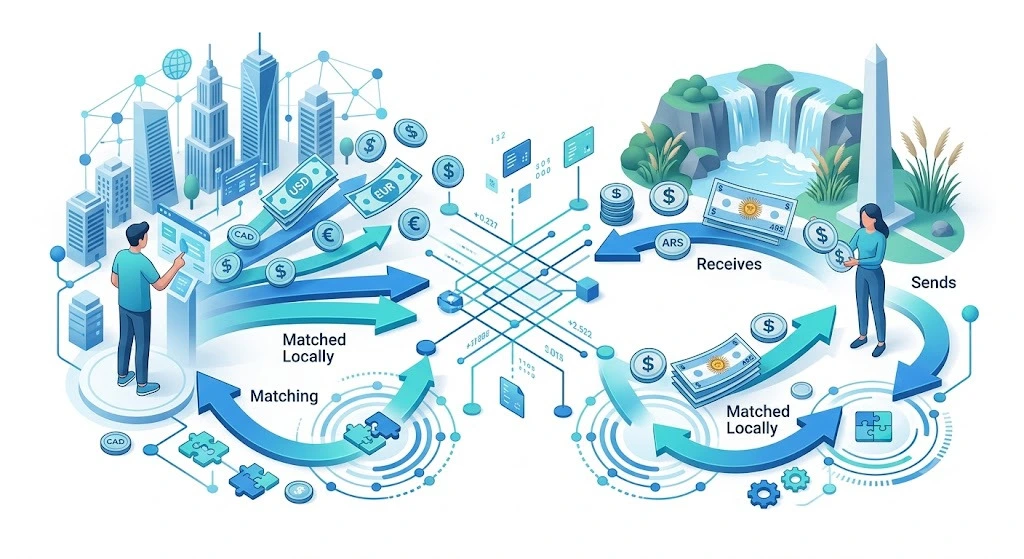
This off-platform local clearing is the key to bypassing international friction. By facilitating local-to-local transfers on both ends of the matching equation, the platform ensures that users achieve the true, real-time market exchange rate. The elimination of intermediary correspondent banks allows the application of minimal, transparent, and fixed structural fees. A detailed evaluation of real savings when bypassing local physical branches demonstrates that this community-driven liquidity model is vastly superior for maintaining the financial integrity of the remittance.
Executing successful local clearing requires deep integration with regional financial infrastructure. The Argentine banking and digital payment ecosystem is highly developed, offering several instantaneous methods for the final leg of the transfer. To ensure seamless liquidity distribution, the platform supports the two primary domestic routing identifiers: the CBU (Clave Bancaria Uniforme) and the CVU (Clave Virtual Uniforme).
The CBU is the standard 22-digit identifier used by all traditional financial institutions in the country. This includes major established entities such as Banco Nación, Banco Galicia, and Banco Santander Argentina. When a P2P match is executed, the local funds are dispatched directly via a domestic wire transfer to the recipient's CBU, settling almost immediately during standard banking hours.
In parallel, the rise of Fintech has popularized the CVU, an equivalent 22-digit identifier designed exclusively for digital wallets and non-bank financial providers. The dominant player in this sector is Mercado Pago, a digital wallet deeply embedded in the daily commerce of the region. Integrating CVU support is crucial, as it provides the unbanked and underbanked populations with immediate access to digital funds, allowing recipients to pay for groceries, utilities, and services directly from their mobile devices. By accommodating both CBU and CVU standards, the ecosystem ensures that the local transfer segment is universally accessible, fast, and frictionless.
Utilizing a P2P matching marketplace is designed to be as intuitive as traditional methods, despite the sophisticated backend technology. The objective is to provide a seamless user experience that abstracts the complexity of domestic clearing and matching algorithms. Recognized by many in the diaspora as the best transfer app for high-inflation corridors, the platform employs a streamlined workflow.
First, the user initiates a transaction by selecting the target fiat currency and inputting the exact amount. The platform's algorithm immediately displays the live interbank exchange rate and explicitly details the minimal fixed platform fee—ensuring zero hidden margins. Once the terms are accepted, the system scans the marketplace liquidity to find a counterpart user with an opposing currency requirement.
Upon a successful algorithmic match, the internal wallet balances are updated instantaneously. The final step involves the off-platform settlement, where the counterpart in the destination country releases the local funds via domestic transfer to the requested CBU or CVU (such as a Mercado Pago account or a Banco Galicia checking account). Because this leg is treated as a standard national transfer, it avoids all international SWIFT delays.
Operating a decentralized matching marketplace requires rigorous security protocols and strict adherence to international financial regulations. The foundation of platform security is the mandatory Know Your Customer (KYC) protocol. Before any user can interact with the matching engine, they must undergo comprehensive identity verification, which aligns with global Anti-Money Laundering (AML) directives. Understanding the comprehensive documentation requirements for identity verification is essential, as this initial barrier prevents fraudulent actors from entering the ecosystem.
Beyond regulatory compliance, the platform enforces security through behavioral economics and community accountability. Every completed transaction requires a mandatory evaluation by both the sender and the receiver. This closed-loop feedback mechanism generates a highly accurate public reliability score for every participant. Users with exceptional ratings benefit from faster matching times, while those who fail to uphold the platform's standards are systematically marginalized or removed. Exploring the mechanisms behind community-driven trust ratings reveals how this peer-reviewed approach creates a self-regulating, highly secure environment for all participants.
Protecting remittances from the dual threats of systemic inflation and legacy banking fees is a critical necessity for the global diaspora. Traditional correspondent banking, with its opaque margins and sluggish processing times, is fundamentally unsuited for optimizing financial support in volatile economic corridors. By transitioning to a P2P matching methodology, users can reclaim the purchasing power of their capital, securing the real interbank exchange rate while benefiting from the speed of localized digital clearing via systems like Mercado Pago and major national banks.
The financial architecture of the future relies on community-driven liquidity, transparency, and technological efficiency. Users can discover the foundational principles driving equitable global finance to better understand the long-term vision of this decentralized model. To secure the true value of cross-border capital, utilizing a live rate simulator is the first practical step toward circumventing inflation and ensuring every transaction is optimized for maximum impact.
Because the international transaction is settled instantly on the platform via P2P matching, the speed of delivery depends entirely on the local off-platform clearing network. In most cases, local domestic transfers to a CBU (traditional banks) or a CVU (digital wallets like Mercado Pago) are processed instantly or within a few business hours, entirely bypassing the multi-day delays associated with international SWIFT transfers.
Yes. The primary flaw in traditional remittance services is the inclusion of hidden exchange rate margins. The P2P matching model eliminates these margins by pairing users directly at the real market interbank rate. The platform sustains its operations strictly through minimal, clearly displayed fixed transfer fees that are agreed upon before the transaction is finalized, ensuring total transparency.
The exchange rate is determined by the live interbank market rate, free from retail markups. By matching the supply and demand of currencies directly between users within the platform's multi-currency wallet ecosystem, the system guarantees that individuals bypass the artificially deflated official rates or bank-imposed margins, preserving the maximum local purchasing power.
Absolutely. The platform operates under strict regulatory frameworks, requiring all participants to complete comprehensive KYC identity verification before accessing the marketplace. Furthermore, the mandatory dual-evaluation system at the end of every transaction ensures a highly trusted, community-vetted environment that deters fraud and guarantees accountability during the off-platform local clearing phase.

Our peer-to-peer currency exchange and money transfer platform is currently under development. We are preparing a solution that will allow you to exchange currencies with a seamless and secure experience.
To be among the first to know and not miss anything about the launch, join the club by subscribing to our newsletter.
Visuals disclosure : In the interest of transparency, please note that the images illustrating this article were created using artificial intelligence (AI) generation tools.
© CashSwap Club 2026 - All rights reserved
Designed with ❤️ in Paris • Made in France 🇫🇷
 Spanish