
For millions of individuals living abroad, supporting families and managing financial obligations across borders is a monthly necessity. The global remittance landscape has long been dominated by legacy institutions that dictate the pace and price of moving capital. However, the emergence of decentralized financial technologies and peer-to-peer (P2P) matching systems is fundamentally disrupting this established order. When individuals look to send money El Salvador, the contrast between traditional physical agencies and modern digital platforms becomes glaringly apparent. This comprehensive analysis delves into the mechanical differences, the hidden costs of legacy systems, and the revolutionary approach of matching-based marketplaces like CashSwap Club. By understanding these mechanisms, users can optimize their financial flows, ensuring that every cent intended for families and investments reaches its destination without being diluted by opaque institutional margins.
Table of Contents
Understanding the specific financial ecosystem of El Salvador is crucial for evaluating the efficiency of any money transfer method. In 2001, El Salvador adopted the United States Dollar (USD) as its official legal tender, effectively entirely dollarizing its economy. This monetary policy eliminated local currency volatility against the dollar, bringing a level of macroeconomic stability. However, for the diaspora living in Europe, Canada, or the United Kingdom, sending funds still involves an inevitable currency conversion from Euros (EUR), British Pounds (GBP), or Canadian Dollars (CAD) into USD.
The domestic banking infrastructure in El Salvador is robust and highly integrated with the USD network. Major financial institutions such as Banco Agrícola, Banco Cuscatlán, and Banco Dávivienda form the backbone of the country's financial clearing system. When funds arrive in the country, they are typically routed through these major banks or distributed via extensive networks of digital wallets and physical cash pickup locations. The reality on the ground dictates that recipients require immediate access to liquid USD to cover daily living expenses, medical bills, or educational costs.
In such a fully dollarized environment, the speed of the transaction and the elimination of intermediary foreign exchange margins are major advantages. Every fraction of a percentage lost in a poor exchange rate translates to less purchasing power for the recipient. Therefore, the strategic selection of a remittance channel is not merely a matter of convenience; it is a critical financial decision that directly impacts the economic well-being of households in El Salvador.
Historically, the diaspora has relied on physical money transfer agencies and traditional wire transfers. While these methods offer a sense of familiarity, their underlying infrastructure is inherently inefficient and costly. Traditional banks operate on the SWIFT (Society for Worldwide Interbank Financial Telecommunication) network. SWIFT is essentially a secure messaging system that banks use to send payment orders to one another. Because no single bank has a direct relationship with every other bank globally, a single international transfer must often hop through multiple correspondent banks before reaching the final destination.
Each intermediary bank in the SWIFT chain extracts a fee for processing the transaction. Furthermore, the initiating bank or traditional transfer agency applies two primary layers of cost: explicit transfer fees and implicit exchange rate markups. The explicit fee is the upfront cost advertised to the sender. The implicit cost, however, is far more insidious. Institutions rarely offer the real, mid-market interbank rate—the rate at which banks trade currencies with one another. Instead, they offer a skewed retail rate, pocketing the difference. For those looking to understand the mechanics behind currency valuations, it becomes evident that this spread is where the majority of institutional profit is generated.
Physical agencies compound these inefficiencies by maintaining expensive brick-and-mortar storefronts, paying staff, and managing physical cash logistics. These overhead costs are inevitably passed down to the consumer. The result is a slow, opaque process where the sender is often left wondering exactly how much the recipient will receive and when the funds will actually clear in Banco Agrícola or Banco Cuscatlán.
The modern alternative to the SWIFT network and physical agencies is the decentralized model of Peer-to-Peer (P2P) matching. Platforms like CashSwap Club operate as highly advanced marketplaces that pair individuals looking to exchange opposite currency pairs. The fundamental paradigm shift here is that the money never actually crosses international borders.
This system operates through the management of multi-currency digital wallets. A user on the platform can hold balances in EUR, USD, GBP, and CAD. The matching engine seamlessly pairs a user in Europe wanting to send EUR in exchange for USD with a user holding USD who requires EUR. The transaction on the platform merely updates the internal ledger, crediting and debiting the respective digital wallets instantaneously. By eliminating the cross-border movement of capital, the system bypasses correspondent banking networks entirely, which is a core reason exploring the architectural advantages of decentralized matchmaking reveals such massive cost reductions.
For the local fiat leg of the transaction—moving the money from the platform to a local Salvadoran bank account or vice versa—the transfers are handled domestically. A user withdrawing USD from their CashSwap Club wallet will receive a local national bank transfer directly into their Banco Dávivienda or Banco Agrícola account, utilizing the fast, domestic clearing systems of El Salvador rather than slow international wires. Because the platform perfectly matches supply and demand, it can offer the real, un-padded interbank exchange rate, charging only a minimal, entirely transparent fixed fee for the matching service.
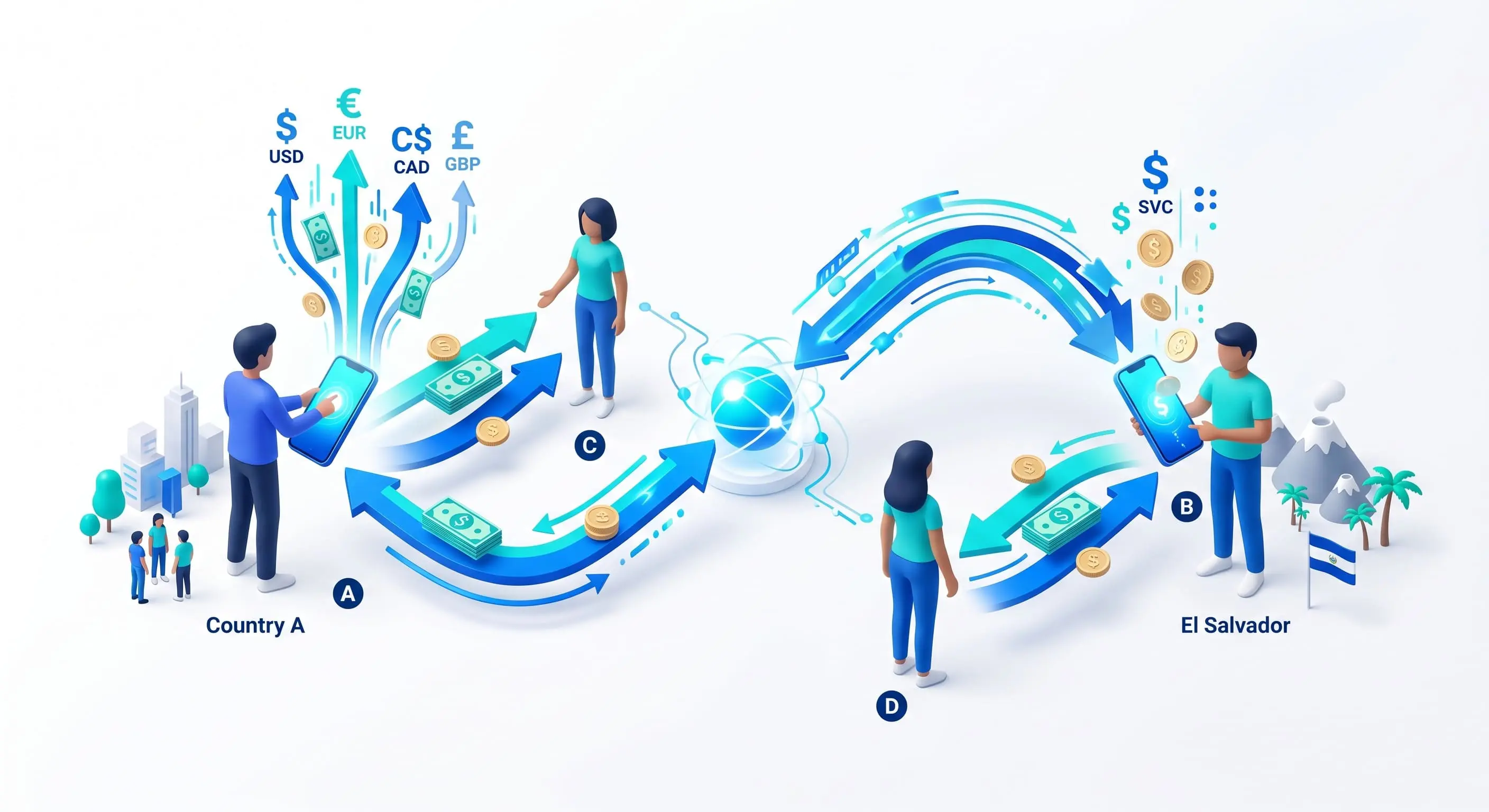
Transitioning from a traditional agency to a P2P marketplace is designed to be frictionless. For users seeking the best money transfer app, the user experience must be intuitive, highly secure, and exceptionally fast. The workflow for executing a transfer to El Salvador via a matching platform follows a logical, standardized sequence.
First, the user creates an account and undergoes standard identity verification. Once the account is active, the user funds their platform wallet using a domestic transfer in their home currency (for example, a SEPA transfer in Europe for EUR). Once the EUR wallet is credited, the user enters the desired matching criteria: the amount of EUR to swap for USD. The algorithmic engine immediately scans the marketplace for a counterparty. Due to high liquidity, this matching process typically occurs in fractions of a second.
Once the match is finalized, the USD is credited to the user's USD wallet on the platform. The final step involves initiating a withdrawal to the intended recipient's bank account or digital wallet in El Salvador. To maintain the integrity of the marketplace and guarantee absolute transparency, the ecosystem relies on a mandatory dual-evaluation system. At the conclusion of every transaction, both the sender and the receiving counterparty must rate the exchange. This self-regulating mechanism ensures that only reliable actors remain in the liquidity pool, fostering a community built on mutual trust and accountability.
The primary concern for any individual moving capital internationally is security. The P2P matching model is rigorously structured to prevent fraud and ensure absolute compliance with international financial regulations. The foundation of this security is the KYC (Know Your Customer) protocol. KYC is a mandatory regulatory requirement where financial institutions verify the identity, address, and financial profile of their clients before allowing them to transact. This completely eliminates anonymous actors from the platform, ensuring a closed, verified ecosystem.
Furthermore, because the funds traded on the platform are pre-funded into user wallets, the risk of non-payment or settlement failure is entirely eradicated. The platform acts as a secure escrow environment; funds are only released and swapped when both sides of the transaction are fully collateralized. Individuals looking for essential strategies for securing digital funds will note that keeping transactions within a closed-loop, pre-funded environment is the most effective defense against counterparty risk.
The community-driven aspect of the mandatory rating system adds a layer of behavioral security. By forcing users to evaluate the speed and reliability of the local fiat off-ramping process, the platform continuously purges bad actors and elevates trusted liquidity providers. This results in a highly secure, institutional-grade trading environment that remains accessible to everyday consumers.
The days of surrendering hard-earned capital to the opaque margins and hidden fees of legacy banks and physical agencies are drawing to a close. The economic reality of El Salvador's dollarized infrastructure demands a faster, leaner, and more transparent method of routing funds. By leveraging a peer-to-peer matching architecture, platforms like CashSwap Club completely eliminate cross-border friction, offering the true interbank market rate alongside minimal, fixed processing costs.
This is not merely a technological upgrade; it is a paradigm shift toward financial equity. By cutting out intermediary institutional rent-seekers, the wealth generated by the diaspora remains fully intact upon arrival, directly empowering local communities and families. To take part in this paradigm shift, it is highly recommended to embrace a fairer financial system by discovering the core principles of P2P finance. The next logical step for any sender is to utilize a live rate simulator to instantly calculate the exact amount of USD that will land in El Salvador, proving the mathematical superiority of the P2P matching model.
Unlike traditional agencies that hide their true costs in inflated exchange rates, P2P matching platforms charge a very minimal, strictly transparent fixed fee. Because the money does not cross borders via the SWIFT network, expensive intermediary bank charges are completely eliminated. The sender sees the exact, final cost before confirming any transaction.
The system utilizes the real, mid-market interbank exchange rate. By matching supply and demand directly between users, the platform bypasses institutional markups entirely. This guarantees that the conversion from EUR, GBP, or CAD to USD yields the highest possible amount for the recipient in El Salvador.
Absolutely. The platform operates under strict international financial compliance, requiring rigorous KYC (Know Your Customer) identity verification for all users. Furthermore, the escrow-based wallet system and the mandatory dual-rating evaluation ensure that all transactions are fully collateralized and conducted between verified, trusted parties.
The matching process on the platform is nearly instantaneous. Once the currencies are swapped into the USD wallet, the final delivery speed depends solely on the local domestic transfer networks in El Salvador (such as a direct deposit to Banco Agrícola or Banco Cuscatlán), which typically clear within the same business day or instantly, depending on the local payment rails chosen.
Visuals disclosure : In the interest of transparency, please note that the images illustrating this article were created using artificial intelligence (AI) generation tools.
© CashSwap Club 2026 - All rights reserved
Designed with ❤️ in Paris • Made in France 🇫🇷
 Spanish