The flow of capital across international borders represents much more than simple financial transactions; for millions of families, the remesas (remittances) corridor is an absolute economic lifeline. As globalization expands, the necessity for secure, fast, and affordable cross-border financial routing becomes increasingly critical. However, navigating the traditional financial ecosystem often exposes senders to opaque pricing structures, disadvantageous currency valuations, and significant delays. Today, modern financial technology provides sophisticated alternatives to legacy systems, entirely redefining how capital is moved. This comprehensive guide analyzes the structural flaws of traditional banking, explores the specificities of the Mexican financial landscape—including instant digital networks and vast cash-pickup infrastructures like OXXO and Elektra—and explains how decentralized Peer-to-Peer (P2P) matching architectures offer a radically optimized solution.
To truly understand the value of modern Fintech solutions, it is essential to deconstruct the legacy systems that have monopolized international finance for decades. Traditional banks and conventional remittance operators heavily rely on the SWIFT (Society for Worldwide Interbank Financial Telecommunication) network. While historically significant, SWIFT is merely a messaging system that requires capital to jump through a convoluted chain of correspondent intermediary banks. Every institution in this chain levies a processing charge, which drastically inflates the overall transfer fees.
More critically, traditional financial institutions rarely process transactions at the real interbank exchange rate—the wholesale market price at which large banks trade currencies. Instead, they apply a substantial, hidden markup (often ranging from 3% to 6%) on the currency conversion. This spread acts as an invisible tax on the sender. When a user attempts to send money to Mexico through these traditional channels, the advertised "low flat fee" is usually a facade hiding the massive value lost during the currency exchange. Furthermore, these transactions can take several business days to clear, leaving both the sender and the recipient in a state of financial uncertainty. For a deeper technical analysis of why legacy systems fail modern demands, understanding the structural differences between SWIFT, SEPA, and P2P networks provides crucial context on the evolution of global routing.
Optimizing international transfers requires a profound understanding of the destination country's domestic financial infrastructure. The Mexican banking sector is highly developed, dominated by massive institutions such as BBVA México, Banorte, and Santander México. For recipients holding formal bank accounts with these institutions, the country utilizes a highly efficient digital clearing system known as SPEI (Sistema de Pagos Electrónicos Interbancarios). Developed by the Banco de México, SPEI allows for near-instantaneous, 24/7 domestic bank transfers. When an international remittance correctly interfaces with domestic SPEI rails, the final delivery is exceptionally fast.
However, a defining characteristic of the Mexican economy is the large percentage of the population operating entirely outside the traditional banking system. For millions of unbanked citizens, receiving funds directly into a formal bank account is impossible. This reality has necessitated the creation of robust retail cash-pickup networks. Convenience store chains like OXXO and retail giants like Elektra function as de facto financial hubs across the nation. Through these networks, a recipient can walk into a local neighborhood store and withdraw physical cash using nothing more than a secure withdrawal code and a valid ID. Bridging the gap between international digital capital and local physical cash is the ultimate challenge for remittance providers, and ensuring that this conversion happens without predatory fees is paramount.
In stark contrast to the slow and expensive correspondent banking model, decentralized Peer-to-Peer (P2P) architectures have emerged as the most efficient way to manage cross-border flows. CashSwap Club operates as a specialized marketplace built entirely on this matching technology. The foundational premise of this system is both simple and revolutionary: the money never actually crosses physical or digital international borders.
The platform facilitates this by managing closed-loop, multi-currency wallets holding major global currencies (currently EUR, USD, GBP, and CAD). When a user needs to convert Euros to Mexican Pesos (MXN), the platform does not attempt to wire the Euros to North America. Instead, the transaction takes place exclusively between wallets of the exact same currency within the platform's secure environment. The sender's Euros are algorithmically matched with another user seeking Euros. Simultaneously, the equivalent value in local Mexican Pesos is cleared entirely off-platform via domestic Mexican networks.
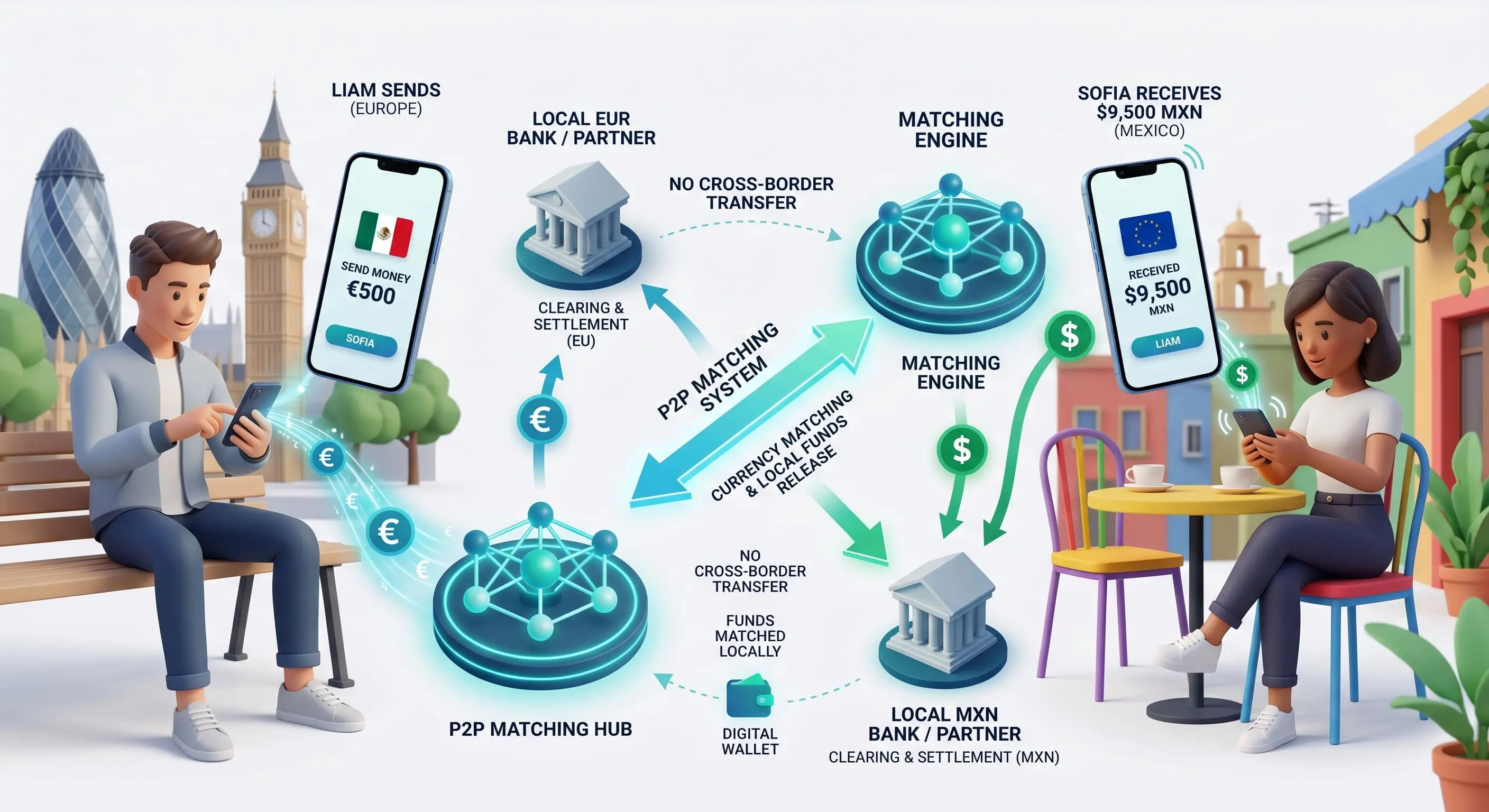
Because the platform eliminates the international banking chain, it completely avoids institutional currency conversion spreads. The matching engine aligns supply and demand to offer the true interbank exchange rate, charging only a minimal, transparent flat fee for the matching service. This architecture ensures that maximum value reaches the recipient. To fully grasp how to leverage this system for maximum financial retention, users can explore a detailed guide on securing the interbank rate for Mexican remittances. Furthermore, understanding the ethical foundation of this borderless financial model is essential; it is highly recommended to read the foundational manifesto outlining the commitment to decentralized and fair capital mobility.
Transitioning to a modern P2P marketplace requires an intuitive user experience, especially when dealing with physical cash pickups. The process is designed to be highly secure yet straightforward. Here is the operational lifecycle of a transaction intended for an OXXO or Elektra cash withdrawal:
When bypassing legacy banking monopolies, financial security remains the paramount concern. The architecture of a P2P matching marketplace is specifically engineered to mitigate the vulnerabilities inherent in international transit. Because the funds traded on the platform never cross borders, they are never exposed to international wire interception or volatile mid-transit currency fluctuations. The major currencies deposited by users are held in institutional-grade safeguarding accounts, fully segregated from operational capital.
From a regulatory standpoint, strict adherence to global Anti-Money Laundering (AML) directives is rigorously enforced. The combination of comprehensive upfront KYC checks and the mandatory bilateral evaluation at the conclusion of every transfer creates a highly secure, self-regulating community. The evaluation system ensures total transparency: every participant is accountable, and the release of platform funds is contingent upon the verified success of the local clearing. This closed-loop trust mechanism provides a level of security that traditional blind wire transfers simply cannot match.
The persistent reliance on traditional banking networks for the remesas corridor results in billions of dollars lost annually to hidden currency markups and arbitrary fees. As the financial landscape evolves, the P2P matching model stands out as the ultimate solution for optimizing cross-border capital. By confining same-currency transactions to a secure platform and leveraging robust domestic networks like SPEI, OXXO, and Elektra for local clearing, users finally gain access to the real interbank exchange rate. For anyone looking for the best money transfer app to maximize the value sent to loved ones, migrating away from legacy systems is the only logical step. It is time to embrace the transparency of decentralized matching and calculate precise, real-time transaction savings using the live platform simulator.
Unlike traditional institutions that hide their profits within inflated currency conversion spreads, the P2P architecture provides the true interbank exchange rate. The only cost incurred by the user is a minimal, highly transparent flat fee charged for the matching service, ensuring that the maximum possible amount reaches the recipient.
Because P2P matching relies on local domestic clearing, the speed is vastly superior to international SWIFT transfers. If the local flow is routed via the SPEI instant banking network, or a digital withdrawal code is generated for an OXXO/Elektra pickup, the funds are typically available to the recipient in Mexico within minutes to a few hours after the platform match is confirmed.
Yes. The local clearing mechanisms perfectly accommodate the unbanked population. By selecting a cash pickup option, the domestic flow generates a secure, unique reference number. The recipient simply presents this code along with a valid official ID at any participating OXXO or Elektra retail location to collect the physical cash.
Absolutely. The platform enforces institutional-grade security measures, including mandatory KYC identity verification and strict AML compliance. Furthermore, funds are safeguarded in dedicated wallets, and the transaction is only finalized after a mandatory bilateral evaluation from both users, ensuring total transparency and eliminating the risk of fraud.

Our peer-to-peer currency exchange and money transfer platform is currently under development. We are preparing a solution that will allow you to exchange currencies with a seamless and secure experience.
To be among the first to know and not miss anything about the launch, join the club by subscribing to our newsletter.
Visuals disclosure : In the interest of transparency, please note that the images illustrating this article were created using artificial intelligence (AI) generation tools.
© CashSwap Club 2026 - All rights reserved
Designed with ❤️ in Paris • Made in France 🇫🇷
 Spanish