
- Oct 14, 2026
India is the world’s largest recipient of remittances, with annual inflows well above 100 billion US dollars according to World Bank estimates. Behind this macroeconomic figure are millions of individual stories: a software engineer in London supporting parents in Kerala, a nurse in Toronto paying a sibling’s college fees in Punjab, a student in Paris receiving pocket money from Mumbai, or a family in New Jersey sending festival gifts to relatives in Gujarat. All of them share the same two questions whenever they send money to India: how much will it really cost, and how quickly will the money arrive?
For years, the honest answer was “more than expected” and “slower than hoped”. Traditional international bank transfers combine opaque exchange rate margins, intermediary charges and settlement times of several days. Yet India itself has built one of the fastest domestic payment ecosystems on the planet, where money moves between bank accounts in seconds, 24 hours a day. The challenge is to connect senders abroad to this instant infrastructure without paying for slow and expensive cross-border rails. This is exactly where Peer-to-Peer (P2P) matching platforms such as CashSwap Club change the equation. This article explains how the model works for the India corridor, what it costs, how long it takes, and how it fits with Indian realities such as UPI, mobile wallets, major banks and NRE/NRO accounts.
Table of Contents
- Why Traditional Bank Transfers to India Are Slow and Expensive
- India’s Instant Payment Ecosystem: UPI, Mobile Wallets and Major Banks
- How P2P Matching Works: Money That Never Crosses Borders
- NRE vs NRO Accounts: What the Indian Diaspora Should Know
- Step-by-Step Guide: Sending an Express Transfer to India with CashSwap Club
- Security, KYC and Regulatory Compliance
- Cost and Speed Comparison: Which Option Is the Best Money Transfer App for India?
- Conclusion: Real Rates, Real Speed, Real Transparency
- Frequently Asked Questions
Why Traditional Bank Transfers to India Are Slow and Expensive
When a sender initiates an international bank transfer from Europe, the United Kingdom, the United States or Canada to India, the payment usually follows a long and costly path. Understanding this path helps explain why so many people end up paying more and waiting longer than necessary.
The exchange rate markup
The largest cost of an international transfer is rarely the advertised fee. It is the margin added to the exchange rate. The mid-market rate, also called the interbank rate, is the midpoint between the buy and sell prices of two currencies on global markets. Banks and many remittance services apply their own retail rate instead, which can be one to several percentage points less favorable. On a transfer of 2,000 euros to India, a 2.5% markup represents 50 euros that never reach the recipient and never appear as a separate line on the receipt. The mechanism is explained in depth in the guide on why bank exchange rates differ from real market rates.
SWIFT and correspondent bank charges
Most bank transfers to India travel through SWIFT, an international messaging network that connects thousands of banks. SWIFT does not move money itself; it carries payment instructions. When the sending bank has no direct relationship with the recipient’s bank in India, the payment passes through one or more correspondent banks, each potentially deducting a fee. As a result, a family in Hyderabad may receive a slightly lower amount than announced, with no clear explanation of where the difference went.
Several days of waiting
Traditional cross-border transfers to India commonly take one to five business days. Weekends, bank holidays in either country, cut-off times and compliance checks can extend this further. For urgent needs such as medical bills, school fees or a family emergency, this delay is a serious problem. Many senders also discover that the combination of a fixed bank fee and a hidden rate markup costs far more than expected. A detailed breakdown of this issue is available in the article comparing fixed bank fees versus the interbank rate when sending money to India.
India’s Instant Payment Ecosystem: UPI, Mobile Wallets and Major Banks
The paradox of the India corridor is striking: while international transfers can take days, domestic payments inside India are among the fastest in the world. Any solution aiming to deliver money in seconds must plug into this local infrastructure.
UPI (Unified Payments Interface)
UPI, short for Unified Payments Interface, is a real-time payment system launched in 2016 and operated by the National Payments Corporation of India (NPCI). It allows instant transfers between bank accounts using a simple identifier called a UPI ID (for example, name@bankname), a mobile number or a QR code, without needing to share full bank account details. UPI operates 24/7, including weekends and holidays, and transfers typically settle within seconds. It now processes billions of transactions every month and has become the default way Indians pay each other, from street vendors to rent payments. Per-transaction limits are set by NPCI and individual banks, so recipients receiving larger amounts should check the limits that apply to their account. A complete walkthrough is available in the complete P2P guide to sending money to India via UPI.
Paytm, PhonePe and Google Pay India
Most people in India access UPI through consumer apps rather than directly through their bank. PhonePe and Google Pay India are the two leading UPI apps by transaction volume, offering a simple interface to send and receive money instantly, pay bills and scan merchant QR codes. Paytm, one of India’s pioneering fintech brands, also provides UPI payments and has historically offered its own digital wallet. For a recipient, this means that receiving money is usually as simple as sharing a UPI ID or a registered mobile number linked to one of these apps.
State Bank of India, HDFC Bank and ICICI Bank
Behind every UPI app sits a bank account. India’s largest banks, including State Bank of India (SBI), the country’s biggest public sector lender, as well as private leaders HDFC Bank and ICICI Bank, are fully connected to UPI and offer their own mobile banking apps. In addition to UPI, these banks support IMPS (Immediate Payment Service), another 24/7 instant transfer system, as well as NEFT for scheduled transfers and RTGS for high-value payments. For anyone looking to send money to India quickly, the key insight is simple: once funds are paid out domestically through UPI or IMPS, delivery can take just seconds.
How P2P Matching Works: Money That Never Crosses Borders
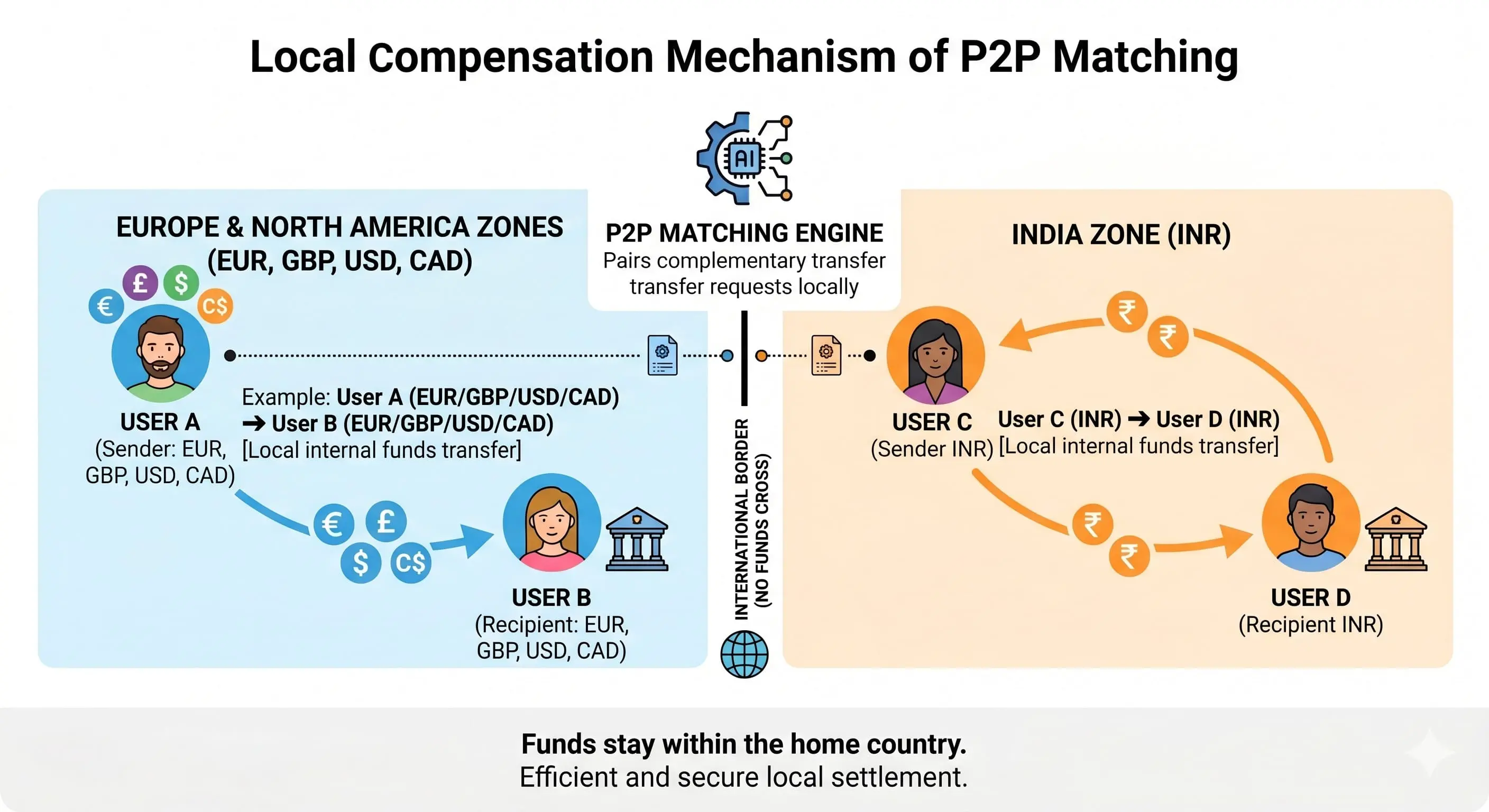
CashSwap Club is a money transfer marketplace based on Peer-to-Peer matching. The core principle is that money never physically crosses borders. Instead of pushing funds through SWIFT and correspondent banks, the platform matches users who need to exchange currencies in opposite directions, so that each side of the exchange is settled locally.
Multi-currency wallets owned by users
Each user holds multi-currency wallets on the platform, available in EUR, USD, GBP and CAD. These wallets belong to the users themselves. On the platform, transactions take place exclusively between wallets of the same currency: euros move between euro wallets, pounds between pound wallets, and so on. No currency conversion happens within the platform’s own flows.
The local rupee leg happens off-platform
The Indian rupee side of the exchange is settled outside the platform, through domestic Indian payment rails such as UPI, IMPS or a bank transfer. A concrete example illustrates the logic. Priya lives in London and wants to send money to her mother in Chennai. At the same time, Arjun, based in Bengaluru, needs pounds to pay for a training course in the UK. The platform matches the two needs. Priya’s pounds move to Arjun’s GBP wallet on CashSwap Club, while Arjun pays the equivalent amount in rupees directly to Priya’s mother through UPI. Neither amount crosses a border. There is no SWIFT fee, no correspondent bank and no exchange rate markup imposed by an intermediary, and the rupee leg can land in the recipient’s account within seconds once it is sent.
The real exchange rate with fixed, transparent fees
Because the platform matches supply and demand directly, it can offer the real market exchange rate, the interbank rate, rather than a padded retail rate. Instead of hidden margins, CashSwap Club charges minimal fixed transfer fees displayed before confirmation. The sender knows exactly how many rupees the recipient will get.
Mandatory two-way rating
To guarantee transparency and security, every transaction must be rated by both users at the end of the exchange. This mutual evaluation builds a visible track record for each member and encourages reliable, timely behavior, which is essential when the goal is near-instant delivery. The values behind this community-based approach are set out in detail, and readers can discover the CashSwap Club manifesto for fair and transparent transfers.
Why more members means faster matches
In a matching system, speed depends on liquidity: the more users active in a corridor, the faster a request finds its counterpart. Members of the Indian diaspora who invite relatives and friends therefore help everyone transfer faster. The mechanics and rewards are explained in the article on the money transfer referral program and how to earn P2P bonuses.
NRE vs NRO Accounts: What the Indian Diaspora Should Know
Non-Resident Indians (NRIs) often hold specific bank accounts in India, and understanding the difference between them helps manage money flows efficiently.
NRE account (Non-Resident External)
An NRE account is designed to hold income earned abroad and transferred to India. Funds are held in rupees, the interest earned is exempt from income tax in India, and both the principal and interest are fully repatriable, meaning they can be transferred back abroad freely. It is typically the preferred option for parking foreign earnings in India.
NRO account (Non-Resident Ordinary)
An NRO account is used to manage income generated in India, such as rent from a property, dividends, a pension or proceeds from a sale. Interest earned is taxable in India, and repatriation abroad is subject to annual limits and supporting documentation. Many NRIs hold both: an NRE account for savings from abroad and an NRO account for local income.
Account rules and tax treatment can change and depend on individual circumstances, so it is advisable to confirm with the bank and a qualified tax adviser which account should receive a given transfer. For family support, many senders simply pay the recipient’s own resident account directly via UPI.
Step-by-Step Guide: Sending an Express Transfer to India with CashSwap Club
The process is designed to be simple, even for users who have never used a fintech app before.
- Create an account: registration takes a few minutes and requires basic personal details.
- Verify identity (KYC): the user uploads an identity document and, where required, a proof of address. This mandatory step protects the entire community.
- Fund the relevant wallet: the sender adds EUR, USD, GBP or CAD to the matching wallet through a domestic bank transfer or a supported local method.
- Enter the recipient’s details: typically the recipient’s UPI ID or bank details at banks such as SBI, HDFC Bank or ICICI Bank. The interface shows the real exchange rate, the fixed fee and the exact amount in rupees.
- Get matched: the platform pairs the request with a counterpart who needs the sender’s currency and can pay rupees locally.
- Local payout in India: the counterpart sends rupees to the recipient through UPI, IMPS or a bank transfer, often arriving within seconds of being sent.
- Confirm and rate: once the recipient confirms receipt, both parties rate each other and the exchange is closed.
For senders who support family every month, planning ahead makes the experience even smoother. The complete guide to automating recurring money transfers explains how to organize regular payments and avoid last-minute stress before festivals or school fee deadlines.
Security, KYC and Regulatory Compliance
Speed should never come at the expense of safety. Several layers of protection work together on CashSwap Club.
Know Your Customer (KYC)
KYC stands for “Know Your Customer”: the legal obligation for financial service providers to verify the identity of their users. Every member goes through identity checks before exchanging money, so each counterpart is a verified person. KYC helps prevent fraud, identity theft and misuse of the platform.
Anti-money laundering controls
Alongside KYC, anti-money laundering (AML) safeguards monitor unusual activity, apply limits where appropriate and support cooperation with authorities when required by law. These measures protect honest users and the integrity of the financial system.
Traceable flows
Because on-platform transactions occur only between same-currency wallets, and local legs go through regulated channels such as UPI and Indian banks, every movement leaves a traceable record. Users should keep these records and remain aware of their own tax and foreign exchange obligations, including India’s Foreign Exchange Management Act (FEMA) where relevant.
Community reputation
The mandatory two-way rating adds a community safeguard on top of regulatory controls. Members can see each counterpart’s history, and repeated negative feedback can lead to restrictions.
Cost and Speed Comparison: Which Option Is the Best Money Transfer App for India?
Choosing the best money transfer app for India comes down to the two questions every sender asks: total cost and delivery time.
- Exchange rate: banks typically apply a retail rate with a margin; P2P matching on CashSwap Club uses the real interbank rate.
- Fees: bank transfers may combine sending fees, correspondent charges and receiving fees; the P2P model relies on minimal fixed fees shown upfront.
- Delivery time: SWIFT transfers often take one to five business days. With P2P matching, timing depends mainly on how quickly a match is found; once the counterpart pays via UPI or IMPS, the rupees typically arrive within seconds, any day of the week.
- Transparency: bank statements rarely reveal the real cost of conversion, while the P2P interface displays the rate, the fee and the rupee amount before confirmation.
In practice, removing the exchange rate markup and intermediary banks generally means more rupees for the recipient, particularly on larger or recurring transfers. And as more members join the India corridor, matches tend to happen faster, bringing the whole process closer to real time.
Conclusion: Real Rates, Real Speed, Real Transparency
India has built a world-class instant payment infrastructure with UPI, PhonePe, Google Pay India, Paytm and banks such as SBI, HDFC Bank and ICICI Bank. Traditional international transfers simply fail to take full advantage of it. By matching senders abroad with counterparts who pay rupees locally, CashSwap Club connects the Indian diaspora to this ecosystem at the real market exchange rate, with minimal fixed fees and full visibility on every step.
The most effective way to measure the difference is to compare actual numbers. Senders can try the live exchange rate simulator on CashSwap Club to see exactly how many rupees a loved one in India would receive at the real interbank rate, before committing to anything.
Frequently asked questions
How long does it take to send money to India with P2P matching?
Timing depends mainly on how quickly a matching counterpart is found. Once the counterpart pays the recipient in India via UPI or IMPS, the rupees usually arrive within seconds, including on weekends and public holidays.
Can the recipient receive money via UPI, Paytm, PhonePe or Google Pay?
Yes. The rupee payout is made through Indian domestic rails, so the recipient can receive funds on a UPI ID linked to apps such as PhonePe, Google Pay India or Paytm, or directly into an account at banks such as SBI, HDFC Bank or ICICI Bank.
What are the transfer fees and which exchange rate applies?
CashSwap Club applies the real interbank exchange rate and charges minimal fixed transfer fees displayed before confirmation, so the sender knows the exact rupee amount in advance, without a hidden rate markup.
Is sending money to India through a P2P platform safe and legal?
Every user is identity-verified (KYC), anti-money laundering controls apply, and all flows are traceable through same-currency wallets and regulated Indian payment channels. Users remain responsible for their own tax and foreign exchange obligations, such as those under FEMA in India.

Peer-to-peer currency exchange, finally simple and fair.
Our peer-to-peer currency exchange and money transfer platform is currently under development. We are preparing a solution that will allow you to exchange currencies with a seamless and secure experience.
To be among the first to know and not miss anything about the launch, join the club by subscribing to our newsletter.
Visuals disclosure : In the interest of transparency, please note that the images illustrating this article were created using artificial intelligence (AI) generation tools.