
Remittances from Egyptians abroad are one of the country's most important sources of foreign currency. From the Gulf states to Europe, the United Kingdom and North America, millions of Egyptian workers, professionals and students regularly send money home to support parents, pay school fees, finance weddings, build homes or simply cover the monthly household budget. For these families, every pound matters, and every delay can have real consequences.
Anyone looking to send money to Egypt faces the same two questions: how much will the transfer really cost, and how quickly will the family receive the money? The answer depends heavily on the channel chosen. Traditional routes through major Egyptian banks such as the National Bank of Egypt (NBE), Banque Misr and CIB (Commercial International Bank) remain trusted and widely used, but they come with conversion margins, intermediary fees and, at times, branch queues. A newer approach, direct Peer-to-Peer (P2P) clearing, matches complementary needs between users so that money never physically crosses borders. This article compares both models objectively to help senders make an informed choice.
Egypt's payment landscape has changed significantly in recent years. Alongside traditional bank branches, digital tools now allow recipients to receive and move Egyptian pounds (EGP) quickly and conveniently. Understanding these reception methods is essential, because the speed and cost of a transfer depend largely on how the money is finally delivered.
The National Bank of Egypt and Banque Misr are the country's two largest state-owned banks, with extensive branch networks reaching cities, towns and rural areas alike. CIB is the leading private-sector bank, known for its digital services and strong presence among urban and business customers. All three receive international transfers and offer accounts in Egyptian pounds and in foreign currencies. For many families, a deposit into an account at one of these banks remains the most familiar and traceable way to receive funds.
InstaPay is Egypt's national instant payment application, launched under the supervision of the Central Bank of Egypt. It allows users to send money between bank accounts, cards and mobile wallets in real time, at any hour, using a simple identifier such as a phone number or a payment address. For remittance recipients, InstaPay is a game changer: once funds are in the Egyptian banking system, they can move between banks almost instantly, without visiting a branch.
Mobile wallets such as Vodafone Cash, along with similar services offered by other telecom operators and banks, allow users to store, send and withdraw Egyptian pounds directly from a mobile phone. These wallets are particularly valuable for people without a traditional bank account or living far from a branch. Funds can be withdrawn at partner outlets or ATMs, used to pay bills, or transferred to other wallets and accounts.
Each of these options has its strengths, and choosing between them depends on the recipient's habits and location. A complete overview of the available channels is available in the ultimate P2P transfer guide for sending money to Egypt.
Banks such as NBE, Banque Misr and CIB are solid institutions, and the security they provide is real. The issue lies less with the receiving bank than with the international chain that carries the money from abroad, and with how costs are presented to the sender.
When euros, pounds sterling, US dollars or Canadian dollars are converted into Egyptian pounds, the rate applied is rarely the real market rate. Sending banks and many providers apply their own rate, which includes a margin above the interbank rate (the rate at which banks trade currencies among themselves). The advertised transfer fees may look modest, but the real cost is often hidden in the conversion. The analysis of marketplaces versus banks and the battle of hidden transfer fees shows how these margins accumulate over time.
Most international bank transfers travel through the SWIFT network, a global messaging system linking banks worldwide. When the sending bank and the Egyptian receiving bank do not have a direct relationship, the payment passes through one or more correspondent banks, each of which may deduct a fee. The recipient may also be charged a receiving fee. As a result, the family sometimes receives less than expected, with no clear breakdown of who took what.
International transfers can take several business days to reach an account at NBE, Banque Misr or CIB, particularly when compliance checks, weekends or public holidays intervene. Egypt's banking week also differs from that of Europe and North America, which can add further delays when transfers are initiated close to a weekend.
Beyond fees, the Egyptian context adds specific challenges that the diaspora knows well.
The Egyptian pound has gone through several significant devaluations in recent years. For long periods, a gap existed between the official rate and the rates seen on the informal market, creating confusion and risk for families. Following the Central Bank of Egypt's move toward a more flexible exchange rate in 2024, that gap largely narrowed, and the official banking rate became the main reference again. For senders, this makes the choice of a channel that applies the real market rate, with no added margin, more important than ever. These dynamics also interact with domestic inflation, as explained in the article on the real cost of inflation for diaspora purchasing power.
Cash pickup at a branch or agency counter remains common, but it often involves travel, waiting times, limited opening hours and document checks. In periods of high demand, such as before religious holidays or the start of the school year, queues can be long. For elderly parents or people living in remote areas, this is a real burden. The comparison of online marketplaces versus local branches and the real savings involved highlights how digital delivery removes much of this friction.
Direct P2P clearing is based on a simple idea: at any moment, some people want to send money to Egypt, while others in Egypt, or with Egyptian pounds, need foreign currency abroad. Instead of moving money across borders through a chain of banks, a matching system connects these complementary needs so that each side of the exchange is settled locally.
On CashSwap Club, money never travels internationally. The platform manages multi-currency wallets belonging to users, in EUR, USD, GBP and CAD. Transactions on the platform take place exclusively between wallets of the same currency. The flow in Egyptian pounds takes place off-platform, through domestic bank transfers or local solutions such as InstaPay or a mobile wallet.
Consider a sender in London who wants to support parents in Alexandria, and a user who holds Egyptian pounds but needs sterling, perhaps to pay tuition in the United Kingdom. The platform matches them. The sender moves pounds sterling to the counterpart's GBP wallet on the platform, while the counterpart sends the equivalent amount in Egyptian pounds through InstaPay to the parents' account at Banque Misr, or to their Vodafone Cash wallet. Each leg is a domestic, single-currency operation. No correspondent bank is involved, and the exchange takes place at the real market rate with minimal, transparent fixed fees.
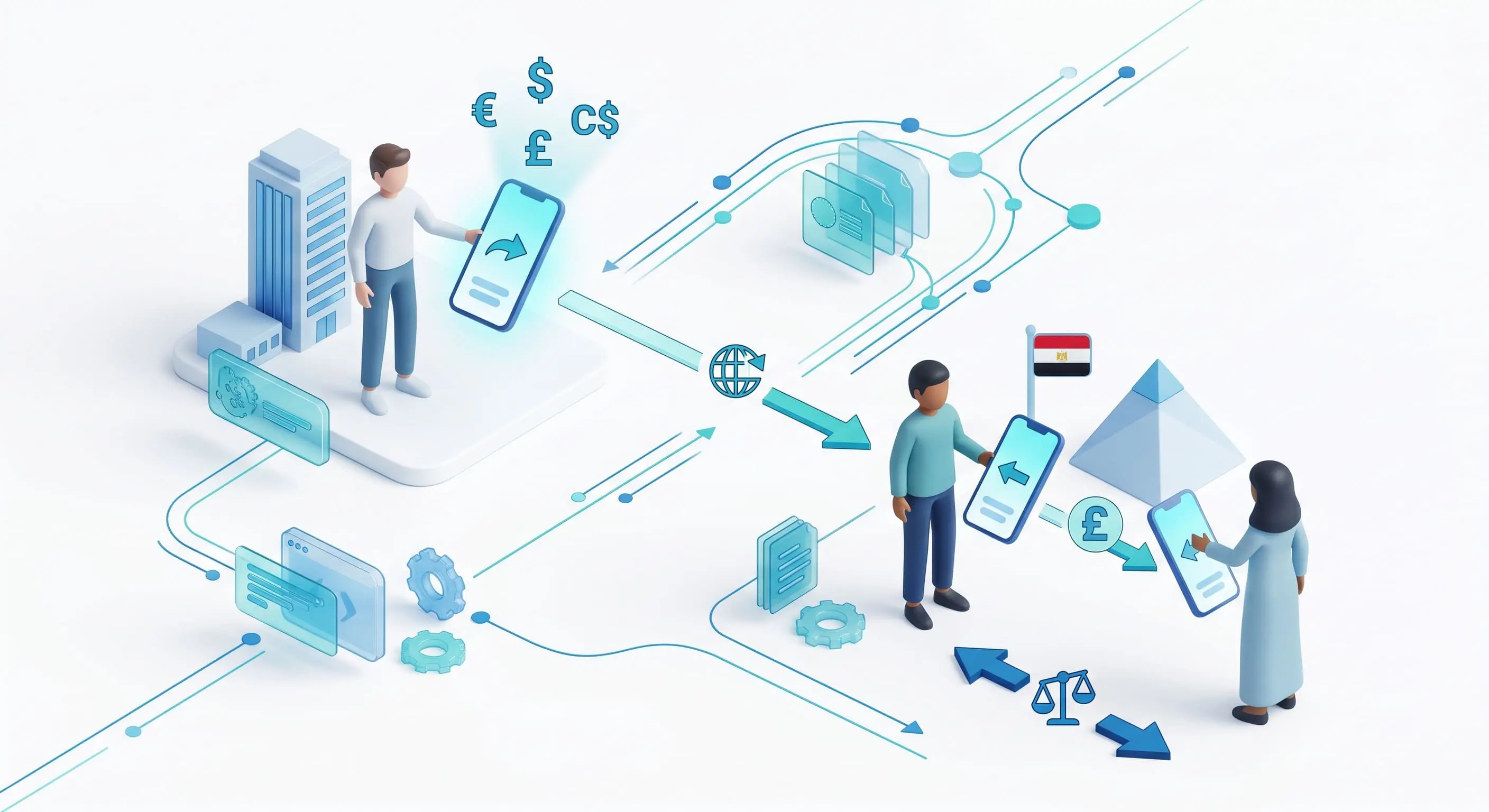
Because the exchange is based on the real market rate, which in Egypt now closely tracks the official interbank rate, senders know in advance exactly how many Egyptian pounds the family will receive. There is no conversion margin added on top, and no exposure to informal market rates. Delivery through InstaPay or a mobile wallet also means no trip to a branch and no waiting at a counter.
The cost structure is simple: the real market rate and a fixed fee displayed before confirmation. Timing depends mainly on how quickly a matching counterpart is found and on the speed of the local transfer. Since InstaPay operates in real time, the Egyptian leg can be very fast once the match is made, although timing may vary depending on the amount and the currency pair. For larger amounts, such as property purchases, specific precautions apply, as detailed in the guide on investing in Egyptian real estate with secure large transfers.
Every transaction must be evaluated by both users at the end of the exchange. This mandatory two-way rating creates a visible track record for each participant and encourages reliable behaviour across the community. The values of fairness and solidarity behind this approach are described in the CashSwap Club manifesto for fair, community-driven money transfers.
The more members the community has, the faster and smoother matching becomes for everyone. The platform therefore encourages users to invite friends and relatives from the diaspora, and the P2P money transfer referral program and its bonuses explains how this can also generate rewards.
KYC requires financial services to confirm the identity of their users, usually through an identity document and sometimes additional information. In a P2P model, this ensures that every counterpart is a real, identified person, which makes fraud considerably harder.
Financial platforms are also subject to anti-money laundering (AML) rules, which require monitoring of unusual activity and cooperation with authorities when necessary. In Egypt, the banking system, InstaPay and mobile wallets operate under the oversight of the Central Bank of Egypt, while senders' countries have their own regulators. These frameworks protect honest users by keeping the ecosystem sound.
Fund protection depends on the applicable regulatory framework and on how user funds are kept separate from company funds. The complete guide on financial regulators and user fund protection explains the role of supervisory authorities and the safeguards in place.
Egyptian banks such as NBE, Banque Misr and CIB remain reliable institutions, and tools like InstaPay and Vodafone Cash have made receiving money faster than ever. The weak link is often the international leg: conversion margins, correspondent bank deductions and processing delays that reduce what the family actually receives. Direct P2P clearing addresses these issues by keeping each leg of the exchange local, applying the real market rate and displaying a fixed fee upfront.
When comparing transfer fees and exchange rates, the most reliable approach is to look at the final amount received rather than the advertised fee. Before the next transfer, senders can try the live exchange rate simulator on CashSwap Club and see in seconds exactly how many Egyptian pounds will reach their loved ones, with no hidden margin and no counter queue.
The cheapest option is usually the one that applies the real market exchange rate with a transparent fixed fee. Comparing the total amount received in Egyptian pounds, rather than the advertised fee alone, is the most reliable way to identify the best money transfer app.
International bank transfers to NBE, Banque Misr or CIB can take several business days. With P2P matching, timing depends mainly on finding a counterpart, and the Egyptian leg can be very fast when delivered through InstaPay or a mobile wallet.
Yes. Recipients can receive Egyptian pounds directly into a bank account linked to InstaPay or into a mobile wallet such as Vodafone Cash, avoiding branch visits and counter queues.
P2P platforms operate within regulatory frameworks that include KYC verification and anti-money laundering obligations. On CashSwap Club, every user is verified and every transaction is evaluated by both parties, reinforcing trust and accountability.

Our peer-to-peer currency exchange and money transfer platform is currently under development. We are preparing a solution that will allow you to exchange currencies with a seamless and secure experience.
To be among the first to know and not miss anything about the launch, join the club by subscribing to our newsletter.
Visuals disclosure : In the interest of transparency, please note that the images illustrating this article were created using artificial intelligence (AI) generation tools.
© CashSwap Club 2026 - All rights reserved
Designed with ❤️ in Paris • Made in France 🇫🇷
 French