Remittances are one of the pillars of the Salvadoran economy. Every month, members of the diaspora in the United States, Canada, Europe and beyond send money home to cover rent, school fees, medical care and daily expenses. Behind each transfer lies a simple but critical expectation: the money must arrive in full, on time and without falling into the wrong hands. As digital channels replace cash counters and paper forms, the security of the network carrying each transaction has become just as important as its price.
Anyone looking to send money to El Salvador eventually asks two questions: how much will this transfer really cost, and how quickly will the family receive the money? A third question now deserves equal attention: how well is this transaction protected? This article explains how El Salvador's dollarized economy shapes the way remittances are received, why end-to-end encryption and secure networks matter, where traditional banks and agencies add hidden costs, and how a Peer-to-Peer (P2P) matching model offers a transparent, community-driven alternative.
El Salvador adopted the US dollar as its official currency in 2001. More than two decades later, the dollar is used for salaries, savings, prices, loans and everyday purchases. This has a direct consequence for remittances: for the family receiving funds, there is no local currency conversion to worry about. A dollar sent is, in principle, a dollar received.
For senders based in the United States, dollarization removes an entire layer of cost. No exchange rate is needed between the sending and receiving countries, which means no conversion margin should apply. Speed becomes the main variable: the faster the dollars reach the recipient's account or wallet, the sooner they can be used for urgent needs. For senders in Europe, the United Kingdom or Canada, the situation is different. Their euros, pounds or Canadian dollars must be converted into US dollars at some point, and the exchange rate applied at that moment determines how much the family actually receives.
Families in El Salvador typically receive money through several channels, each with its own advantages:
The country's experiment with Bitcoin as legal tender, introduced in 2021 and later revised so that its acceptance became voluntary, added another layer to this landscape. The guide on Bitcoin versus USD remittances to El Salvador examines how these options compare for families who simply need reliable dollars.
Every digital transfer involves sensitive information: names, phone numbers, bank account details, identity documents and transaction amounts. If this data is intercepted or stolen, the consequences range from fraud to identity theft. Choosing secure networks is therefore not a technical detail but a central part of financial protection.
Encryption transforms readable data into a coded format that only authorized parties can decode. Two levels are commonly discussed. Encryption in transit, typically through the HTTPS protocol (visible as a padlock in the browser address bar), protects data while it travels between a phone or computer and a service's servers. End-to-end encryption goes further: data is encrypted on the sender's device and can only be decrypted by the intended recipient, so intermediaries cannot read it along the way. In practice, financial services combine several layers of protection, and users should look for clear signals that their connection and their data are protected at every stage.
Before choosing the best money transfer app, a few checks reduce risk considerably: verify that the app or website uses an encrypted connection, enable two-factor authentication (a second verification step, such as a code or biometric check), avoid public Wi-Fi when making transfers, download apps only from official stores, and never share verification codes with anyone, even someone claiming to be from customer support. Recipients in El Salvador should apply the same rules to their banking and wallet apps.
Security is essential, but cost remains the deciding factor for most families. Traditional channels often look affordable at first glance, yet several cost layers are not always clearly displayed.
For members of the diaspora sending euros, pounds or Canadian dollars, the exchange rate is where most of the cost hides. Banks and many agencies apply their own rate, which includes a margin above the interbank rate (the rate at which banks trade currencies among themselves). The advertised transfer fees may seem small, while the real cost is buried in the conversion. In a period of rising prices, these losses compound, a dynamic explored in the analysis of how inflation erodes diaspora purchasing power.
International bank transfers usually travel through the SWIFT network, a global messaging system connecting banks. When the sending and receiving banks do not work directly together, one or more correspondent banks handle the payment and may each deduct a fee. The recipient at Banco Agrícola, Banco Cuscatlán or Banco Davivienda may then receive less than expected, with no clear explanation.
Traditional remittance agencies remain popular, but fees vary widely depending on the amount, the payment method and the delivery option. Cash pickup may require travel, waiting times and identity checks at the counter. A detailed comparison of digital apps versus traditional agencies for sending money to El Salvador highlights the trade-offs between convenience, cost and speed.
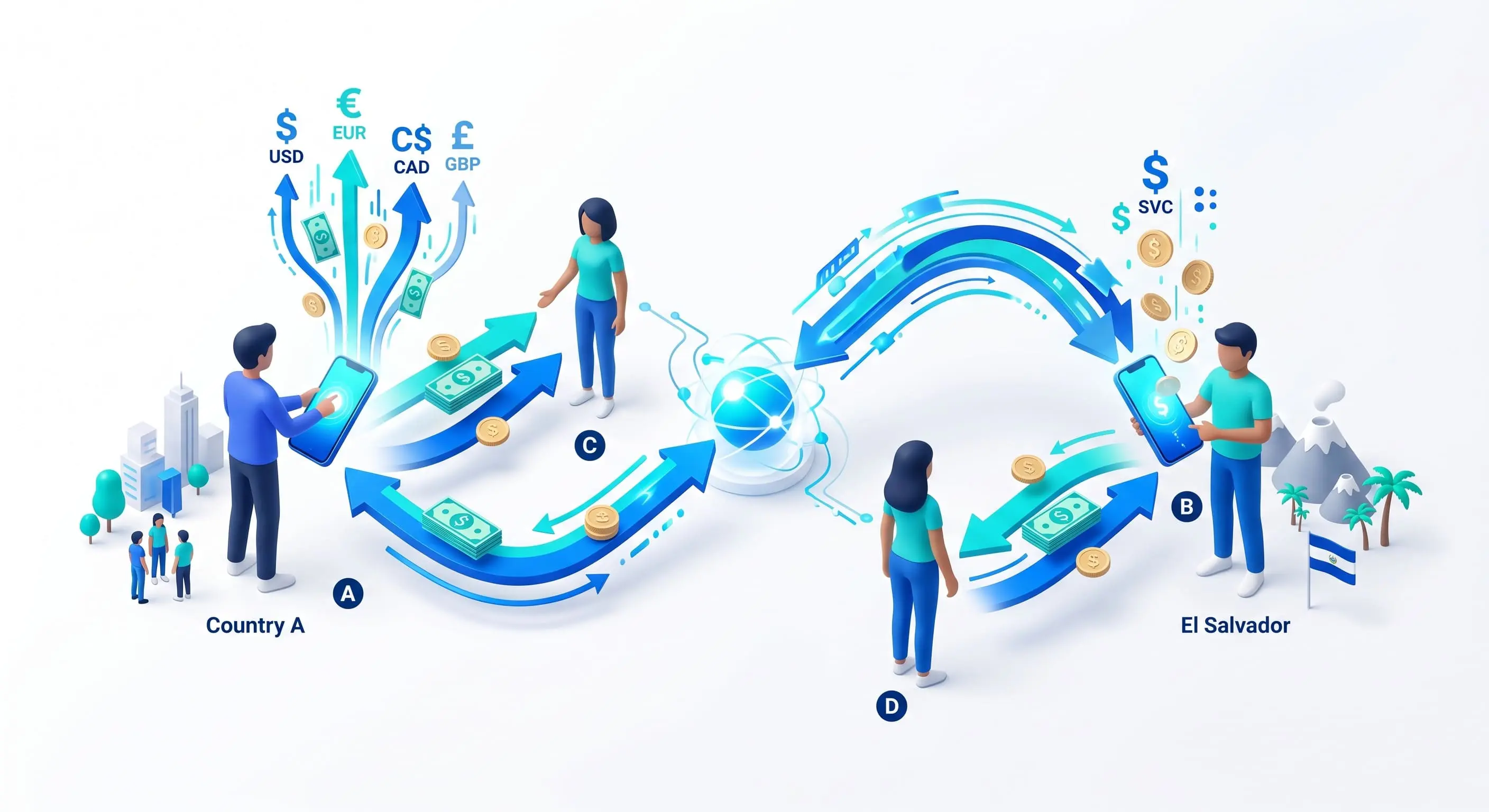
Peer-to-Peer matching starts from a simple observation: at any moment, some people need to move money from one country to another, while others need to move money in the opposite direction. Instead of sending funds across borders, a matching system connects these complementary needs so that each leg of the exchange is settled locally.
On CashSwap Club, money never travels internationally. The platform manages multi-currency wallets belonging to users, in EUR, USD, GBP and CAD. Transactions on the platform take place exclusively between wallets of the same currency. The corresponding local flow, in US dollars in the case of El Salvador, takes place off-platform through national bank transfers or local payment solutions.
Consider a sender in Spain who wants to support a relative in San Salvador, and a Salvadoran user who needs euros, perhaps to pay for studies in Europe. The platform matches them. The sender moves euros to the counterpart's EUR wallet on the platform, while the counterpart sends the equivalent amount in US dollars through a domestic transfer to the relative's account at a local bank or to a local wallet. Each leg is a domestic, single-currency operation. No correspondent banks are involved, and the exchange takes place at the real market rate with minimal, transparent fixed fees.
The cost structure is straightforward: the real market exchange rate and a fixed fee displayed before confirmation. For senders using USD, no conversion is needed at all, which fits perfectly with El Salvador's dollarized economy. As for timing, it depends mainly on how quickly a matching counterpart is found and on the speed of the domestic transfer in El Salvador. Since both legs are national operations, they generally avoid the multi-day delays associated with international wires, although timing can vary with the amount and local banking hours.
Every transaction must be evaluated by both users at the end of the exchange. This mandatory two-way rating builds a visible track record for each participant and encourages reliable behaviour across the community. The principles of fairness and solidarity behind this model are described in the CashSwap Club manifesto for transparent, community-driven transfers.
Because faster matching benefits everyone, the platform encourages users to invite friends and relatives from the diaspora. The P2P money transfer referral program and its bonuses explains how growing the community can also generate rewards.
KYC requires financial services to confirm the identity of their users, usually through an identity document and sometimes additional information. In a P2P model, this verification ensures that every counterpart is a real, identified person, which makes fraud far more difficult.
Financial platforms are also subject to anti-money laundering (AML) obligations, which require monitoring of unusual activity and cooperation with authorities when necessary. In El Salvador, the financial system is supervised by the Superintendencia del Sistema Financiero (SSF), while senders' countries have their own regulators. These frameworks protect honest users by keeping the ecosystem clean.
Fund protection depends on the applicable regulatory framework and on how user funds are separated from company funds. The complete guide on financial regulators and user fund protection explains the role of supervisory authorities and the safeguards in place.
El Salvador's dollarized economy offers the diaspora a rare advantage: no local currency conversion and the possibility of fast, predictable transfers. That advantage is only fully realized when the chosen channel avoids hidden margins, intermediary deductions and insecure networks. Encryption, two-factor authentication and verified counterparts protect the data; transparent pricing and the real market rate protect the value.
P2P matching brings these elements together. By keeping money within national borders, matching complementary needs and applying the interbank rate with minimal fixed fees, CashSwap Club helps families receive more of every dollar sent. Before the next transfer, the most reliable approach is to compare real figures: senders can check the live exchange rate simulator on CashSwap Club and see in seconds exactly how many dollars will reach their loved ones in El Salvador.
The safest options use encrypted connections, verified identities and traceable delivery, such as deposits into a USD bank account at banks like Banco Agrícola, Banco Cuscatlán or Banco Davivienda, or into a regulated digital wallet. Enabling two-factor authentication adds an important layer of protection.
International bank wires can take several business days. With P2P matching, timing mainly depends on finding a counterpart and on the speed of the domestic transfer in El Salvador, which generally avoids multi-day international delays.
El Salvador uses the US dollar, so senders using USD need no conversion. Senders using euros, pounds or Canadian dollars do face a conversion, which is why comparing the rate offered with the real market rate is essential.
P2P platforms operate within regulatory frameworks that include KYC verification and anti-money laundering obligations. On CashSwap Club, every user is verified and every transaction is evaluated by both parties, reinforcing trust and accountability.

Our peer-to-peer currency exchange and money transfer platform is currently under development. We are preparing a solution that will allow you to exchange currencies with a seamless and secure experience.
To be among the first to know and not miss anything about the launch, join the club by subscribing to our newsletter.
Visuals disclosure : In the interest of transparency, please note that the images illustrating this article were created using artificial intelligence (AI) generation tools.
© CashSwap Club 2026 - All rights reserved
Designed with ❤️ in Paris • Made in France 🇫🇷
 Spanish