- Oct 23, 2026
For millions of Filipino families, education is the most important investment of all. Across the world, overseas Filipino workers and members of the diaspora send money home every month, and a large share of it goes into one priority: keeping children, siblings, nieces and nephews in school. When enrolment opens and the tuition deadline approaches, the same questions always come up. How much will it cost to send money to the Philippines? Will the school receive the full amount? And how long will it take before the payment is confirmed?
Paying tuition fees from abroad is more demanding than sending everyday support. Schools set precise amounts and strict deadlines, a missing peso can delay enrolment, and payment instructions vary from one institution to another. This guide explains how money is received in the Philippines, how to pay tuition fees directly and securely, what the real transfer fees look like, and how a transparent Peer-to-Peer model helps families keep more of every peso for what really matters.
Table of Contents
- Why education remittances matter so much for Filipino families
- How money is received in the Philippines: e-wallets, cash pickup and banks
- Paying tuition fees directly to a school: what families need to know
- The hidden costs of traditional bank transfers
- How P2P matching works to deliver the real exchange rate
- Step-by-step guide to sending tuition with CashSwap Club
- Security, KYC and regulatory compliance
- Conclusion: every peso saved goes back into education
- Frequently Asked Questions
Why education remittances matter so much for Filipino families
The Philippines is one of the world's largest recipients of remittances, with personal transfers from abroad exceeding USD 35 billion per year according to the country's central bank, the Bangko Sentral ng Pilipinas (BSP). These flows represent close to a tenth of the national economy. Behind the statistics are very concrete realities: a nurse in London paying for her younger brother's engineering degree, a seafarer covering his daughter's private school fees in Cebu, a family in Toronto supporting a niece's nursing studies in Manila.
Education ranks consistently among the top uses of remittance money, alongside food, housing and healthcare. For many households, a degree is seen as the surest path out of financial insecurity, and sometimes as the first step toward working abroad in turn. That is why tuition payments carry such emotional and financial weight: they are not occasional gifts, but long-term commitments that stretch across years of study.
Day-to-day reality for the diaspora also involves other urgent needs. Instant transfers are essential for daily family support, such as groceries, utilities and transport, and for emergency medical coverage when a relative is hospitalised and a deposit is required before treatment. In these situations, every hour counts. A transfer method that is fast for emergencies and precise for tuition deadlines is therefore invaluable. A broader overview of the options is available in the ultimate P2P guide to sending money to the Philippines.
How money is received in the Philippines: e-wallets, cash pickup and banks
The Philippines has one of the most diverse receiving ecosystems in Asia. Choosing the right channel depends on the recipient's habits, location and the purpose of the payment.
Digital wallets: GCash and Maya
GCash is the country's leading e-wallet, used by tens of millions of Filipinos to pay bills, shop, transfer money and even invest. Its popularity rests on its simplicity: a mobile number is enough to receive funds, which can then be spent instantly, transferred to a bank or withdrawn. Maya (formerly PayMaya) is its main competitor, combining an e-wallet with a licensed digital bank. Both apps offer bills payment features that cover many schools, universities and utility providers, making them highly practical for tuition. Their main limitation lies in wallet and transaction ceilings, which depend on the account's verification level; fully verified accounts benefit from much higher limits.
Cash pickup networks: Palawan Pawnshop and Cebuana Lhuillier
Despite rapid digitalisation, cash remains essential, particularly in rural provinces and among older family members. Palawan Pawnshop (through its Palawan Express service) and Cebuana Lhuillier operate thousands of branches across the archipelago, often in places where no bank is present. The recipient simply presents a valid ID and a reference number to collect the funds. This option is convenient for those without a bank account, but it requires a trip to the branch and is less suited to direct tuition payments. A dedicated guide to cash pickup remittances in the Philippines details how these networks operate and what to check before sending.
The major banks: BDO Unibank, BPI and Metrobank
BDO Unibank, the country's largest bank by assets, Bank of the Philippine Islands (BPI), the oldest bank in Southeast Asia, and Metrobank together form the backbone of the Philippine banking system. Many private schools and universities hold their collection accounts with these institutions, and some accept tuition payments through dedicated bills payment facilities. Local transfers between banks and e-wallets run on two national systems: InstaPay, for real-time transfers typically up to PHP 50,000 per transaction, and PESONet, a batch system suited to larger amounts that usually settles within the same banking day.
Paying tuition fees directly to a school: what families need to know
Sending money to a relative who then pays the school is the most common approach, but it is not always the best one. Paying the institution directly offers several advantages: the amount reaches the school exactly as invoiced, a clear payment record exists, and there is no risk of the money being diverted to other urgent household needs.
Check the school's accepted payment methods
Each school publishes its own payment instructions. Common options include deposits into the school's bank account at BDO, BPI or Metrobank, payment through the bills payment menus of GCash or Maya, online payment portals, or settlement at the cashier's office. Before any transfer, the official instructions should be obtained directly from the school's registrar or accounting office, never from an unverified message or social media post, as fake payment requests are a known scam around enrolment periods.
Always include the student reference
Tuition payments must be linked to the right student. The student's full name, ID number and the academic term should accompany every payment. Keeping the proof of payment and sending a copy to the school's accounting office helps avoid delays in enrolment validation.
Plan around deadlines
Tuition is usually due at the start of each semester or term, with possible instalment plans. Sending funds a few days before the deadline leaves time to resolve any issue. For students studying abroad rather than in the Philippines, the challenges are different but just as real: the student guide to paying tuition abroad with P2P transfers covers that scenario in depth, while the article on how international students can avoid bank fees on transfers focuses on reducing everyday costs.
The hidden costs of traditional bank transfers
Traditional banks remain a trusted option, but their international transfers often come with costs that are not immediately visible.
- The sending fee: a fixed charge applied by the sender's bank, usually displayed upfront.
- The exchange rate margin: instead of the interbank exchange rate (the real rate at which banks trade currencies among themselves), the bank applies a less favourable rate and keeps the difference. This margin is rarely itemised, yet it often represents the largest part of the total cost.
- Intermediary bank fees: international transfers travel through the SWIFT network, the messaging system connecting banks worldwide, and may pass through one or more correspondent banks, each deducting a commission.
- Receiving charges: some Philippine banks deduct a fee on incoming international transfers before crediting the account.
For tuition, these deductions create a specific problem: if the school expects PHP 45,000 and only PHP 44,200 arrives, enrolment can be put on hold until the balance is paid. Delays are another concern, as SWIFT transfers typically take two to five business days. These issues do not stem from weak regulation: banks are among the most heavily supervised institutions in the world. The problem lies in pricing transparency. For a clear view of how regulators protect user funds, and where their oversight ends, the full guide to financial regulators and user fund protection offers useful context.
How P2P matching works to deliver the real exchange rate
CashSwap Club takes a different approach based on Peer-to-Peer (P2P) matching. Instead of pushing a single payment across borders through a chain of banks, the platform pairs users whose currency needs complement each other. Money never physically crosses borders.
The platform manages multi-currency wallets in EUR, USD, GBP and CAD that belong to users, and exchanges on the platform take place exclusively between wallets of the same currency. Local currency flows, meanwhile, travel outside the platform through domestic bank transfers or local payment solutions such as national instant transfer systems. Each side of the operation remains a domestic transfer, which is typically faster and cheaper than an international wire.
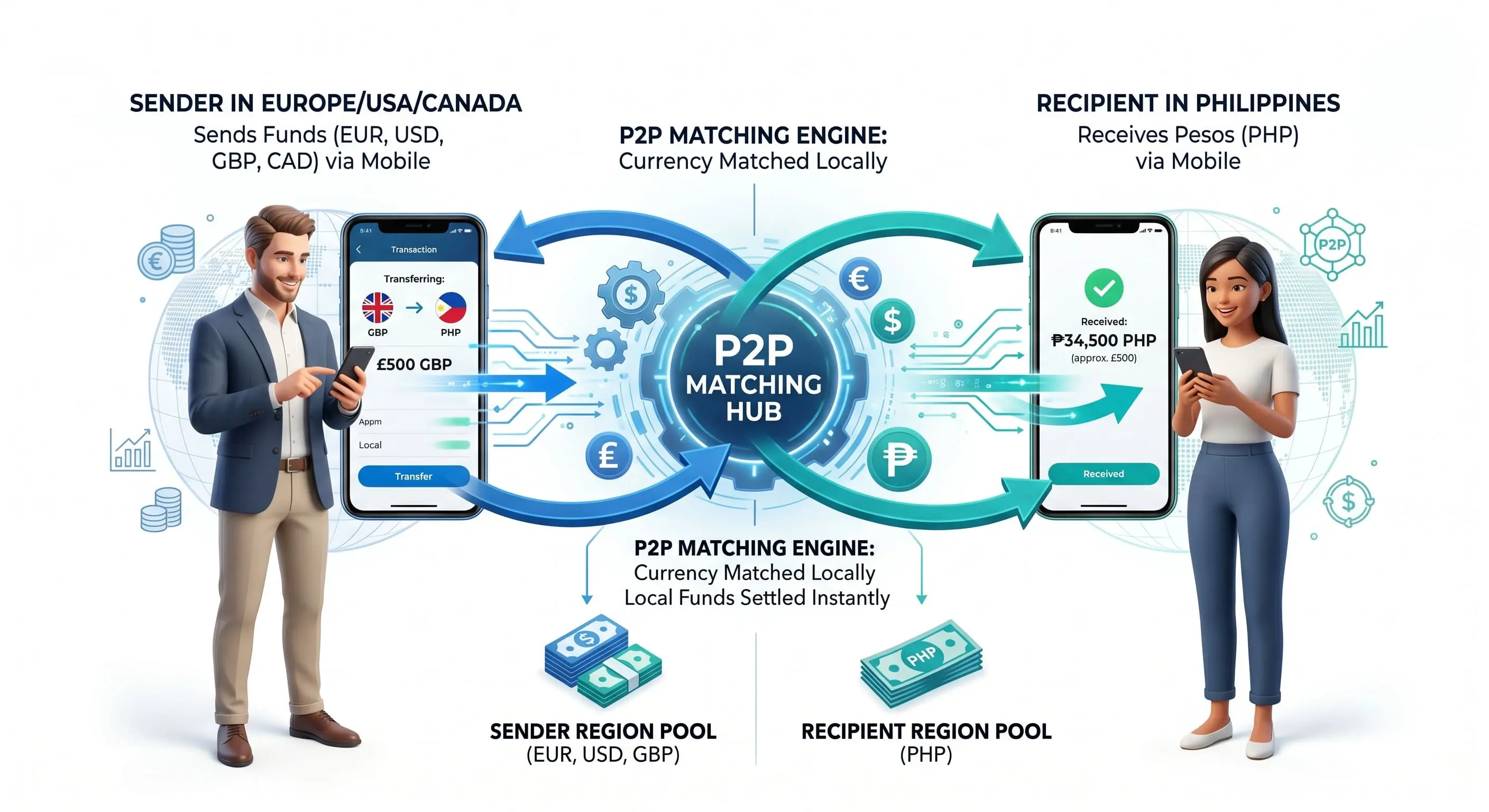
This model brings several concrete benefits for families paying tuition:
- No correspondent bank chain: without SWIFT, the stacked intermediary commissions disappear.
- The real market rate: because supply and demand meet directly, the platform can offer the interbank rate, with no hidden margin.
- Minimal, fixed fees shown in advance: the exact cost is known before validation, making it possible to plan tuition payments to the peso.
- Shorter timelines: domestic transfers are often near-instant, which matters both for enrolment deadlines and for medical emergencies.
- Mutual ratings: every exchange is rated by both parties, building a transparent track record within the community.
Step-by-step guide to sending tuition with CashSwap Club
The process has been designed to be straightforward, even for first-time users.
Step 1: create an account and verify identity
Registration begins with a KYC check (Know Your Customer), a standard identity verification required by anti-money laundering regulations. It usually involves an ID document and sometimes proof of address.
Step 2: check the rate and fees in the simulator
Before committing, the live simulator shows the rate applied, the fixed fee and the exact amount involved. There are no surprises after validation.
Step 3: confirm the payment destination
Decide where the funds should land: the school's official account or bills payment channel, a relative's GCash or Maya wallet, or a bank account at BDO, BPI or Metrobank. For tuition, the school's official instructions and the student reference should be ready.
Step 4: complete the local transfer and get matched
The sender funds the operation with a domestic transfer in their own currency. The platform matches the request with a complementary counterparty, and funds move locally on each side.
Step 5: confirm receipt and rate the exchange
Once the funds have arrived, both parties rate the transaction. For tuition, forwarding the proof of payment to the school completes the process.
The strength of a P2P marketplace grows with its community: the more members, the faster and smoother the matching. The money transfer referral programme that rewards members with P2P bonuses makes it easy to invite relatives and friends abroad who also support family back home, while earning rewards along the way.
Security, KYC and regulatory compliance
When searching for the best money transfer app to the Philippines, price matters, but security matters just as much. A cheap transfer that fails on the day of an enrolment deadline or a hospital admission is the most costly option of all.
Systematic identity verification ensures that every counterparty is a real, identified person. Transaction monitoring, aligned with international anti-money laundering standards set by the FATF (Financial Action Task Force), helps detect unusual activity. On the Philippine side, the BSP supervises banks, e-money issuers such as GCash and Maya, and remittance and pawnshop operators, which must all comply with strict identity and reporting rules. The mandatory mutual rating system on the platform adds a layer of community oversight.
A few good habits further reduce risk: verify any provider's regulatory status in the official registers of its home country, use only recipient accounts that are fully verified, obtain school payment details from official sources only, and keep every receipt. The values of fairness, transparency and community solidarity that guide the platform are set out in the CashSwap Club manifesto, which explains the vision for fairer money transfers.
Conclusion: every peso saved goes back into education
Supporting a loved one's education from abroad is one of the most meaningful commitments a family member can make. It deserves a transfer method that is fast, precise and transparent. The Philippines offers an excellent receiving ecosystem, from GCash and Maya to cash pickup networks and major banks such as BDO, BPI and Metrobank. What often makes the difference is the sending side: hidden exchange rate margins and intermediary fees quietly reduce the amount that reaches the school.
P2P matching offers a clear alternative: domestic flows on each side, the real market rate and fixed fees known in advance, within a community where every exchange is rated. To find out exactly how many pesos the next tuition payment will deliver, the most direct step is to try the live exchange rate simulator on CashSwap Club and compare the result with a bank quote. Over a full degree, the savings can add up to an extra semester of books, transport or living costs.
Frequently asked questions
Can tuition fees be paid directly to a school in the Philippines from abroad?
Yes. Many schools accept payments into their official bank accounts at banks such as BDO, BPI or Metrobank, or through bills payment features in GCash and Maya. Payment details should always be obtained directly from the school, and the student's name and ID number should accompany each payment.
How long does it take to send money to the Philippines?
A traditional SWIFT bank transfer typically takes two to five business days. Domestic transfers through InstaPay are near-instant, while PESONet usually settles within the same banking day, which is why solutions relying on local transfers are generally much faster.
What is the cheapest way to send tuition money to the Philippines?
The cheapest option is usually the one that applies the real interbank exchange rate with a fixed, visible fee and no intermediary deductions. Comparing the final amount received in pesos, not just the advertised fee, gives the most accurate picture.
Is it safe to send money to GCash or Maya from abroad?
Yes, provided the recipient's account is fully verified and the transfer goes through a regulated provider. GCash and Maya are supervised by the Bangko Sentral ng Pilipinas, and verified accounts benefit from higher limits and stronger protection.

Peer-to-peer currency exchange, finally simple and fair.
Our peer-to-peer currency exchange and money transfer platform is currently under development. We are preparing a solution that will allow you to exchange currencies with a seamless and secure experience.
To be among the first to know and not miss anything about the launch, join the club by subscribing to our newsletter.
Visuals disclosure : In the interest of transparency, please note that the images illustrating this article were created using artificial intelligence (AI) generation tools.