
- Jun 5, 2026
For millions of expatriates and overseas workers around the globe, remitting funds back home is much more than a simple financial transaction. It is a vital lifeline. When individuals seek to send money to the Philippines, they are actively participating in the economic resilience of their home country, providing essential capital for daily family support, securing educational futures through the payment of tuition fees, and ensuring immediate readiness for emergency medical coverage. However, the global financial system has long penalized these critical cross-border flows with opaque structures, delayed processing times, and exorbitant costs.
Historically, the diaspora has been forced to rely on legacy financial institutions and traditional remittance corridors, which are often burdened by intermediary banks and hidden margins. The modern era of financial technology, however, demands a more equitable solution. This comprehensive guide explores the paradigm shift brought about by Peer-to-Peer (P2P) matching technologies. By completely eliminating the need for international wire transfers and matching local currency flows directly, modern platforms are returning value to the users. This article delves deep into the mechanics of borderless digital finance, analyzing how the disintermediation of traditional banking structures provides the most cost-effective, secure, and transparent method for international capital allocation.
Table of Contents
- The Hidden Cost of Traditional Remittances
- How P2P Matching Revolutionizes Money Transfers
- Delivering Funds in the Philippines: The Local Ecosystem
- Step-by-Step Guide to Using CashSwap Club
- Security, Compliance, and Trust in P2P Systems
- Conclusion and Next Steps
The Hidden Cost of Traditional Remittances
To fully appreciate the innovation behind modern financial platforms, one must first understand the structural inefficiencies of traditional international banking. When a standard cross-border transfer is initiated via a conventional bank, the funds do not travel directly from the sender's account to the recipient's account. Instead, the transaction relies on an antiquated network of correspondent banks, often referred to as the SWIFT network. Each bank in this chain acts as a tollbooth, deducting processing charges, administrative costs, and communication fees.
Beyond these explicit operational charges, the most significant financial drain comes from the manipulation of the exchange rate. Traditional remittance operators and large financial institutions rarely offer the mid-market rate—the true, objective rate at which banks trade currencies with one another. Instead, they apply a substantial markup, creating a hidden margin that silently erodes the value of the remitted capital. For an overseas worker sending a significant portion of their monthly salary to support a family in Manila or Cebu, a markup of three to five percent translates into a massive loss of purchasing power over a year.
Furthermore, the reliance on intermediary banks introduces severe delays. A standard international wire transfer can take anywhere from three to five business days to clear, depending on the time zones, public holidays, and the specific banking corridors involved. When families require immediate capital for urgent medical procedures or strict academic enrollment deadlines, these delays are not merely inconvenient; they are highly detrimental. The demand for transparency and speed has naturally led users toward exploring alternative models like peer-to-peer networks, which actively bypass these legacy bottlenecks.
How P2P Matching Revolutionizes Money Transfers
The core philosophy of CashSwap Club rests on a disruptive yet elegantly simple concept: the most efficient way to move money across borders is to not move it across borders at all. Rather than navigating the complex and costly web of international correspondent banking, the platform utilizes a sophisticated Peer-to-Peer (P2P) matching engine. This model fundamentally redefines the architecture of global remittances.
In practice, CashSwap Club functions as a multi-currency marketplace. Users hold secure wallets on the platform, denominated in major global currencies such as EUR, USD, GBP, and CAD. When a user in Europe wishes to send funds to Asia, the platform's algorithm scans the marketplace to find an opposing user with an inverse currency requirement. The matching engine locks the exchange at the true interbank market rate, ensuring absolute fairness. The actual exchange of platform-held currencies occurs instantly between the users' respective platform wallets. Because the transaction happens internally within the platform's ecosystem, the funds never cross physical borders, thereby completely bypassing international SWIFT fees and intermediary banking delays.
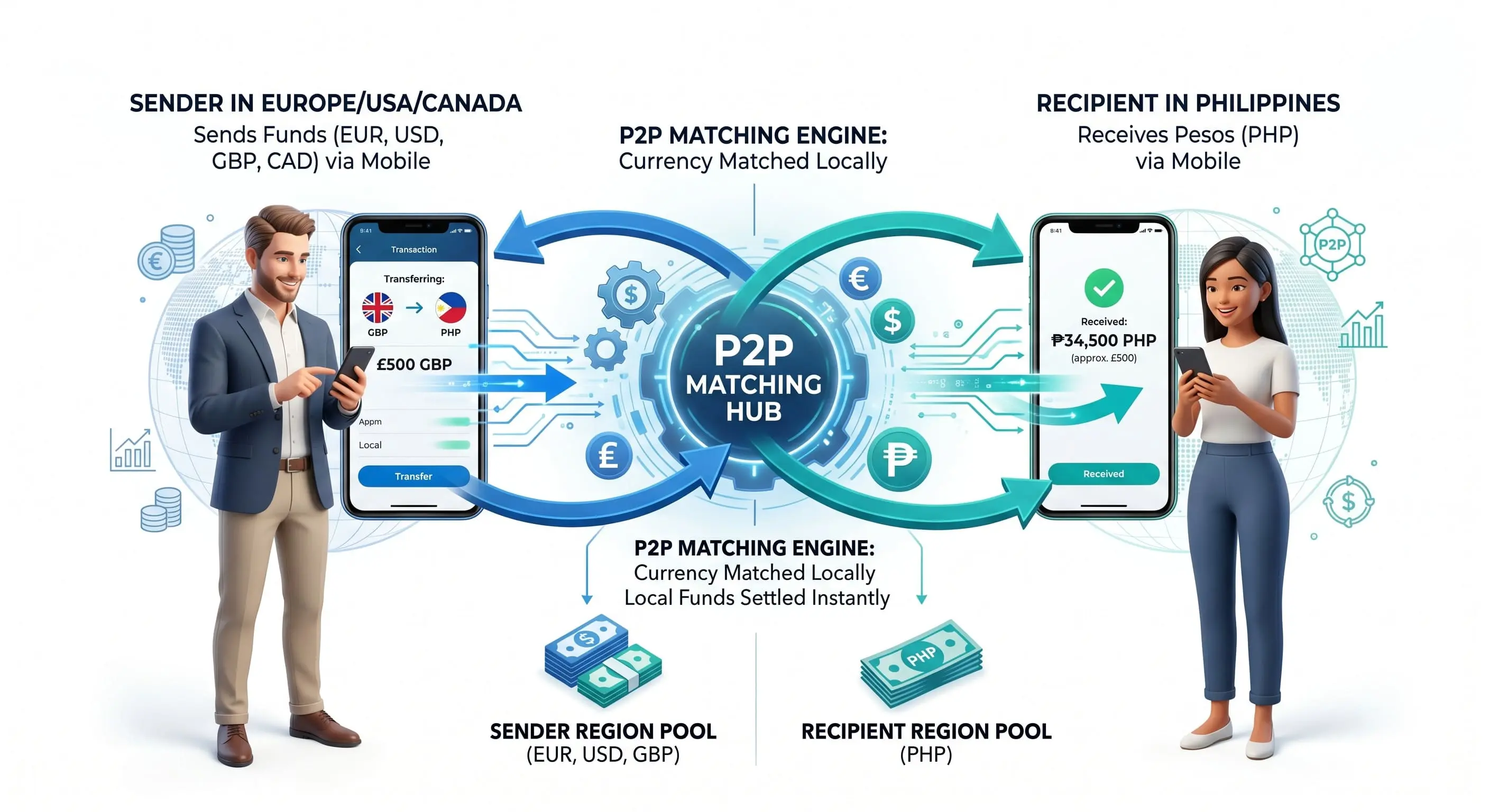
The settlement of the local currency (in this case, the Philippine Peso) is executed entirely off-platform via domestic banking channels or localized digital payment solutions. By restricting international movement and focusing strictly on localized domestic distribution, CashSwap Club maintains an exceptionally lean operational model. This efficiency allows the platform to charge only minimal, highly transparent fixed transfer fees, completely devoid of hidden currency spreads. For individuals looking to understand the core ethos of this equitable financial model, it is highly recommended to discover the principles driving transparent financial inclusion through borderless matching.
Delivering Funds in the Philippines: The Local Ecosystem
The success of any international remittance platform depends entirely on its integration with the recipient country's domestic financial infrastructure. The Philippines presents a unique and dynamic economic landscape, characterized by a rapidly growing digital economy juxtaposed with regions that still heavily rely on physical cash. To be considered the best transfer app, a platform must cater to all facets of this diverse domestic ecosystem, providing seamless localized off-ramps for the matched funds.
For the highly banked population, particularly those residing in major metropolitan hubs like Metro Manila, direct integration with the nation's premier financial institutions is paramount. The platform facilitates direct domestic transfers to leading local banks, including BDO Unibank, the Bank of the Philippine Islands (BPI), and Metrobank. Because these transfers originate from a local domestic source (following the P2P matching process), they are processed through national clearing systems like InstaPay or PESONet, resulting in rapid, often instantaneous, credit to the beneficiary's account.
However, true financial inclusion in the Philippines is heavily driven by the explosive adoption of mobile wallets. Applications like GCash and Maya (formerly PayMaya) have revolutionized daily commerce, allowing users to pay utility bills, purchase groceries, and manage digital savings without requiring a traditional bank account. Connecting international remittance flows directly to these e-wallets is critical for supporting the daily financial realities of millions of families. The instantaneous nature of these e-wallet credits is particularly crucial when addressing urgent financial needs, such as emergency medical coverage or securing enrollment by paying tuition fees on tight deadlines.
Furthermore, one must consider the reality of the rural diaspora. In provinces and remote islands where traditional banking infrastructure is sparse and digital connectivity can be inconsistent, physical cash remains king. For these demographics, the integration of extensive cash pickup networks is non-negotiable. Partnerships or local routing capabilities through ubiquitous pawnshops and remittance centers, notably Palawan Pawnshop and Cebuana Lhuillier, ensure that even the most geographically isolated communities can receive vital family support safely and promptly.
Step-by-Step Guide to Using CashSwap Club
Transitioning from traditional banking to a P2P matching marketplace is designed to be a highly intuitive and frictionless experience. The interface prioritizes user control, real-time transparency, and strict adherence to security protocols. Here is a comprehensive breakdown of the operational flow utilized to execute a successful transaction on the platform.
Step 1: Account Verification and KYC Initialization
Before participating in the marketplace, every user must undergo a stringent verification process. This involves submitting official government identification and confirming residency details. This step ensures a secure ecosystem devoid of fraudulent actors and guarantees full compliance with global financial regulations.
Step 2: Funding the Multi-Currency Wallet
Once verified, the user credits their CashSwap Club digital wallet using their primary currency (e.g., EUR, USD, GBP, CAD). This top-up is usually performed via a standard domestic bank transfer in the user's host country, ensuring that the initial capital deposit incurs zero international routing fees.
Step 3: Market Creation and Algorithmic Matching
The user then defines the parameters of their exchange, specifying the exact amount they wish to convert to Philippine Pesos. The platform instantly displays the current, un-marked-up interbank exchange rate and explicitly states the minimal fixed platform fee. The transaction order is then placed into the secure matching engine, which pairs it with corresponding liquidity demands within the P2P community.
Step 4: Domestic Settlement and Mandatory Rating
Upon successful matching, the platform executes the currency swap between the users' internal wallets. Subsequently, the equivalent funds are released domestically in the Philippines to the recipient's chosen destination—be it a GCash account, a BDO Unibank account, or a Palawan Pawnshop branch. To finalize the process and maintain the integrity of the community, both parties are required to submit a mutual evaluation rating. This mandatory feedback loop guarantees absolute behavioral transparency and builds intrinsic trust within the user base.
By streamlining these operations, the system democratizes access to premium financial routing. Users seeking to maximize the impact of their hard-earned capital can seamlessly start optimizing international transactions today by exploring the live platform capabilities.
Security, Compliance, and Trust in P2P Systems
When dealing with international capital flows, security and regulatory compliance must be the foundational pillars of the operation. The transition to a disintermediated financial model does not equate to a reduction in oversight; in fact, modern P2P marketplaces often employ technological safeguards that surpass traditional banking protocols.
The implementation of rigorous Know Your Customer (KYC) and Anti-Money Laundering (AML) directives is absolute. Every individual operating within the CashSwap Club environment is fully authenticated. The platform employs advanced cryptographic standards to secure wallet data and utilizes real-time monitoring algorithms to detect and prevent anomalous transaction behaviors. This ensures that the platform remains a safe harbor exclusively for legitimate personal and business remittances.
However, technological security is only one half of the equation; psychological trust is equally vital in a peer-to-peer environment. This is precisely why the mandatory mutual evaluation system is integrated into the core user journey. By compelling users to rate their transactional counterparts, the platform fosters a self-regulating community. High-rated users benefit from faster matching times and enhanced platform standing, while bad actors are systematically filtered out. For users looking to deepen their understanding of digital defense mechanisms, adopting best practices for secure digital payments is highly advised to ensure end-to-end protection.
Conclusion and Next Steps
The methodology of global remittances is undergoing a profound and necessary evolution. The antiquated systems reliant on multiple intermediary banks, hidden margin spreads, and sluggish processing times are no longer adequate for a hyper-connected global diaspora. The financial sacrifices made by overseas workers deserve to be protected and maximized.
Through intelligent Peer-to-Peer matching, robust local integrations with essential services like GCash, Maya, and major Philippine banks, and a steadfast commitment to the true interbank exchange rate, CashSwap Club presents a definitive solution. By keeping currency within its respective borders and simply matching the ownership of multi-currency digital wallets, the platform strips away the unnecessary friction of international finance. The result is a highly efficient, secure, and community-driven ecosystem that ensures every possible cent reaches its intended destination.
Do not let hidden margins erode the value of essential financial support. Experience the transparency of borderless matching by utilizing the live rate simulator directly on the platform and witness the tangible difference in cost efficiency.
Frequently asked questions
How long does it take for funds to reach the recipient in the Philippines?
Because the international border is bypassed and funds are matched via domestic reserves, delivery is remarkably fast. Once the P2P match is secured on the platform, local disbursements to major Philippine banks (like BDO or BPI) via InstaPay, or directly to e-wallets like GCash and Maya, are typically completed within minutes to a few hours.
Are there any hidden margins in the exchange rate?
No. CashSwap Club strictly adheres to the real interbank mid-market exchange rate. Unlike traditional remittance services that profit by marking up the conversion rate, the platform ensures total transparency. Users only pay a clearly stated, minimal fixed platform fee for utilizing the matching marketplace
Is it safe to use a Peer-to-Peer marketplace for large transfers?
Yes. The platform operates under strict regulatory frameworks, enforcing mandatory KYC (Know Your Customer) and AML (Anti-Money Laundering) verifications for all users before any transaction can occur. Furthermore, the mandatory mutual rating system at the end of each exchange ensures accountability and builds a secure, highly vetted user community.
Can recipients collect physical cash if they do not have a bank account or e-wallet?
Absolutely. Recognizing the vital importance of financial accessibility in rural and provincial areas, the local settlement process supports routing to widespread cash pickup networks. Beneficiaries can easily retrieve physical cash at established local hubs such as Palawan Pawnshop or Cebuana Lhuillier.

Peer-to-peer currency exchange, finally simple and fair.
Our peer-to-peer currency exchange and money transfer platform is currently under development. We are preparing a solution that will allow you to exchange currencies with a seamless and secure experience.
To be among the first to know and not miss anything about the launch, join the club by subscribing to our newsletter.
Visuals disclosure : In the interest of transparency, please note that the images illustrating this article were created using artificial intelligence (AI) generation tools.