- Aug 14, 2026
The global Overseas Filipino Worker (OFW) diaspora represents one of the most dedicated communities supporting loved ones back home through regular money transfers. Every month, millions of workers across Europe, North America, the Middle East, and Asia send capital to the Philippines to cover essential household expenses, urgent medical bills, and university tuition fees. However, traditional remittance corridors are frequently bogged down by high transfer fees, opaque exchange rate markups, and delayed processing times. For families in the Philippines, immediate access to cash is not merely a convenience—it is a daily necessity. This comprehensive guide explores modern money transfer mechanisms, comparing legacy bank networks with peer-to-peer (P2P) matching systems, while detailing local cash pickup solutions across extensive pawnshop networks like Palawan Pawnshop and Cebuana Lhuillier, alongside digital wallets such as GCash and Maya.
Table of Contents
- 1. The Inefficiencies of Traditional Bank Remittances and Hidden FX Costs
- 2. The Peer-to-Peer (P2P) Matching Architecture: A Fair Remittance Solution
- 3. Local Reception Corridors in the Philippines: GCash, Maya, Cebuana, Palawan, and Major Banks
- 4. Step-by-Step Guide to Sending Money to the Philippines via P2P Matching
- 5. Regulatory Compliance, Financial Security, and KYC Protocols
- 6. Conclusion and Strategic Optimization for OFW Remittances
1. The Inefficiencies of Traditional Bank Remittances and Hidden FX Costs
For decades, sending remittances to the Philippines through traditional commercial banks required routing transactions across the international SWIFT network. Under this legacy setup, a transfer initiated in euros (EUR), US dollars (USD), British pounds (GBP), or Canadian dollars (CAD) passes through multiple intermediary correspondent banks before reaching the Philippines. Each institution along the chain deducts processing fees and handling surcharges, which reduces the final amount delivered to the recipient. This lack of transparency creates constant uncertainty regarding the exact payout amount.
The most substantial hidden expense in conventional remittances stems from foreign exchange rate markups. Financial institutions rarely offer retail customers the real mid-market interbank exchange rate. Instead, banks apply a spread—a hidden margin added onto the rate—effectively charging an invisible fee on every converted peso. When families rely on these funds for recurring living expenses or school tuition fees, these exchange rate markups represent a significant loss of value over time. To better understand how traditional intermediaries charge hidden fees and how to avoid them, consult this analysis on marketplace solutions versus banks in the battle of hidden transfer fees.
Transfer speed is another critical pain point in traditional cross-border wire transfers. Bank transfers can take anywhere from two to five business days to clear, especially if initiated over a weekend or during public holidays. When family members in the Philippines face urgent healthcare needs or strict tuition fee deadlines, waiting several days for bank clearing is unacceptable. Consequently, senders require transparent, predictable, and rapid solutions that deliver funds without unexpected deductions.
2. The Peer-to-Peer (P2P) Matching Architecture: A Fair Remittance Solution
To eliminate the high fees and processing delays associated with traditional bank wires, modern financial platforms utilize a Peer-to-Peer (P2P) currency matching model. Operating as a decentralized marketplace, CashSwap Club relies on a simple yet powerful principle: money never physically crosses international borders. Instead of conducting costly transborder wire transfers, the platform uses an algorithmic matching engine to pair complementary foreign exchange orders between users.
The platform manages multi-currency digital wallets holding major global currencies, including EUR, USD, GBP, and CAD. Internal platform exchanges occur exclusively between wallets denominated in the same currency. When a user in Europe or North America wants to transfer funds converted into Philippine Pesos (PHP), the matching engine pairs the request with another user holding PHP locally who needs the foreign currency. Local currency payouts are then settled off-platform using fast domestic clearing networks or local payout partners.
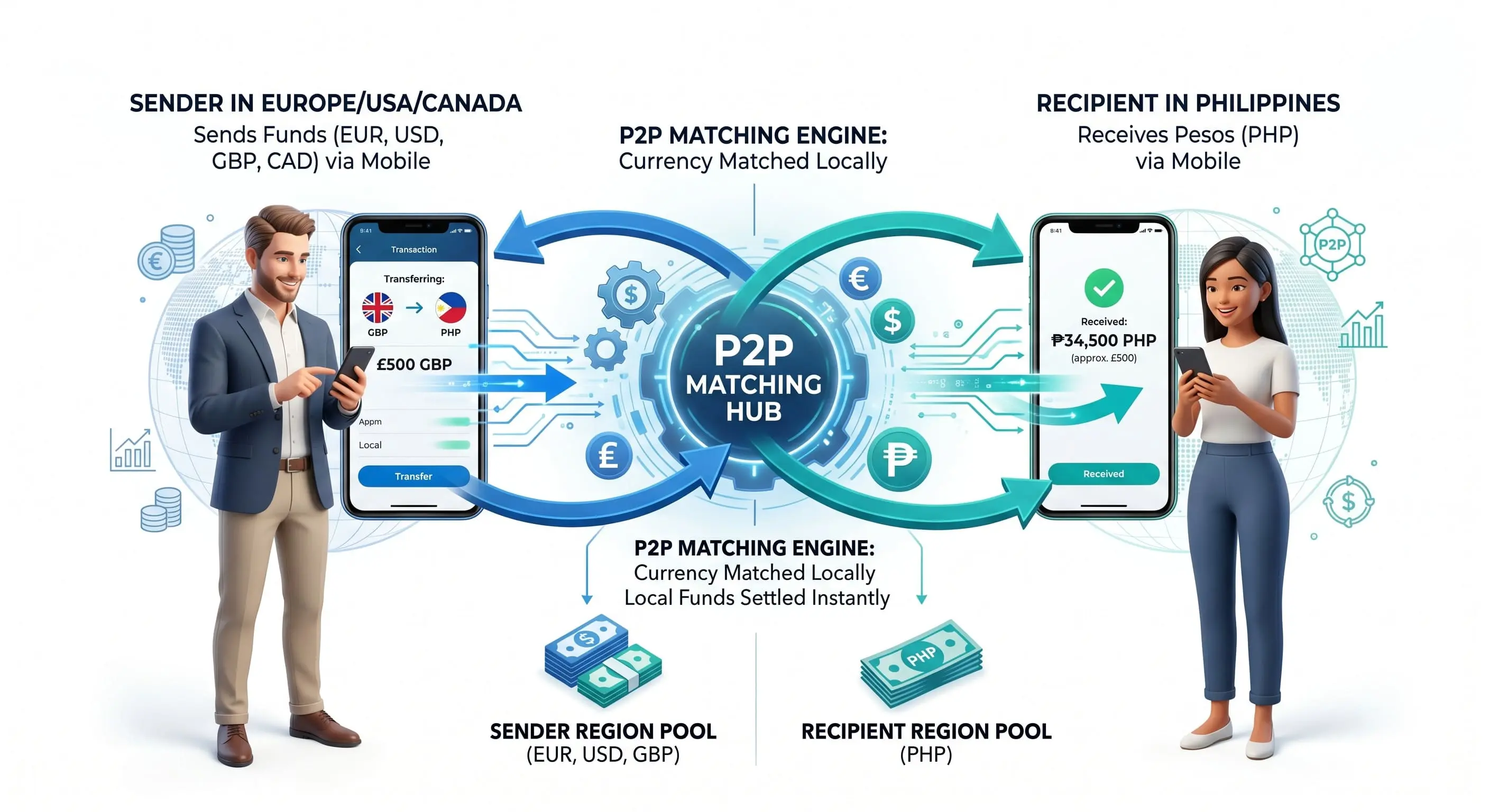
By bypassing correspondent banks and international wire clearinghouses, operational costs drop significantly. For a detailed breakdown of how network infrastructure impacts transfer efficiency, explore this comparative analysis on network architectures comparing SWIFT, SEPA, and P2P matching. This architecture enables users to exchange currencies at the real mid-market interbank exchange rate with only minimal, transparent fixed fees. Those interested in supporting an equitable financial model can review the manifesto for fair global money transfers.
3. Local Reception Corridors in the Philippines: GCash, Maya, Cebuana, Palawan, and Major Banks
A key requirement for money transfers to the Philippines is offering versatile payout methods that match the daily lives of recipients. The Philippines boasts a diverse financial ecosystem where digital mobile wallets, traditional commercial banks, and vast neighborhood cash pickup networks coexist.
Depending on the recipient's preference and location, several primary payout options are available across the archipelago:
- Over-the-Counter Cash Pickup (Palawan Pawnshop & Cebuana Lhuillier): For family members who prefer physical cash or do not maintain a traditional bank account, physical branch networks are essential. Palawan Pawnshop (Palawan Express Pera Padala) and Cebuana Lhuillier operate thousands of branches across major cities and remote provinces, allowing recipients to collect cash immediately using a reference number and valid government ID.
- Leading Digital Mobile Wallets (GCash & Maya): Mobile wallets have transformed financial inclusion in the Philippines. Platforms like GCash and Maya (formerly PayMaya) allow recipients to instantly receive remittances directly on their smartphones, enabling instant bill payments, online purchases, or bank transfers.
- Major Commercial Bank Accounts: Direct bank deposits remain ideal for larger remittances. Local clearing networks allow funds to be deposited directly into accounts at leading financial institutions such as BDO Unibank, Bank of the Philippine Islands (BPI), and Metrobank.
Whether sending money for daily family maintenance, emergency hospital bills, or quarterly school tuition fees, matching the payout method to the recipient's immediate needs ensures maximum convenience. To compare the cost savings of digital marketplaces against physical neighborhood transfer branches, read this guide on marketplace vs local branch transfer savings.
4. Step-by-Step Guide to Sending Money to the Philippines via P2P Matching
Sending money to the Philippines using a peer-to-peer marketplace is a simple, transparent process designed to offer maximum value and speed:
- Account Registration & Verification: Sign up on the platform and complete user profile verification to meet international financial compliance standards.
- Select Currency Pair & Amount: Choose the source wallet currency (EUR, USD, GBP, or CAD) and enter the transfer amount destined for Philippine Pesos (PHP). The platform displays the live mid-market exchange rate alongside a transparent fixed fee.
- Algorithmic Order Matching: The P2P matching engine pairs the transfer request with complementary demand within the platform's multi-currency wallet ecosystem.
- Select Recipient Payout Option: Enter the beneficiary's details in the Philippines. Select direct bank deposit (BDO, BPI, Metrobank), mobile wallet credit (GCash, Maya), or over-the-counter cash pickup at Cebuana Lhuillier or Palawan Pawnshop branches.
- Execution & Mutual Rating: Once local settlement is completed, both participating users complete a mandatory rating of the exchange experience. To learn how user ratings maintain platform integrity, read this article on trust rating systems on P2P platforms.
This streamlined process resolves the sender's primary concerns: costs are fully transparent, and funds reach the recipient in minutes or within hours. To explore strategies for getting the best rate, consult the ultimate P2P transfer guide for sending money to the Philippines.
5. Regulatory Compliance, Financial Security, and KYC Protocols
Financial security is the foundation of trustworthy peer-to-peer money transfers. Reputable P2P platforms operate under strict regulatory compliance frameworks, incorporating automated Know Your Customer (KYC) and Anti-Money Laundering (AML) controls.
The KYC verification process requires users to submit valid government-issued identification and proof of address before conducting transactions. These security steps prevent fraud, identity theft, and unauthorized access, ensuring that all participants within the P2P matching ecosystem are fully verified. Furthermore, because local currency payouts execute through established banking channels, licensed digital wallets, or official pawnshop networks, funds are protected throughout the entire process.
In addition to strict KYC protocols, the mandatory mutual rating system after every transaction fosters a self-regulating community built on accountability. Combined with bank-grade encryption and secure authentication layers, modern mobile transfer applications offer robust protection for global money transfers. For an overview of how mobile apps are innovating in this space, check out this article on how mobile money transfer apps disrupt fintech.
6. Conclusion and Strategic Optimization for OFW Remittances
Optimizing money transfers to the Philippines allows Overseas Filipino Workers to maximize the hard-earned money they send back to their families. By replacing traditional bank wire transfers with peer-to-peer liquidity matching, senders eliminate hidden exchange rate markups and avoid high processing fees.
Combining real mid-market exchange rates with flexible payout channels—including cash pickup at Palawan Pawnshop and Cebuana Lhuillier, mobile wallet credits to GCash and Maya, or direct deposits to BDO, BPI, and Metrobank—ensures speed, transparency, and convenience. To simulate live exchange rates and experience transparent money transfers, visit the CashSwap Club currency marketplace today.
Frequently asked questions
How long does it take for a recipient in the Philippines to receive cash pickup or digital wallet funds?
Once matched on the platform, local clearing is initiated immediately. Direct deposits to mobile wallets like GCash and Maya, or cash pickup availability at Palawan Pawnshop and Cebuana Lhuillier, typically complete within minutes to a few hours.
Are there hidden exchange rate markups when sending money to the Philippines?
No. P2P matching platforms convert funds using the real mid-market interbank exchange rate without adding hidden margins. Senders pay only a fixed, transparent transfer fee disclosed prior to confirming the transaction.
Is a bank account required for the recipient to receive money in the Philippines?
No. While direct bank deposits to major institutions like BDO, BPI, and Metrobank are fully supported, recipients without a bank account can pick up physical cash at thousands of Palawan Pawnshop or Cebuana Lhuillier branches, or receive funds directly in their GCash or Maya mobile wallets.
Is it safe to send remittances through a P2P currency matching platform?
Yes. P2P platforms adhere to international financial security standards, including identity verification (KYC) and Anti-Money Laundering (AML) regulations. Additionally, mandatory mutual ratings after every exchange ensure transparency and trust across the user community.

Peer-to-peer currency exchange, finally simple and fair.
Our peer-to-peer currency exchange and money transfer platform is currently under development. We are preparing a solution that will allow you to exchange currencies with a seamless and secure experience.
To be among the first to know and not miss anything about the launch, join the club by subscribing to our newsletter.
Visuals disclosure : In the interest of transparency, please note that the images illustrating this article were created using artificial intelligence (AI) generation tools.