- Aug 5, 2026
The global remittance market is undergoing a structural transformation, challenging the long-standing monopolies of traditional financial institutions. For millions of expatriates and international professionals, managing cross-border financial flows is a routine necessity. However, the mechanics of these transactions are often obscured by misleading marketing terminology. A prominent example is the ongoing debate between "fixed bank fees" and the application of the "interbank exchange rate." Understanding this distinction is critical for anyone looking to send money to India, one of the world's largest and most dynamic remittance corridors. This comprehensive guide deconstructs the hidden costs of legacy banking networks, examines the specificities of the Indian financial ecosystem, and explains how modern Peer-to-Peer (P2P) matching architectures are revolutionizing international capital mobility.
Table of Contents
- The Illusion of Fixed Fees in Traditional Banking
- The Indian Financial Landscape: Banks, UPI, and NRI Accounts
- How P2P Matching Unlocks the Real Interbank Exchange Rate
- Step-by-Step Guide: Executing a Secure Transfer
- Compliance, KYC, and Absolute Financial Security
- Conclusion: A New Era for Global Remittances
- Frequently Asked Questions
The Illusion of Fixed Fees in Traditional Banking
For decades, traditional banks and legacy remittance operators have relied on the SWIFT (Society for Worldwide Interbank Financial Telecommunication) network to process international transactions. When a user initiates a wire transfer, institutions frequently advertise low or even zero "fixed transfer fees." This marketing strategy creates a false sense of economy. The reality is that the actual cost of the transaction is discreetly embedded within the exchange rate markup.
The interbank exchange rate represents the wholesale price at which major global banks trade currencies with one another. It is the true, unmanipulated value of a currency at any given second. Instead of providing this real market rate to consumers, traditional banks apply a significant spread—often ranging from 3% to 6% above the interbank rate. Consequently, a transaction marketed with "no transfer fees" can ultimately cost the sender a substantial amount in lost currency value. Furthermore, the SWIFT network relies on a chain of correspondent intermediary banks. Each intermediary institution in this chain can deduct its own handling charges before the funds finally reach the destination, resulting in unpredictable final payout amounts and agonizing delays that can stretch across several business days.
The Indian Financial Landscape: Banks, UPI, and NRI Accounts
To accurately assess the efficiency of a money transfer, one must understand the specific financial infrastructure of the destination country. India boasts one of the most advanced and rapidly evolving digital payment ecosystems in the world. For the global Indian diaspora, routing funds efficiently requires navigating both traditional banking institutions and modern mobile architectures.
Historically, funds have been directed to major national institutions such as the State Bank of India (SBI), HDFC Bank, and ICICI Bank. For Non-Resident Indians (NRIs), these banks offer specialized account structures that are crucial for wealth management. It is vital to distinguish between an NRE (Non-Resident External) account and an NRO (Non-Resident Ordinary) account. NRE accounts are designed exclusively for parking foreign earnings; the funds are freely repatriable, and the interest earned is entirely tax-free in India. Conversely, NRO accounts are utilized to manage income generated within India (such as rental yields or pensions) and are subject to local taxation rules.
Beyond traditional accounts, the Unified Payments Interface (UPI) has completely transformed the speed of local clearing. Overseen by the National Payments Corporation of India, UPI allows for instant, real-time bank-to-bank transfers. This infrastructure powers ubiquitous mobile wallets including Paytm, PhonePe, and Google Pay India. When a remittance platform can interface effectively with the UPI network or domestic banking channels, the delivery time for the recipient drops from days to mere seconds, bridging the gap between international dispatch and local utility.
How P2P Matching Unlocks the Real Interbank Exchange Rate
In stark contrast to the costly and sluggish SWIFT network, decentralized financial technologies have introduced a profoundly more efficient model. CashSwap Club operates as a specialized marketplace leveraging Peer-to-Peer (P2P) matching. The foundational premise of this business model is elegant: the money never physically crosses international borders.
The platform functions by managing multi-currency wallets (currently supporting EUR, USD, GBP, and CAD) belonging to its verified users. When an individual wishes to exchange euros for rupees, the platform does not wire euros to India. Instead, transactions occur exclusively between wallets of the exact same currency within the platform's closed ecosystem. The euros from the sender are matched internally with another user seeking euros. Simultaneously, the equivalent value in Indian Rupees (INR) is cleared entirely off-platform via local domestic transfers—such as a direct IMPS or UPI payment from a local provider to the recipient's HDFC Bank account or PhonePe wallet.
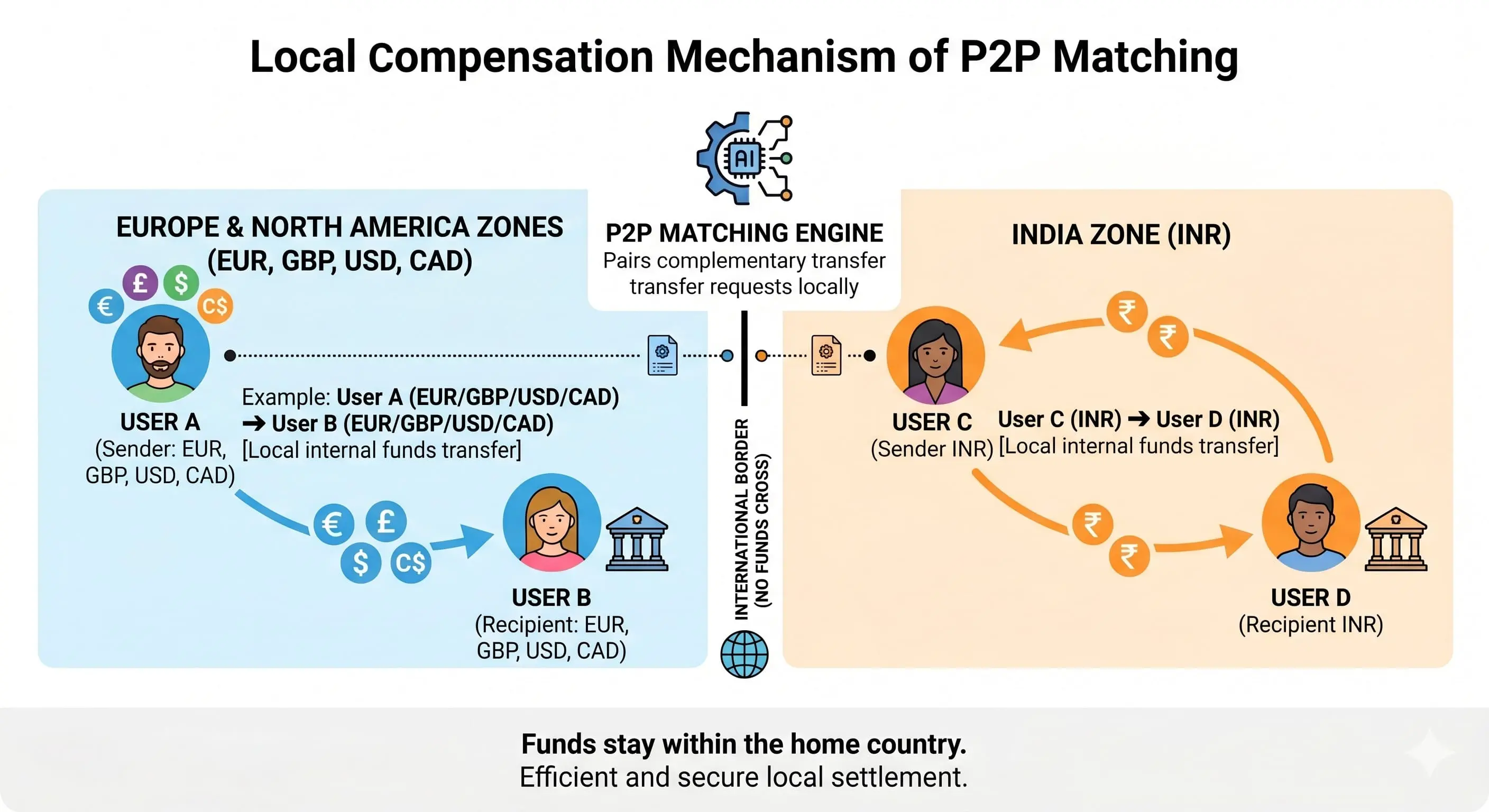
Because the funds do not navigate the labyrinth of international correspondent banks, the platform avoids institutional currency conversion spreads. This localized clearing mechanism makes it possible to perfectly align supply and demand, thereby offering the true interbank exchange rate to all users. The only cost applied is a minimal, transparent flat fee for the matching service itself. For users seeking to grasp the ethical and operational foundations of this borderless financial model, it is highly recommended to study the core manifesto outlining a fairer, decentralized financial ecosystem.
Step-by-Step Guide: Executing a Secure Transfer
The transition from legacy banking interfaces to a modern P2P marketplace is designed to be intuitive while maintaining rigorous security standards. Here is the operational lifecycle of a transaction designed to send money to India efficiently:
- Account Verification (KYC): To maintain a secure community, every participant must pass a strict Know Your Customer (KYC) verification. This process prevents illicit activities and ensures network integrity. To expedite this initial phase, users should consult the definitive KYC checklist for the exact identity documents required.
- Wallet Funding: The user deposits a major currency (e.g., EUR, USD, GBP, CAD) into their secure platform wallet using standard domestic payment methods, avoiding international deposit fees.
- Initiating the Match: The user enters the desired transfer amount and the recipient's local Indian details (such as an ICICI Bank account number or a UPI ID). The algorithmic matching engine instantly pairs this request with counter-party demand at the real-time interbank exchange rate.
- Local Clearing: The same-currency exchange finalizes instantly on the platform. Concurrently, the local INR funds are dispatched via domestic channels. To fully leverage the speed of the Indian digital infrastructure, users can master how to send money to India via UPI using P2P networks, ensuring delivery to Paytm or Google Pay India in real-time.
- Mandatory Community Evaluation: A transaction is only considered fully closed once both parties have evaluated the exchange. This mandatory rating system guarantees total transparency and builds an unshakeable web of trust. Users can discover how mandatory trust rating systems protect P2P platforms by permanently filtering out unreliable participants.
Compliance, KYC, and Absolute Financial Security
When bypassing traditional banking networks, the foremost concern for any user is financial security. The architecture of a P2P matching marketplace is inherently designed to mitigate systemic risks. Because transactions happen exclusively between wallets holding the same currency on the platform, the capital is never exposed to the vulnerabilities of international transit. The funds remain securely safeguarded in institutional-grade accounts until the dual-sided matching conditions are perfectly met.
Furthermore, regulatory compliance is non-negotiable. The platform adheres to stringent Anti-Money Laundering (AML) directives globally. The integration of a mandatory bilateral evaluation at the end of every exchange creates a self-regulating, highly secure community. Every participant knows exactly who they are transacting with, and bad actors are mathematically and systematically excluded from the marketplace. This combination of strict initial KYC onboarding, segregated currency wallets, and continuous peer review results in an environment that is objectively safer than traditional blind wire transfers.
Conclusion: A New Era for Global Remittances
The dichotomy between fixed bank fees and the real interbank exchange rate exposes the inherent flaws of legacy financial institutions. While traditional banks mask their profits behind inflated currency conversions and slow SWIFT routing, the future of international finance is decentralized, transparent, and community-driven. By utilizing a P2P matching architecture, the capital remains protected, the exorbitant intermediary costs are eradicated, and the recipient in India gains access to funds instantly via modern networks like UPI or directly into NRE/NRO accounts at institutions like SBI. For those searching for the best money transfer app to optimize their hard-earned capital, it is time to abandon opaque banking practices. Take control of the financial exchange process and calculate exact real-time savings using the live currency simulator.
Frequently asked questions
What is the difference between fixed bank fees and the interbank exchange rate?
Fixed bank fees are the upfront charges advertised by traditional banks to process a wire transfer. However, banks also add a hidden markup (spread) to the interbank exchange rate—the actual, real-time wholesale price of the currency. P2P matching platforms bypass this by charging a minimal, transparent flat fee while providing the true interbank exchange rate, resulting in significantly more funds reaching the destination.
How fast will the recipient in India receive the money?
Because the P2P architecture clears local currencies entirely outside the platform using domestic networks, the speed is unparalleled. If the recipient uses the UPI network (such as Paytm, PhonePe, or Google Pay India) or an immediate bank transfer service (IMPS), the funds are typically available instantly or within a few minutes after the platform match is completed.
Can funds be transferred directly to an NRE or NRO account?
Yes. The local clearing process supports direct deposits into Indian banking institutions, including SBI, ICICI Bank, and HDFC Bank. Senders simply need to provide the correct account details (NRE for tax-free foreign income or NRO for local income management) during the transfer setup.
Is a P2P matching marketplace safe for large transfers?
Absolutely. The platform employs rigorous security measures, including mandatory KYC identity verification and strict AML compliance. Furthermore, because transactions occur strictly between same-currency wallets on the platform and require mandatory bilateral evaluations, the funds are safeguarded from the risks and volatility associated with traditional cross-border transit.

Peer-to-peer currency exchange, finally simple and fair.
Our peer-to-peer currency exchange and money transfer platform is currently under development. We are preparing a solution that will allow you to exchange currencies with a seamless and secure experience.
To be among the first to know and not miss anything about the launch, join the club by subscribing to our newsletter.
Visuals disclosure : In the interest of transparency, please note that the images illustrating this article were created using artificial intelligence (AI) generation tools.