The economic bond between the Ivorian diaspora residing across Europe, North America, and the United Kingdom and their families back home represents a vital lifeline for millions of households. From paying daily living costs and funding education to settling utility bills or building real estate, sending money to Ivory Coast is a constant priority for overseas workers. However, traditional financial corridors rely heavily on legacy banking networks that impose steep fees, hidden currency markups, and multi-day delays. As West Africa accelerates its digital transformation, mobile money ecosystems have revolutionized how money is received, stored, and spent on the ground. Understanding how to combine modern Peer-to-Peer (P2P) currency matching with local West African mobile networks allows senders to achieve complete pricing transparency, real interbank exchange rates, and instant local payouts.
For decades, individuals sending funds from Europe or North America to Ivory Coast relied on legacy SWIFT wire networks or traditional brick-and-mortar remittance agencies. When initiating a cross-border wire through a commercial bank, capital travels through a chain of intermediary correspondent banks. Each institution along this routing chain deducts handling commissions and processing charges, which significantly reduces the final sum delivered to the beneficiary. Senders are often forced to issue secondary transfers to cover unexpected shortfalls on essential expenses.
Beyond explicit handling fees, traditional commercial banks profit heavily from inflated exchange rate markups. Rather than granting retail clients access to the live mid-market rate—the real interbank exchange rate applied between major global institutions—banks add a hidden percentage spread to currency conversions. This invisible fee inflates total transfer fees silently. Furthermore, traditional bank wires routinely take between three and five business days to clear, creating stressful uncertainty when money is needed urgently. To explore how modern digital alternatives bypass these legacy banking traps, review this comparative analysis on network architectures comparing SWIFT, SEPA, and P2P matching.
To eliminate cross-border friction, settlement delays, and hidden costs, advanced financial marketplaces leverage Peer-to-Peer (P2P) currency matching architectures. Platforms such as CashSwap Club operate on a core technical principle: capital never physically crosses international borders. By avoiding cross-border wire routing entirely, the platform bypasses correspondent banking networks and eliminates intermediary handling charges.
The marketplace manages multi-currency digital wallets holding major global currencies, including Euro (EUR), US Dollar (USD), British Pound (GBP), and Canadian Dollar (CAD). Internal platform transactions execute exclusively between wallets denominated in the same currency. When a user requests a currency exchange, the platform's algorithmic engine matches the order with a counterparty expressing an inverse currency demand within the multi-currency pool. Local currency flows are subsequently settled off-platform using fast domestic bank transfers or national mobile clearing rails in each respective jurisdiction.
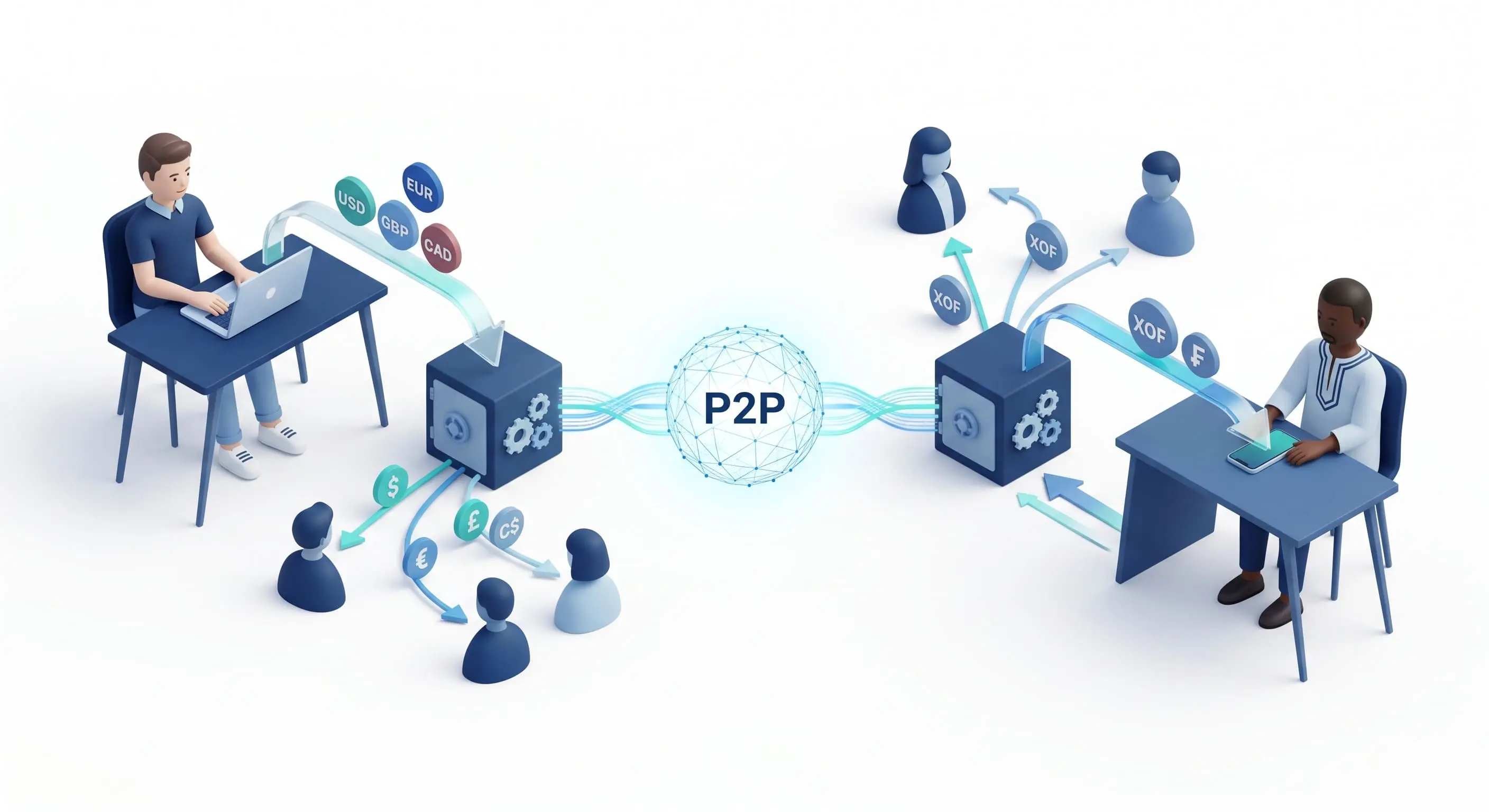
By conducting local clearing and internal matching, the P2P engine delivers direct access to the live exchange rate with zero added markups. Senders pay only minimal, fully disclosed fixed fees, ensuring complete pricing clarity. Senders seeking to support community-driven financial systems can consult the manifesto for transparent money exchange. To explore the broader impact of mobile solutions on global finance, read this detailed article on how mobile money transfer apps disrupt fintech.
Executing an international transaction through a P2P currency matching marketplace is a streamlined process engineered to answer two fundamental user concerns: exactly how much will the transaction cost and how fast will the recipient receive the funds?
This transparent workflow provides total pricing clarity from the outset. Senders can monitor order execution in real time using this dedicated guide to track money transfer status in real time.
To optimize remittances to Ivory Coast, recognizing local payout dynamics is essential. Mobile money serves as the primary financial engine for daily life across Abidjan and regional provinces. Safely delivering funds directly to mobile wallets provides unparalleled convenience for families managing daily household needs.
Major local receiving options include:
Selecting the best transfer app requires leveraging platforms that seamlessly integrate local mobile money channels with transparent P2P matching. For an in-depth breakdown of local payout rails and banking options in Abidjan, consult the ultimate guide to sending money to Ivory Coast via bank and mobile money.
Achieving rapid speed and low transfer fees must be backed by uncompromising financial security. Operating a secure P2P currency matching marketplace requires strict compliance with international Know Your Customer (KYC) standards and Anti-Money Laundering (AML) regulations enforced by global banking authorities.
Every participant must complete mandatory identity verification before initiating currency exchanges. This regulatory layer protects the network against identity theft, fraud, and unauthorized access. Because local currency disbursements execute through official domestic banking channels or regulated mobile operators, user capital remains fully protected against loss or interception throughout the transaction lifecycle.
Combined with bank-grade encryption, multi-factor authentication, and mandatory double-sided user reviews, P2P marketplaces establish exceptional safety standards for international transfers. Senders seeking detailed insight into processing schedules across global corridors can consult this analysis on instant international wire real processing times.
Sending remittances from Europe, North America, or the UK to Ivory Coast does not have to involve expensive bank wire charges, long delays, or hidden currency spreads. By bypassing traditional SWIFT banking networks in favor of Peer-to-Peer currency matching and local clearing, senders can ensure their family members receive exact amounts rapidly.
Whether funding an Orange Money wallet, topping up an MTN MoMo balance, or transferring directly to accounts at SGCI, Ecobank, or NSIA Banque, local clearing delivers optimal speed, complete fee transparency, and robust financial security. Take control of your cross-border payments today: visit the CashSwap Club money transfer platform to test the live rate simulator and experience transparent, community-driven financial exchanges.
Transactions execute using the real live mid-market interbank exchange rate without hidden currency markups or spread fees. The platform charges only a low, fixed transfer fee that is fully disclosed prior to transaction confirmation.
Once matched within the platform's liquidity pool, local clearing is initiated immediately. Mobile wallet payouts to Orange Money, MTN MoMo, Wave, or Moov Money typically complete within a few minutes up to 24 hours.
Yes. Funds delivered directly to Orange Money, MTN MoMo, or Wave wallets enable beneficiaries to immediately pay local utility bills, including CIE electricity and SODECI water payments, directly from their smartphones.
Yes. International financial regulations mandate that all users complete KYC identity verification before conducting transfers. This protects user funds, prevents financial fraud, and ensures full legal compliance.

Our peer-to-peer currency exchange and money transfer platform is currently under development. We are preparing a solution that will allow you to exchange currencies with a seamless and secure experience.
To be among the first to know and not miss anything about the launch, join the club by subscribing to our newsletter.
Visuals disclosure : In the interest of transparency, please note that the images illustrating this article were created using artificial intelligence (AI) generation tools.
© CashSwap Club 2026 - All rights reserved
Designed with ❤️ in Paris • Made in France 🇫🇷
 French