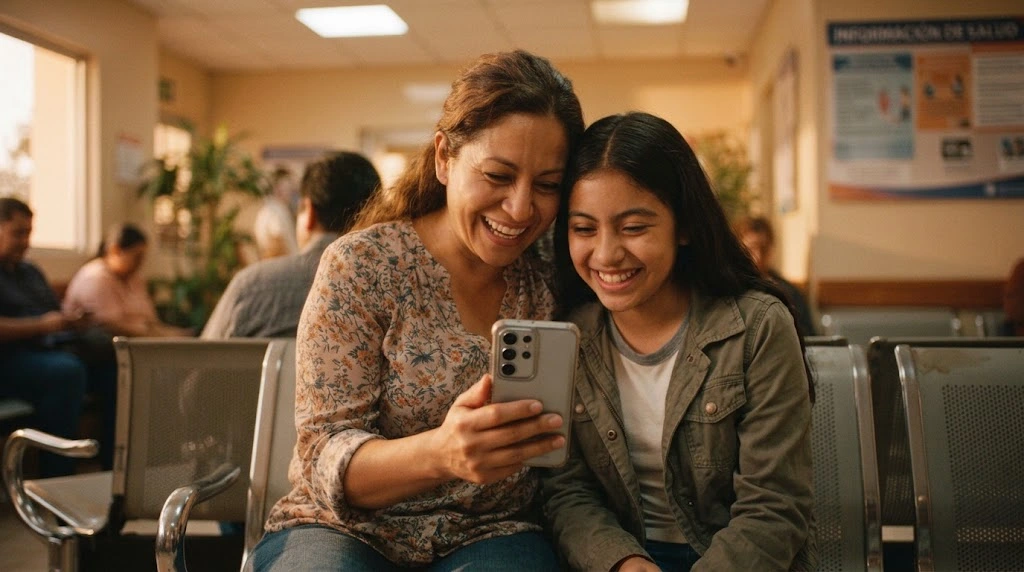
Mexico sits at the heart of one of the most important remittance corridors in the world. According to Banco de México, the country has received more than 60 billion US dollars per year in recent years, sent mainly by Mexican workers living in the United States, but also from Canada, Spain and other European countries. These remesas pay for groceries, rent, school supplies, medical care and small family businesses across states such as Michoacán, Jalisco, Guanajuato, Oaxaca and Chiapas. For millions of households, they are not a bonus but a lifeline.
Every time someone decides to send money to Mexico, the same two questions come up: how much will this transfer really cost, and how quickly will the family receive the money? The answer depends on far more than the fee displayed on a website. Exchange rate margins, receiving charges at Mexican banks and cash pickup commissions can quietly reduce the amount that reaches loved ones. This article compares how traditional channels and Mexican banks such as BBVA México, Banorte and Santander México handle incoming transfers, explains the local payout options SPEI and OXXO, and shows how Peer-to-Peer (P2P) matching on CashSwap Club offers a more transparent alternative.
The flow of remittances between the United States and Mexico is one of the largest bilateral money corridors on the planet. Remittances represent a significant share of Mexico’s gross domestic product and, in many rural communities, exceed local wages as a source of household income. For a family in a small town in Zacatecas, a monthly transfer of 300 US dollars can cover a large part of basic expenses.
In this context, even small differences in cost have a major impact. A combined loss of 4% on a 300-dollar transfer represents 12 dollars per month, or 144 dollars per year: the equivalent of several weeks of groceries for many families. Multiplied across millions of senders, hidden margins represent billions of dollars that leave migrant communities instead of supporting them. This is why transparency on transfer fees and the exchange rate is not a technical detail but a question of financial fairness.
The diaspora itself is diverse. Construction and agricultural workers in Texas and California, restaurant employees in Chicago, seasonal workers in Canada, students in Madrid and professionals in New York all have different needs: some prefer depositing directly into a bank account, others need a family member without a bank account to collect cash locally. Any honest comparison must take these realities into account.
Before comparing Mexican banks, it is essential to understand where costs appear along the path of a classic international transfer.
The most significant and least visible cost is the margin applied to the US dollar to Mexican peso (USD/MXN) exchange rate. The real market rate, also called the interbank or mid-market rate, is the midpoint between buying and selling prices on global currency markets. Banks and many remittance companies apply their own, less favorable rate. A transfer advertised as “zero fees” can therefore still cost several percent through the conversion alone. The mechanism is explained in detail in the article on why bank exchange rates differ from real market rates.
Traditional international wire transfers usually travel through SWIFT, a global messaging network that connects banks. SWIFT carries payment instructions rather than money. When the sending and receiving banks have no direct relationship, one or more correspondent banks handle the payment, and each may deduct a fee. The family in Mexico may receive less than expected without knowing why.
Costs do not stop once the money reaches Mexico. Depending on the bank and the account type, an incoming international wire may trigger a receiving fee. Cash pickup services can also include commissions on either side of the transaction. Added together, the sending fee, the exchange rate margin, intermediary charges and receiving costs can represent a substantial share of a modest transfer.
An international bank wire to Mexico commonly takes one to several business days, especially when weekends, US or Mexican public holidays, or compliance checks intervene. For urgent needs such as a hospital bill, this uncertainty adds stress to cost.
Mexico’s banking sector is dominated by a few large institutions. Fee schedules change regularly and depend on account types, so exact amounts should always be checked directly on each bank’s official fee page or through Mexican consumer protection resources before sending money. The comparison below therefore focuses on the criteria that matter most rather than on figures that can quickly become outdated.
BBVA México is the country’s largest bank by assets and customer base. Its mobile app is widely used and supports domestic SPEI transfers, which are generally inexpensive or free for individuals using digital channels. For incoming international transfers, recipients should check whether the account type applies a receiving fee for foreign wires and which exchange rate is used when dollars are converted into pesos.
Banorte is one of the largest Mexican-owned banks, with a strong presence across the country. Like other major banks, it offers SPEI transfers through its digital banking channels and receives international wires. The key points to verify are the conversion rate applied to incoming dollars, any fee for receiving international payments, and the conditions attached to the recipient’s account.
Santander México, part of the Spanish Santander group, is particularly relevant for senders in Spain and other European countries. It supports SPEI, international transfers and digital banking. As with the other institutions, the real cost for the recipient depends on the exchange rate applied at conversion and on any receiving commissions.
The main lesson is clear: the cheapest way to deliver pesos is to rely on domestic Mexican rails such as SPEI, rather than on international wires that trigger conversion margins and intermediary charges. A full method is described in the guide to sending money to Mexico at the interbank rate.
SPEI (Sistema de Pagos Electrónicos Interbancarios) is the interbank electronic payment system operated by Banco de México. It allows transfers between Mexican bank accounts using an 18-digit account number called a CLABE. SPEI operates around the clock, and most transfers are credited within seconds. For a recipient with an account at BBVA México, Banorte, Santander México or another participating institution, SPEI is the fastest and usually the cheapest way to receive pesos.
A large part of the population, especially in rural areas, still relies on cash and does not use a traditional bank account. This is where Mexico’s vast retail networks play a key role. OXXO, the country’s largest convenience store chain with tens of thousands of locations, and Elektra stores linked to Banco Azteca are widely used for cash services. Depending on the service used, a recipient can collect money by presenting a withdrawal code or reference number and an identity document at the counter, without needing a bank account. The options and their costs are covered in the article on cash pickups in Mexico through OXXO, Elektra and P2P transfers.
Cash pickup is essential for financial inclusion, but it often carries additional commissions and requires travel to a store. Whenever possible, a SPEI deposit remains the most efficient option, while cash pickup serves families who need it.
CashSwap Club is a money transfer marketplace based on Peer-to-Peer matching. Its founding principle is that money never physically crosses borders. Instead of routing funds through SWIFT and correspondent banks, the platform matches people who need to exchange currencies in opposite directions, so that each side of the exchange is settled locally.
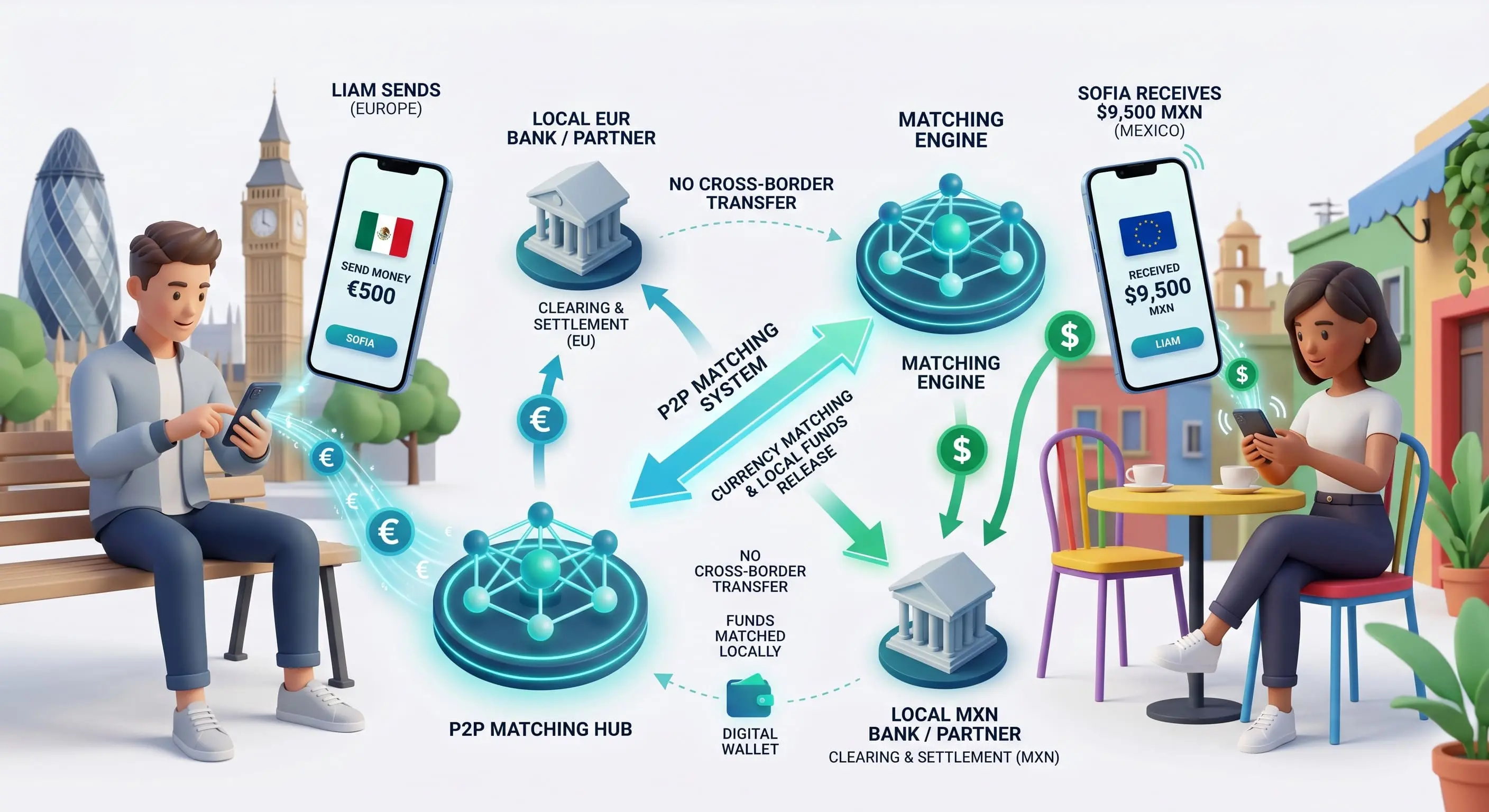
Each user holds multi-currency wallets on the platform in EUR, USD, GBP and CAD. These wallets belong to the users. Transactions on the platform take place exclusively between wallets of the same currency: dollars move between dollar wallets, euros between euro wallets. No conversion happens within the platform’s own flows.
The Mexican peso side of the exchange takes place outside the platform, through domestic Mexican channels such as SPEI or a local solution. An example makes this concrete. Carlos works in Houston and wants to send money to his mother in Puebla. At the same time, Mariana, who lives in Mexico City, needs US dollars to pay for a course in the United States. The platform matches the two needs. Carlos’s dollars move to Mariana’s USD wallet on CashSwap Club, while Mariana sends the equivalent amount in pesos to Carlos’s mother via SPEI. Neither amount crosses a border: no SWIFT fees, no correspondent banks and no conversion margin imposed by an intermediary.
Because supply and demand are matched directly, the platform can offer the real market exchange rate rather than a padded retail rate, with minimal fixed fees displayed before confirmation. The sender knows exactly how many pesos the family will receive.
Every transaction must be rated by both users once the exchange is complete. This mutual evaluation builds a visible reputation for each member and encourages reliable, timely behavior. The principles behind this community model are explained in full, and readers can read the CashSwap Club manifesto for fair and transparent remittances.
Many families receive money every two weeks or every month. For these regular needs, the complete guide to automating recurring money transfers explains how to plan payments and avoid last-minute pressure. And because matching speed improves as more members join a corridor, diaspora users who invite relatives help everyone; the details are covered in the article on the money transfer referral program and how to earn P2P bonuses.
KYC stands for “Know Your Customer”: the legal obligation for financial service providers to verify the identity of their users. Every CashSwap Club member is verified before exchanging money, so each counterpart is an identified person. This helps prevent fraud, identity theft and misuse of the platform.
Anti-money laundering (AML) controls complement KYC by monitoring unusual activity, applying limits where appropriate and supporting cooperation with authorities when required by law. These measures protect honest users and the wider financial system.
On-platform transactions occur only between same-currency wallets, and local legs go through regulated channels such as SPEI and supervised Mexican banks. Every movement therefore leaves a traceable record, unlike informal cash couriers where funds circulate without documentation.
The mandatory two-way rating adds a community safeguard on top of regulatory controls. Members can view the history of their counterparts, and repeated negative feedback can lead to restrictions.
Finding the best money transfer app for Mexico means comparing total cost and delivery time, not just the headline fee.
In practice, removing the conversion margin and intermediary banks generally means more pesos for the family, especially on recurring transfers. Over a year, the difference can be significant for households that depend on remittances.
Mexican banks such as BBVA México, Banorte and Santander México offer efficient domestic services through SPEI, and networks such as OXXO keep cash accessible to families without bank accounts. The weak point remains the international leg, where exchange rate margins and intermediary fees quietly erode remittances. By matching senders abroad with counterparts who pay pesos locally, CashSwap Club connects the diaspora to Mexico’s fast domestic rails at the real market exchange rate, with minimal fixed fees and full visibility.
The simplest way to see the difference is to compare real numbers. Senders can check the live exchange rate simulator on CashSwap Club to find out exactly how many pesos a loved one in Mexico would receive at the real interbank rate, before committing to anything.
Timing depends mainly on how quickly a matching counterpart is found. Once the counterpart pays the recipient through SPEI, the pesos are usually credited within seconds, including outside banking hours.
Yes, cash pickup services allow recipients to collect money in stores such as OXXO or Elektra using a withdrawal code and an identity document. Availability and costs depend on the service used, so a SPEI deposit remains the fastest and most economical option when possible.
Fees at BBVA México, Banorte and Santander México vary by account type and change over time, so official fee schedules should be checked. In most cases, the biggest cost is the exchange rate margin rather than the receiving fee, which is why using the interbank rate makes the largest difference.
On CashSwap Club, every user is identity-verified (KYC), anti-money laundering controls apply, and all flows are traceable through same-currency wallets and regulated Mexican channels such as SPEI. Every exchange is also rated by both parties.

Our peer-to-peer currency exchange and money transfer platform is currently under development. We are preparing a solution that will allow you to exchange currencies with a seamless and secure experience.
To be among the first to know and not miss anything about the launch, join the club by subscribing to our newsletter.
Visuals disclosure : In the interest of transparency, please note that the images illustrating this article were created using artificial intelligence (AI) generation tools.
© CashSwap Club 2026 - All rights reserved
Designed with ❤️ in Paris • Made in France 🇫🇷
 Spanish