- Sep 16, 2026
The economic bridge connecting the Ghanaian diaspora across North America, Europe, and the United Kingdom with their families back home represents a vital financial engine. Every year, significant volumes of foreign currency flow into Ghana to support household living expenses, cover university tuition fees, fund healthcare, and capitalize family agricultural projects or real estate developments. However, executing international transfers to Ghana in Ghanaian Cedi (GHS) frequently involves navigating complex banking friction. Traditional cross-border wire transfers routinely suffer from hidden bank fees, arbitrary exchange rate markups, and intermediary handling deductions that silently erode the net funds received. Understanding how to bypass traditional banking corridors using Peer-to-Peer (P2P) currency matching platforms allows senders to achieve complete pricing transparency, real interbank exchange rates, and rapid local payouts across Ghana's extensive Mobile Money and commercial banking networks.
Table of Contents
- 1. The Friction of Traditional Bank Wires to Ghana: Hidden Markups and Intermediary Deductions
- 2. P2P Currency Matching: How Local Clearing Eliminates Cross-Border Overhead
- 3. Step-by-Step Guide: Executing a Fast, Transparent Money Transfer to Ghana
- 4. Ghana’s Local Financial Ecosystem: Mobile Money Networks and Key Commercial Banks
- 5. Regulatory Compliance, KYC Protocols, and Financial Security
- 6. Conclusion: Take Control of Transfers to Ghana with Real-Time Rate Transparency
1. The Friction of Traditional Bank Wires to Ghana: Hidden Markups and Intermediary Deductions
For decades, individuals sending money to Ghana through conventional commercial banks relied on legacy correspondent banking networks operating under the SWIFT protocol. When initiating a cross-border wire, capital passes sequentially through multiple intermediary correspondent banks before reaching the beneficiary's local account. Each intermediary along the routing path deducts handling charges, processing commissions, and relay surcharges. Consequently, the final net amount credited in Ghanaian Cedi (GHS) falls short of expectations, forcing senders to issue corrective payments to settle exact invoices or household requirements.
Beyond explicit handling fees, legacy commercial banks extract substantial profit margins by manipulating exchange rates. Retail clients are rarely granted access to the live interbank exchange rate—the real mid-market exchange rate applied between major global financial institutions. Instead, banks add an arbitrary currency spread when converting source funds into Ghanaian Cedi (GHS). This hidden markup quietly inflates total costs. Overseas senders seeking to evaluate these pricing mechanics can review this technical guide on how to spot and avoid hidden bank fees on global money transfers.
Settlement speed presents another critical hurdle. Traditional SWIFT transfers to West Africa routinely require between three to five business days to clear, subject to cut-off times, international time zone discrepancies, and manual clearing queues. For diaspora senders funding time-sensitive academic fees or family needs, legacy banking delays create unnecessary operational friction. Senders looking to compare traditional options with modern solutions can explore this breakdown on how to send money to Ghana with low fees and best exchange rates.
2. P2P Currency Matching: How Local Clearing Eliminates Cross-Border Overhead
To eliminate intermediary banking friction, hidden currency markups, and settlement opacity, modern financial marketplaces utilize Peer-to-Peer (P2P) currency matching architectures. Platforms such as CashSwap Club operate on a core technical model: money never physically crosses international borders. By avoiding cross-border wire routing entirely, the marketplace bypasses correspondent banking chains and eliminates associated handling charges.
The marketplace manages multi-currency digital wallets holding major global currencies, including Euro (EUR), US Dollar (USD), British Pound (GBP), and Canadian Dollar (CAD), belonging to users. Internal platform transactions execute exclusively between wallets denominated in the same currency. When a user requests a currency exchange to send funds to Ghana, the platform's algorithmic matching engine pairs the order with a counterparty expressing an inverse currency demand within the multi-currency liquidity pool. Local currency flows are subsequently settled off-platform using fast domestic bank wire transfers or national mobile clearing rails within each respective jurisdiction.
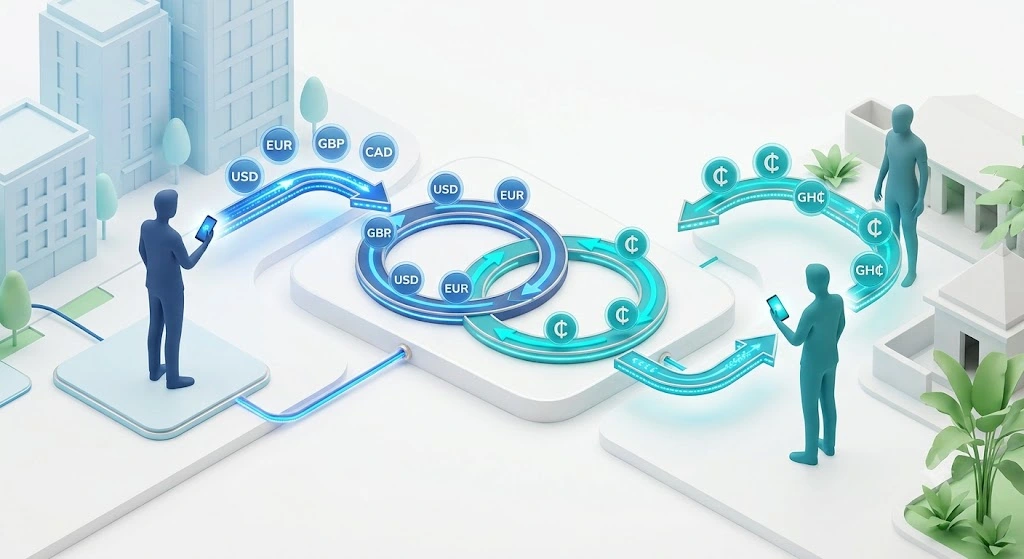
By conducting local clearing and internal matching, the P2P engine delivers direct access to the real interbank exchange rate with zero added markups. Senders pay only minimal, fully disclosed fixed fees, ensuring complete pricing clarity. Senders seeking to understand the structural advantages of local matching can review this study on why choosing P2P for money transfers outperforms traditional banks. Users interested in supporting fair, community-driven financial systems can also consult the manifesto for fair financial exchange.
3. Step-by-Step Guide: Executing a Fast, Transparent Money Transfer to Ghana
Executing an international transfer to Ghana through a P2P currency matching marketplace is a streamlined process engineered to answer two fundamental end-user priorities: exactly how much will the transaction cost and how fast will the recipient receive the funds?
- Account Registration & Identity Verification: The user registers an account and completes mandatory Know Your Customer (KYC) identity verification by submitting valid government photo identification and proof of address.
- Setting Transfer Parameters: The sender selects the source currency wallet (EUR, USD, GBP, or CAD) and inputs the target amount in Ghanaian Cedi (GHS). The platform instantly displays the real live interbank exchange rate alongside a transparent, fixed transfer fee.
- Algorithmic Liquidity Matching: The platform's algorithm pairs the exchange order with complementary currency demand within the multi-currency pool.
- Local Clearing and Off-Platform Disbursement: Upon order validation, local currency (GHS) is disbursed off-platform directly into the beneficiary's Mobile Money wallet or bank account. Settlement completes within a few minutes up to a maximum of 24 hours depending on local bank clearing windows.
- Mandatory Mutual User Evaluation: Following transaction completion, both participating users evaluate and rate the exchange. This double-sided review system maintains community trust and high service standards.
This transparent workflow provides total pricing clarity from the outset. Senders can monitor order execution step-by-step using this dedicated guide to instant international wire real processing times explained.
4. Ghana’s Local Financial Ecosystem: Mobile Money Networks and Key Commercial Banks
To optimize money transfers to Ghana, recognizing local payout dynamics is essential. Mobile Money is not simply a convenience in Ghana; it is the dominant economic operating system for daily life across both urban hubs like Accra and Kumasi, as well as rural agricultural communities. Rapid access to cash via Mobile Money accounts allows recipients to pay immediate expenses without needing to visit physical bank branches.
Key receiving channels in Ghana include:
- Mobile Money Ecosystems (MTN MoMo, Vodafone Cash, AirtelTigo Money): MTN Mobile Money (MoMo) holds a commanding market share in Ghana, serving as the primary digital wallet for millions of citizens. Together with Vodafone Cash (Telecel Cash) and AirtelTigo Money, mobile wallets enable recipients to instantly settle household utility bills, fund local family farming operations, purchase goods, and cover educational expenses directly from their phones.
- Major Commercial Banking Institutions: For larger corporate, educational, or real estate transactions, direct bank deposits are supported across leading national financial institutions, including Ecobank Ghana, GCB Bank (Ghana Commercial Bank), and Absa Bank Ghana. Direct account crediting provides robust settlement for high-value family investments.
For diaspora families managing multi-faceted payments—such as educational tuition or family health coverage—combining P2P matching with direct mobile payout delivers unmatched speed. Senders supporting students abroad can also explore this specialized guide to paying tuition fees abroad via P2P transfers. For broader context on global payment stability and digital assets, review this analysis on the role and stability of crypto assets in global money transfers.
5. Regulatory Compliance, KYC Protocols, and Financial Security
Achieving fast settlement speeds and eliminating hidden transfer fees must be supported by uncompromising financial safety standards. Financial security is maintained through strict compliance with Know Your Customer (KYC) protocols and Anti-Money Laundering (AML) regulations enforced by sovereign central banks and regulatory bodies worldwide.
Every participant must complete identity verification by uploading valid government photo identification prior to executing currency exchanges. This mandatory verification layer protects the ecosystem against fraud, identity theft, and unauthorized access. Because local currency disbursements execute through official domestic banking networks (such as Ecobank Ghana, GCB Bank, or Absa Bank Ghana) or licensed mobile network operators like MTN MoMo, user capital remains fully protected throughout the settlement lifecycle.
Combined with bank-grade encryption, multi-factor authentication, and mandatory double-sided user reviews, P2P marketplaces establish exceptional safety standards for global money management.
6. Conclusion: Take Control of Transfers to Ghana with Real-Time Rate Transparency
Sending money to Ghana in Cedi (GHS) should not mean accepting inflated bank wire charges, hidden currency markups, or multi-day processing delays. By replacing legacy correspondent banking networks with Peer-to-Peer currency matching and local clearing, overseas senders ensure that their family members receive exact amounts rapidly.
Whether topping up an MTN MoMo wallet for daily family living expenses, funding a Vodafone Cash or AirtelTigo account, or transferring capital directly to accounts at Ecobank Ghana, GCB Bank, or Absa Bank Ghana, local P2P clearing delivers optimal speed, full fee transparency, and robust financial security. Take control of your transfers to Ghana today: visit the CashSwap Club money transfer marketplace to test the live rate simulator and experience fair financial exchanges.
Frequently asked questions
How much does it cost to send money to Ghana (GHS) using a P2P matching marketplace?
Transactions execute at the real live mid-market interbank exchange rate without hidden exchange rate spreads or currency markups. The platform charges only a low, fixed transfer fee that is fully disclosed prior to transaction confirmation.
How fast will a recipient in Ghana receive funds on MTN MoMo or a bank account?
Once matched within the platform's liquidity pool, local clearing is initiated immediately. Payouts to mobile wallets (MTN MoMo, Vodafone Cash, AirtelTigo Money) or major bank accounts (Ecobank Ghana, GCB Bank, Absa Bank Ghana) typically complete within a few minutes up to 24 hours.
Can recipients in Ghana use Mobile Money to pay bills and family expenses immediately?
Yes. Funds credited directly to an MTN MoMo, Vodafone Cash, or AirtelTigo Money wallet in Ghana can be used immediately by the recipient to pay bills, purchase everyday goods, cover school fees, or support agricultural projects without visiting a physical bank branch.
Is identity verification (KYC) required before sending money to Ghana?
Yes. International financial regulations mandate that all users complete KYC identity verification before conducting currency transfers. This ensures account authenticity, prevents financial fraud, and safeguards user capital.

Peer-to-peer currency exchange, finally simple and fair.
Our peer-to-peer currency exchange and money transfer platform is currently under development. We are preparing a solution that will allow you to exchange currencies with a seamless and secure experience.
To be among the first to know and not miss anything about the launch, join the club by subscribing to our newsletter.
Visuals disclosure : In the interest of transparency, please note that the images illustrating this article were created using artificial intelligence (AI) generation tools.