- Jul 8, 2026
For the global diaspora, the ability to efficiently send money to Ghana is much more than a simple financial transaction; it is a vital lifeline that sustains communities, fuels local entrepreneurship, and supports essential family needs. Every year, billions of dollars flow into the Ghanaian economy from abroad, serving as a critical pillar for national development. However, despite the sheer volume of these cross-border transfers, the underlying financial infrastructure has long been plagued by inefficiencies. Traditional remittance corridors are often characterized by sluggish processing times, opaque pricing models, and exorbitant costs that silently erode the value of the hard-earned funds intended for families back home.
The landscape of financial technology, however, is undergoing a profound transformation. The rise of decentralized matching systems and mobile-first financial ecosystems is dismantling the old monopolies held by legacy banking institutions. Today, the most effective way to support loved ones in West Africa is no longer through a physical bank branch, but through intelligent platforms that leverage local liquidity and peer-to-peer (P2P) mechanics. This comprehensive guide explores the deep-rooted issues within traditional remittance systems, the revolutionary impact of mobile wallets, and the optimal strategies for funding a Mobile Money account in Ghana without falling victim to hidden margins.
Table of Contents
- The Hidden Costs of Traditional Banking and Remittances
- The Mobile Money Revolution in Ghana
- How P2P Matching Revolutionizes Cross-Border Transfers
- Step-by-Step Guide: The Best Money Transfer App Methodology
- Security, Compliance, and Community Trust
- Conclusion: Empowering the Diaspora
The Hidden Costs of Traditional Banking and Remittances
To truly understand how to optimize cross-border transactions, one must first deconstruct the mechanics of traditional financial institutions. For decades, sending capital across international borders required reliance on the SWIFT network (Society for Worldwide Interbank Financial Telecommunication) and a complex web of correspondent banks. When an individual in Europe or North America initiates a transfer to a recipient in West Africa, the funds do not travel in a straight line. Instead, they bounce through multiple intermediary institutions before finally reaching major local institutions such as Ecobank Ghana, GCB Bank, or Absa Bank Ghana.
Each step in this convoluted journey incurs a fee. However, the most significant financial drain is rarely advertised upfront. Legacy operators and high-street banks heavily rely on obscuring the true cost of the transaction through unfavorable currency conversion practices. Rather than offering the mid-market rate—the true interbank rate determined by global forex markets—institutions apply a markup. This hidden margin on the exchange rate acts as a silent tax, often extracting a significant percentage of the total transfer value. For a deeper analysis of this systemic issue, reading about a detailed comparison between marketplaces and traditional banking structures reveals exactly how much capital is lost to these hidden spreads.
Furthermore, traditional banking channels suffer from a significant lack of accessibility for the ultimate beneficiary. While banks like GCB Bank and Absa Bank Ghana offer robust financial services for the urban middle class and corporate sector, relying strictly on traditional bank-to-bank transfers alienates a vast portion of the rural population. The recipient is often forced to travel long distances to physical branches, wait in extensive queues, and deal with cumbersome paperwork just to access their funds. To fully grasp the extent of these geographical and logistical hurdles, one can examine the financial advantages over physical agency locations, which highlights why the modern diaspora is shifting away from brick-and-mortar remittance models.
The Mobile Money Revolution in Ghana
In response to the limitations of traditional banking, Ghana has emerged as one of the most dynamic and mature Mobile Money markets on the African continent. Mobile Money has completely bypassed the need for traditional bank accounts for millions of citizens, transforming any basic mobile phone into a powerful, digital financial instrument. The ecosystem is primarily dominated by three major operators: MTN MoMo, Vodafone Cash, and AirtelTigo Money. These telecom-backed financial services have achieved a level of market penetration that legacy banks could only dream of.
The importance of this infrastructure cannot be overstated, particularly when it comes to the daily realities of the Ghanaian population. For many families, especially those in rural or semi-urban areas, immediate access to cash is a strict necessity. Remittances are frequently utilized to support critical, time-sensitive projects. For instance, agricultural seasons dictate precise windows for purchasing seeds, fertilizers, and farming equipment. A delay of several days caused by traditional banking clearing times can jeopardize an entire harvest. Similarly, educational family projects require prompt payments for school fees, uniforms, and supplies at the beginning of academic terms. Mobile Money solves these temporal challenges by offering instantaneous, localized liquidity.
When an expatriate looks to send money to Ghana, routing the funds directly into an MTN MoMo or Vodafone Cash wallet ensures that the recipient has immediate purchasing power. They can pay merchants directly via their phone, settle utility bills, or visit a local mobile money agent—often located just a few steps from their home—to withdraw physical cash. This seamless integration into the daily economic fabric of the country is why funding mobile wallets has become the absolute gold standard for international remittances directed toward West Africa.
How P2P Matching Revolutionizes Cross-Border Transfers
While Mobile Money solves the problem of local distribution, the challenge of international cross-border friction remains. This is exactly where the CashSwap Club platform introduces a paradigm shift. The core innovation lies in a Peer-to-Peer (P2P) matching business model that completely bypasses the traditional correspondent banking network. In this ecosystem, the money never actually crosses international borders physically or via traditional wire networks.
The mechanism is both elegant and highly efficient. The platform manages secure, multi-currency wallets (holding EUR, USD, GBP, and CAD) for its global user base. When an individual in Paris or London wishes to fund a relative's mobile wallet in Accra, the platform algorithms search for a counterparty—another user who wishes to exchange Ghanaian Cedis (GHS) for EUR, USD, GBP, or CAD. The transactions occur strictly between wallets of the same currency on the platform's closed-loop system, while the local currency leg (the Cedis) is settled locally off-platform, directly via national bank transfers or domestic Mobile Money networks. For individuals seeking a deeper technical understanding of this methodology, understanding the mechanics of why peer-to-peer networks offer superior conditions provides an excellent breakdown of local liquidity routing.
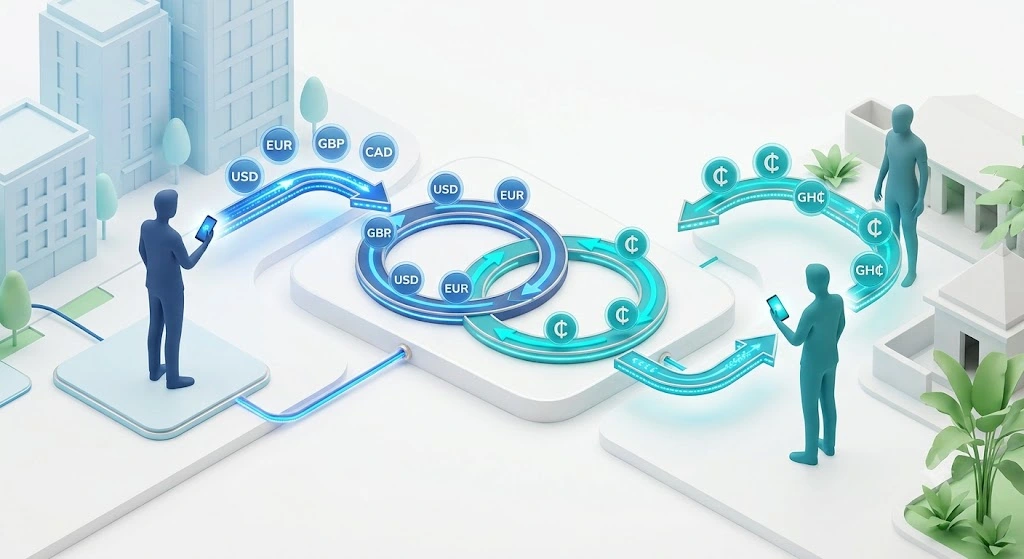
Because no funds are subjected to international SWIFT fees or institutional forex margins, the platform is able to facilitate the exchange at the real market rate (the mid-market or interbank rate). Users are only subject to minimal, strictly transparent fixed transfer fees for the use of the matching engine. This model mathematically guarantees the preservation of capital, ensuring that more Cedis reach the recipient's mobile wallet for every Dollar, Euro, or Pound spent. To master the intricacies of global currency valuation, users can explore strategies on how to navigate currency volatility and leverage the P2P system to lock in the most favorable conditions possible.
Step-by-Step Guide: The Best Money Transfer App Methodology
Utilizing a P2P marketplace to fund an AirtelTigo Money, MTN MoMo, or Vodafone Cash account is designed to be highly intuitive, maximizing user experience while maintaining stringent security protocols. Here is the exact process of how transactions are executed within the ecosystem.
Step 1: Registration and Wallet Funding
The journey begins by accessing the ecosystem and establishing a secure profile. Users are provided with personal, multi-currency digital wallets. To initiate the process, the sender funds their designated wallet (e.g., EUR or USD) using standard, low-cost domestic payment methods within their country of residence. To start optimizing cross-border transactions through the main platform, users simply need to verify their identity and load their initial balance.
Step 2: Creating a Transfer Request
Once the wallet is funded, the user specifies the exact amount they wish to exchange and designates the recipient's local Mobile Money details in Ghana. The system displays the real-time interbank exchange rate and the transparent, fixed transfer fees upfront. There are no surprises, no hidden deductions, and no dynamic margins applied at the last minute.
Step 3: Algorithmic Matching
The platform's intelligent matching engine instantly scans the network for a counterparty whose financial needs precisely mirror the sender's request. Because the marketplace aggregates vast amounts of local liquidity, this matching process is highly efficient, ensuring rapid execution.
Step 4: Local Disbursement and Confirmation
Upon a successful match, the local counterparty disburses the Ghanaian Cedis directly to the provided MTN MoMo, Vodafone Cash, or AirtelTigo Money number via a domestic transfer. Simultaneously, the equivalent hard currency is securely transferred between the users' platform wallets. The recipient in Ghana receives an immediate SMS notification from their telecom provider confirming the deposit, granting them instant access to the funds.
Security, Compliance, and Community Trust
When dealing with international finance, security and regulatory compliance are non-negotiable. The CashSwap Club platform operates under a rigorous framework designed to protect all participants and eliminate the risk of fraud. Foremost among these protections is the stringent Know Your Customer (KYC) protocol. Every individual operating within the marketplace must undergo identity verification before gaining access to the matching engine. This ensures that the network is composed entirely of vetted, legitimate participants.
Beyond standard compliance, the platform utilizes a community-driven trust mechanism. At the conclusion of every single transaction, it is mandatory for both counterparties to evaluate and rate each other. This continuous feedback loop creates an immutable reputation system. Bad actors are swiftly identified and permanently removed from the ecosystem, while reliable users build high trust scores, leading to faster matching and preferred status. The evolution of such transparent systems is heavily rooted in modern technological advancements; those interested in the underlying philosophy can research the technological evolution driving decentralized networks.
This dual layer of security—institutional-grade compliance combined with decentralized community enforcement—provides absolute peace of mind. Users are guaranteed that their funds are held securely within their digital wallets until the exact moment the local disbursement is confirmed by both parties. To understand the ethical and operational guidelines that govern this secure environment, users are encouraged to explore the core values of transparent finance in this comprehensive manifesto.
Conclusion: Empowering the Diaspora
The days of surrendering hard-earned capital to the hidden margins and inflated fees of traditional banks and legacy remittance operators are coming to an end. The integration of advanced P2P matching technology with the robust, ubiquitous Mobile Money networks of Ghana—such as MTN MoMo, Vodafone Cash, and AirtelTigo Money—has created an unprecedented opportunity for financial empowerment. By keeping international currencies within a closed-loop wallet system and relying entirely on localized clearing, the CashSwap Club marketplace ensures that the maximum possible value reaches the intended recipients.
Whether the goal is to fund an urgent agricultural project, pay for a sibling's university tuition, or simply provide daily living expenses, utilizing a transparent, community-driven platform guarantees speed, security, and the preservation of wealth. The power to control exchange rates and eliminate hidden costs is now firmly in the hands of the users. Do not let outdated financial systems tax your generosity. Experience the difference of true market rates and absolute transparency today by utilizing the platform's live rate simulator to calculate the exact savings on your next transfer.
Frequently asked questions
How long does it take for the recipient in Ghana to receive the funds
Because the platform utilizes local peer-to-peer matching, the actual disbursement of funds is treated as a domestic transaction. Once a match is secured on the marketplace, the local counterparty transfers the funds directly to the recipient's MTN MoMo, Vodafone Cash, or AirtelTigo account. This domestic local transfer is usually instantaneous, meaning the recipient gains access to the cash within minutes of the match completion.
What are the real transfer fees compared to legacy banks?
Traditional banks and legacy remittance services typically hide their true costs by inflating the exchange rate (often taking a 3% to 6% margin) on top of a base transfer fee. The CashSwap Club platform eliminates this hidden margin entirely by utilizing the real interbank exchange rate. Users only pay a minimal, transparent, and fixed platform fee for utilizing the matching service, resulting in significantly lower overall costs.
Is it secure to send money without using a traditional banking network?
Yes, it is highly secure. The platform enforces mandatory Know Your Customer (KYC) identity verification for all users before they can participate in the marketplace. Furthermore, funds held in the EUR, USD, GBP, or CAD wallets are safeguarded until the transaction is fully validated. The mandatory post-transaction rating system also ensures that only highly trusted individuals remain active within the community network.
Can the funds be sent directly to a Ghanaian bank account instead of Mobile Money?
While funding Mobile Money wallets (like MTN MoMo) is the most popular and fastest method due to high local accessibility, the P2P matching system is entirely flexible. If the counterparty in Ghana agrees to the terms, the local disbursement can absolutely be routed via a domestic bank transfer to major institutions such as GCB Bank, Ecobank Ghana, or Absa Bank Ghana, depending on the specific needs of the recipient.

Peer-to-peer currency exchange, finally simple and fair.
Our peer-to-peer currency exchange and money transfer platform is currently under development. We are preparing a solution that will allow you to exchange currencies with a seamless and secure experience.
To be among the first to know and not miss anything about the launch, join the club by subscribing to our newsletter.
Visuals disclosure : In the interest of transparency, please note that the images illustrating this article were created using artificial intelligence (AI) generation tools.