
The economic bridge connecting the international Dominican diaspora in North America, Europe, and across the globe with their families back home represents a vital financial engine for the nation's economy. Every year, billions of dollars flow into the Dominican Republic to cover essential living costs, private tuition, medical care, home construction, and local micro-enterprise investments. However, navigating cross-border money transfers to the country requires a comprehensive understanding of local receiving mechanisms, banking friction, and structural transfer costs. Traditional remittance corridors routinely penalize overseas senders through high processing charges, unpredictable delays, and opaque currency conversion markups. Overseas senders are constantly asking the same underlying questions: how much will the transfer cost, and how fast will their family receive the funds? This in-depth article provides an objective comparison between direct bank deposits and physical cash pickup options in the Dominican Republic, evaluates the structural flaws of traditional bank channels, explains how Peer-to-Peer (P2P) currency matching eliminates intermediary friction, and details how compliance frameworks protect user transactions.
For decades, sending funds to the Dominican Republic meant relying on legacy commercial banks or traditional brick-and-mortar money transfer operators. When transferring capital via traditional international wire networks operating under the SWIFT messaging protocol, funds do not follow a direct path. Instead, payments travel sequentially through a chain of intermediary correspondent banks. Each institution along the routing path deducts handling commissions, message transmission surcharges, and processing fees. Consequently, the final net amount credited to the beneficiary's bank account in Dominican Pesos (DOP) or US Dollars (USD) is reduced unpredictably, creating shortfalls that often require secondary corrective transfers.
Beyond explicit processing charges, the most substantial cost of legacy financial corridors lies in exchange rate spreads and hidden bank fees. Commercial banks and traditional transfer agencies rarely grant retail senders access to the real mid-market exchange rate—the live interbank exchange rate applied between major global institutions. Instead, financial intermediaries apply an arbitrary currency spread, inflating foreign exchange costs silently. Overseas senders seeking an objective evaluation of these practices can read this detailed analysis on marketplace vs bank hidden transfer fees as well as this study on marketplace vs local branch real savings on money transfers.
Processing speed presents another major operational barrier. Traditional cross-border wire transfers passing through legacy banking channels typically require three to five business days to clear, subject to cut-off times, international time zone differences, and manual compliance holds. When families require urgent liquidity for healthcare or academic deadlines, multi-day delays introduce unnecessary stress. Overseas senders require modern alternatives that guarantee total pricing clarity and rapid local settlement.
To overcome the high overhead, settlement delays, and pricing opacity of legacy correspondent banking, next-generation financial technology platforms utilize Peer-to-Peer (P2P) currency matching architectures. Platforms such as CashSwap Club operate on a core technical model: capital never physically crosses international borders. By eliminating transborder wire transmission entirely, the marketplace bypasses intermediary correspondent banking chains and eliminates associated handling charges.
The marketplace manages multi-currency digital wallets holding major global currencies, including Euro (EUR), US Dollar (USD), British Pound (GBP), and Canadian Dollar (CAD), belonging to users. Internal platform transactions execute exclusively between wallets denominated in the same currency. When a user requests a currency exchange to send funds to the Dominican Republic, the platform's algorithmic engine matches the order with a counterparty expressing an inverse currency demand within the multi-currency pool. Local currency flows within the Dominican Republic are subsequently settled off-platform using fast domestic bank wire transfers or local payout channels.
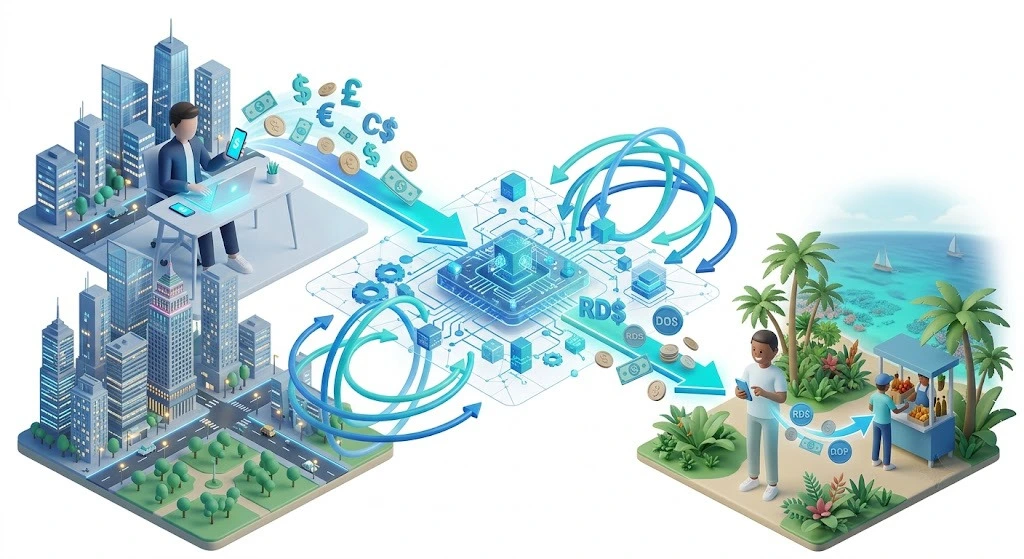
By conducting local clearing and internal matching, the P2P engine delivers direct access to the live mid-market interbank exchange rate with zero added markups. Senders pay only minimal, fully disclosed fixed fees, ensuring complete fee transparency. Senders seeking to optimize exchange rates when supporting family abroad can consult the guide on sending money to the Dominican Republic and rate optimization. Those interested in supporting a fair, community-driven financial framework can also explore the manifesto for transparent money exchange.
Choosing between direct bank deposit and physical cash pickup in the Dominican Republic requires evaluating speed, accessibility, security, and local receiving preferences. Both payout mechanisms offer distinct operational characteristics:
By routing funds through P2P currency matching and local domestic clearing, senders ensure that whether money is directed to a Banreservas account or a local cash pickup counter, foreign exchange conversions reflect the real interbank exchange rate without hidden markups or unexpected receiving deductions.
Executing an international transaction to the Dominican Republic through a P2P currency matching marketplace is a transparent, intuitive process designed to give senders total clarity over fees, exchange rates, and delivery timeframes:
This structured workflow directly answers key end-user priorities: total fees remain fixed and transparent from the outset, and family members in the Dominican Republic receive exact amounts rapidly. Senders can monitor order execution in real time using this dedicated guide to track money transfer status in real time.
Achieving absolute transaction transparency and fee optimization requires strict alignment with global financial safety standards. Financial security is maintained through mandatory compliance with Know Your Customer (KYC) protocols and Anti-Money Laundering (AML) regulations enforced by sovereign central banks and regulatory authorities worldwide.
Every platform participant must complete identity verification by uploading valid government-issued photo ID documents and proof of address prior to executing currency exchanges. Senders seeking to prepare their account documentation can consult the KYC checklist of documents needed for a first transfer. This verification layer protects the network against fraudulent activities, identity theft, and unauthorized access.
Because local currency disbursements execute through official domestic banking networks (such as Banco Popular, Banreservas, Banco BHD) or licensed payout partners, user capital remains fully protected throughout the transfer lifecycle. Combined with bank-grade data encryption and mandatory double-sided user reviews, P2P marketplaces establish exceptional safety standards for international money management.
Supporting family members and managing financial commitments in the Dominican Republic should not be compromised by steep bank wire charges, hidden exchange rate spreads, and processing delays. By bypassing traditional SWIFT networks in favor of Peer-to-Peer currency matching and local clearing, overseas senders ensure that more money reaches their loved ones.
The combination of real mid-market interbank exchange rates, minimal fixed fees, and flexible local clearing across major commercial banks (Banco Popular, Banreservas, Banco BHD) and cash pickup agencies provides an unmatched money transfer experience. Take control of your cross-border payments today: visit the CashSwap Club main platform to test the live rate simulator and experience transparent, community-driven financial exchanges.
Transactions execute using the real live mid-market interbank exchange rate without hidden currency markups or exchange spreads. The platform charges only a low, fixed fee that is fully disclosed prior to transaction confirmation.
Once matched within the platform's liquidity pool, local clearing is initiated immediately. Direct deposits to commercial bank accounts (Banco Popular, Banreservas, Banco BHD) or cash pickup availability generally clear within a few minutes up to a maximum of 24 hours depending on local bank processing schedules.
Direct bank deposit credits funds directly into the beneficiary's bank account, eliminating the need to travel to physical agent locations or carry physical currency in public. Both options are secure when processed through licensed domestic clearing channels, but direct deposit offers greater ongoing convenience.
Yes. International financial regulations and central bank anti-money laundering laws mandate that all users complete KYC identity verification before conducting currency transfers on the platform. This requirement safeguards user capital, prevents financial fraud, and ensures complete legal compliance.

Our peer-to-peer currency exchange and money transfer platform is currently under development. We are preparing a solution that will allow you to exchange currencies with a seamless and secure experience.
To be among the first to know and not miss anything about the launch, join the club by subscribing to our newsletter.
Visuals disclosure : In the interest of transparency, please note that the images illustrating this article were created using artificial intelligence (AI) generation tools.
© CashSwap Club 2026 - All rights reserved
Designed with ❤️ in Paris • Made in France 🇫🇷
 Spanish