
Preparing for an international trip requires meticulous financial planning. Currency conversion and cross-border payments often stand as significant sources of stress and unforeseen expenses for global travelers. Understanding the underlying financial mechanisms is crucial for maintaining a balanced budget while overseas. This comprehensive guide explores modern solutions to optimize financial management abroad, focusing on innovative platforms that redefine transfer transparency and eliminate the redundant costs traditionally imposed by conventional banking institutions.
While globalization has significantly facilitated professional and leisure travel, the banking sector remains highly fragmented by rigid monetary borders. When an individual steps outside their primary currency zone, utilizing local currencies becomes inevitable. This necessity generates a constant flow of currency conversions which, if not strategically anticipated, can heavily impact the overall travel budget.
The primary challenge lies in accessing funds quickly and affordably while ensuring absolute financial security against various fraud risks. When conducting a thorough money transfer comparison, it becomes evident that physical exchange bureaus systematically apply substantial margins on buying and selling rates. Furthermore, relying exclusively on conventional bank cards exposes users to per-transaction commissions, automated teller machine (ATM) withdrawal fees, and highly unfavorable conversion rates. Adopting a diversified strategy, incorporating decentralized technological solutions, is now fundamental to preserving purchasing power during extended or frequent international stays.
Traditional banking institutions have long held an absolute monopoly on international transactions. This control has fostered an asymmetrical economic model heavily reliant on hidden bank fees. During a cross-border payment or wire transfer, the true cost of the operation is rarely displayed explicitly to the customer. Banks generally utilize an exchange rate that is unilaterally marked up compared to the interbank rate—the actual market rate—and add fixed or variable commissions that lack clarity.
The SWIFT interbank network, although technically proven, requires the mandatory intervention of several intermediary or correspondent banks to route funds from point A to point B. Each intermediary deducts an arbitrary transit commission, inexorably reducing the final amount received by the beneficiary. This cumbersome system generates not only prohibitive costs but also processing delays that can extend over several business days. In emergency situations abroad, this latency proves particularly stressful. Faced with these obvious structural limitations, the market demanded the emergence of a fairer, instantaneous, and profoundly transparent alternative.
The continuous rise of financial technology (Fintech) has enabled the emergence of disruptive operational models, foremost among which is the Peer-to-Peer (P2P) matching system. To fully grasp why choose P2P for money transfers, one must analyze its paradigmatic mechanics. Unlike the traditional centralized model, a P2P platform directly connects members with strictly complementary currency needs. In this ingenious, decentralized system, the money never physically crosses international interbank networks.
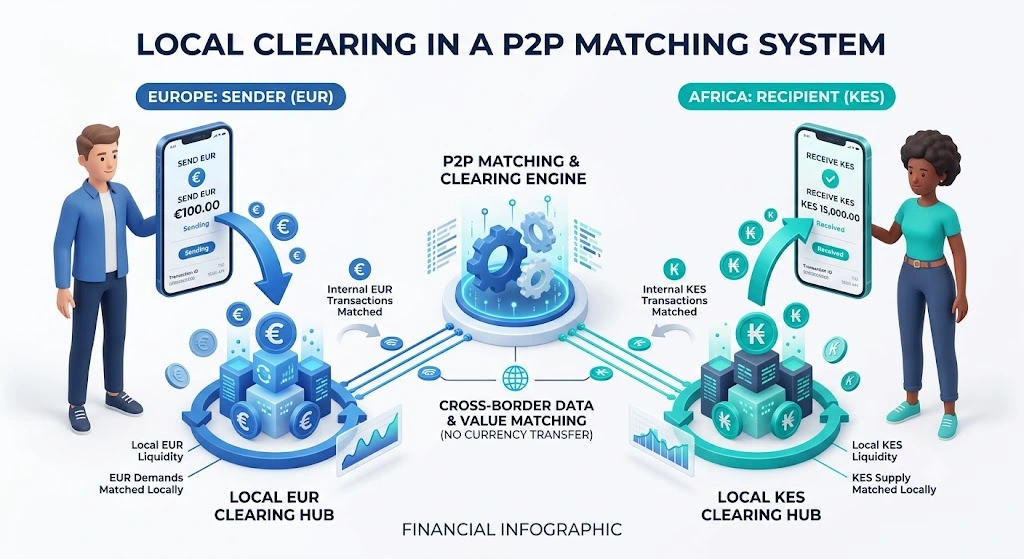
The foundation of this technology relies on the use of multi-currency digital wallets (notably supporting EUR, USD, GBP, and CAD). When a user wishes to exchange euros for US dollars, the platform instantly scans the network to find a counterpart looking to perform the exact opposite operation. The transaction is executed securely between these same-currency wallets hosted on the platform's infrastructure. The true technical innovation is that local currency flows always operate off-platform, utilizing fast national bank transfer networks or local payment solutions. This local clearing engineering mechanically eliminates the exorbitant fees of international correspondent banks. It thus offers the real market exchange rate, paired with minimal, transparent fixed fees. Understanding the philosophy behind this equitable model is highly recommended by reading the official manifesto advocating for a fairer financial system.
Integrating these new marketplaces into a travel routine requires a clear understanding of the process. The user experience is specifically designed to combine fluidity, speed, and uncompromising security. Here is the detailed transactional cycle:
The initial step requires creating a personal account. Rigorous identity verification, commonly known as KYC (Know Your Customer), is mandated by international financial regulations to curb fraud and money laundering. Preparing the appropriate supporting documents is essential to prevent any blockages, as explicitly outlined in this comprehensive guide covering necessary verification documents.
Once the profile is certified, the wallet is credited with the original currency by initiating a simple local bank transfer or via a supported national payment method. This action is exempt from standard international commissions.
On the digital marketplace, the desired amount and target currency are specified. The algorithmic engine takes over, searching for the perfect counterpart. As soon as the match is established, the exchange is executed with absolute transfer transparency and traceability.
The final, mandatory step involves both parties mutually evaluating the transaction. This feedback mechanism is the foundation of the marketplace. The quality, speed, and reliability of the members are guaranteed by these cross-reviews, making exploring trust rating systems paramount to understanding the collaborative and secure essence of the community.
The premise of financial security is non-negotiable in digital fund management. P2P marketplace platforms operate under the strict supervision of local and international financial regulators. The technical infrastructure integrates bank-grade end-to-end encryption protocols, hermetically protecting sensitive personal and transactional data.
Stringent KYC procedures and Anti-Money Laundering (AML) policies ensure the ecosystem remains healthy and every participant is authenticated. Furthermore, the financial architecture relies on segregated accounts. This system guarantees that funds deposited by users are strictly isolated from the company's operational liquidity. In the event of a dispute or unexpected delay, escrow mechanisms lock the funds until complete resolution and bilateral validation, offering undeniable protection during remote operations.
Optimizing a travel budget abroad or sending funds across borders should no longer translate into a resigned acceptance of prohibitive rates and opaque procedures. Current technological breakthroughs are redefining industry standards, positioning pricing fairness, transparency, and community integrity at the center of financial services. Innovative P2P matching systems provide a pragmatic, nearly instantaneous, and highly economical solution to the challenges of global financial mobility.
The era of banking monopolies charging invisible margins is over. To instantly visualize the difference in approach and calculate the tangible savings achievable on the next currency conversion, accessing the live rate simulator is possible by exploring the next-generation platform interface today.
Unlike conventional banking networks, the P2P matching infrastructure guarantees unconditional access to the real market exchange rate (interbank rate). Pricing is reduced to minimal fixed fees, clearly displayed before any operation is validated, thus ensuring the total absence of hidden costs or concealed margins.
Velocity is one of the pillars of the P2P system. Since funds do not transit through slow international networks but are exchanged virtually between internal wallets, the transaction is instantaneous once the match is validated. Final receipt then depends solely on the speed of local transfer networks, which typically ranges from a few minutes to a standard business day.
Absolutely. Legitimate platforms operate under the strict guidance of competent financial regulators and are subject to the same compliance obligations (KYC/AML) as traditional institutions. The use of segregated accounts and the mandatory mutual evaluation system provide a dual safety net, both technological and community-based.

Our peer-to-peer currency exchange and money transfer platform is currently under development. We are preparing a solution that will allow you to exchange currencies with a seamless and secure experience.
To be among the first to know and not miss anything about the launch, join the club by subscribing to our newsletter.
Visuals disclosure : In the interest of transparency, please note that the images illustrating this article were created using artificial intelligence (AI) generation tools.
© CashSwap Club 2026 - All rights reserved
Designed with ❤️ in Paris • Made in France 🇫🇷
 French
  Spanish