
Sending money to Argentina has historically presented a complex challenge for the global diaspora, international remote workers, and families living abroad. Navigating the Argentine financial landscape requires a clear understanding of the disparity between the official exchange rate set by central banking authorities and the true market valuation of foreign currencies. When attempting to bypass local inflation when sending money to Argentina, individuals often encounter significant losses if their transactions rely on conventional cross-border banking rails. Traditional wire transfers frequently convert foreign currencies like USD or EUR using restrictive official rates, substantially eroding the purchasing power of recipient families in Argentina.
Protecting a family's financial stability in Argentina demands transparency, speed, and fairness in every transaction. The rise of modern financial technology has introduced innovative mechanisms that challenge traditional banking monopolies. By examining marketplace vs bank hidden transfer fees, senders can identify methods that bypass unnecessary intermediary markups. Achieving true financial security and obtaining a competitive exchange rate requires moving away from legacy wire systems toward decentralized, community-focused solutions designed to deliver maximum value directly to recipients.
For decades, traditional financial institutions like Banco Nación, Banco Galicia, and Banco Santander Argentina have served as primary conduits for international remittances. However, relying on these conventional banking networks often results in high operational costs and lengthy processing times. When sending money through international wire transfers using the SWIFT network, funds pass through multiple intermediary correspondent banks, each levying its own clearance charge. These accumulated costs create high total transfer fees that severely reduce the net amount received by family members in Argentina.
Beyond explicit processing commissions, legacy banks frequently conceal substantial profit margins inside inflated currency conversion rates. Instead of passing on the real market rate, commercial institutions apply unfavorable retail exchange margins. Understanding why bank exchange rates differ from real market rates is essential for anyone seeking an efficient way to send money to Argentina. For members of the diaspora striving to safeguard their loved ones from local inflationary pressures, these hidden costs represent an unsustainable burden that demands a modern, transparent solution.
Argentina's macroeconomic environment is characterized by unique monetary dynamics, including strict foreign exchange controls and chronic inflation. The official exchange rate, regulated by the Central Bank of Argentina (BCRA), often diverges significantly from parallel market valuations and interbank benchmarks. When foreign currency enters the country via legacy banking protocols, it is frequently converted at official rates that do not reflect actual local purchasing power. Consequently, recipients receive significantly less local currency (ARS) than the true market value of the foreign deposit.
To mitigate these losses, international senders look for the best transfer app capable of bridging the gap between global currencies and local monetary realities. Accessing the true interbank market rate ensures that cross-border remittances retain their full economic value. Achieving this level of fairness requires a structural departure from traditional international wire protocols toward models that optimize currency matching without physical cross-border capital movement.
The Peer-to-Peer (P2P) matching architecture offers a transformative alternative to traditional international bank transfers. CashSwap Club operates as a financial marketplace based on P2P matching where funds never physically cross international borders. The platform manages multi-currency wallets (EUR, USD, GBP, and CAD) owned directly by users. Within the platform, transactions occur exclusively between wallets holding the same currency, eliminating the need for international currency conversion mechanisms that incur heavy bank markups.
Local currency balances flow entirely off-platform using domestic clearing mechanisms, such as national bank transfers or local payment networks. By matching counterparties through local liquidity pools, the platform connects supply and demand seamlessly. This decentralized structure delivers the real interbank exchange rate to users while charging only minimal, fully transparent fixed fees. Exploring why to choose P2P for international money transfers reveals how local clearing models protect senders from traditional banking markups.
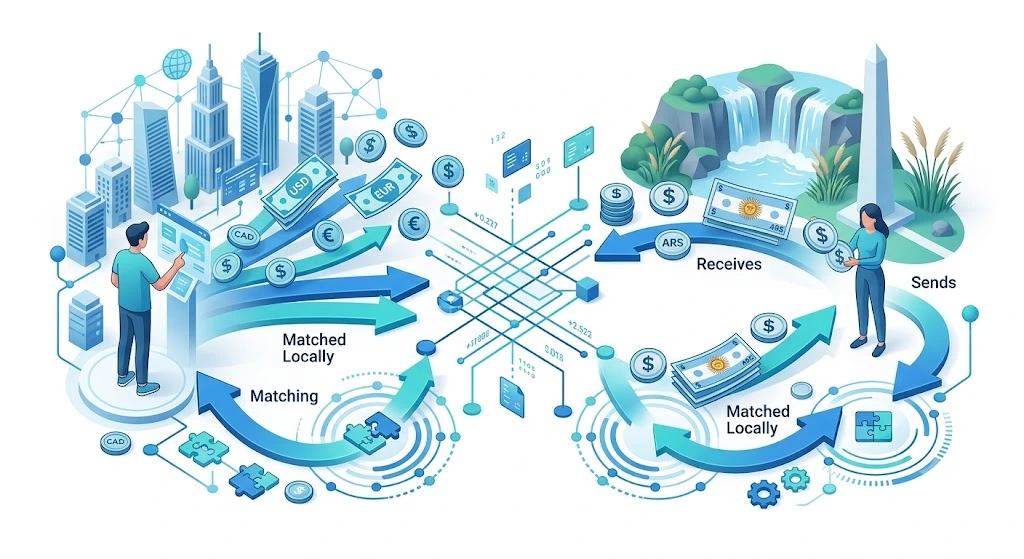
This localized settlement approach drastically reduces both costs and execution times. Rather than waiting days for international correspondent banking channels to settle a transfer, localized matching allows recipients in Argentina to receive their funds rapidly. In addition, assessing a marketplace vs local branch transfer savings comparison underscores the profound economic advantages of software-driven matching over physical branch networks.
A critical advantage of localized P2P matching is its seamless integration with Argentina's modern domestic payment infrastructure. In Argentina, digital transactions rely heavily on standardized account aliases: CBU (Clave Bancaria Uniforme) for traditional bank accounts at institutions like Banco Nación, Banco Galicia, or Banco Santander Argentina, and CVU (Clave Virtual Uniforme) for non-bank fintech accounts. These 22-digit identifiers and their associated text aliases enable instant, 24/7 domestic bank transfers across the nation.
Furthermore, digital wallets—most notably Mercado Pago—have become central to daily financial transactions in Argentina. Local clearing networks utilize these CBU, CVU, and digital wallet channels to execute off-platform settlements instantaneously. When a P2P match is finalized, the recipient's local payout arrives directly into their Mercado Pago account or bank account via domestic instant transfer protocols. This eliminates the need for recipients to visit physical cash collection branches or maintain complex foreign currency bank accounts, maximizing convenience and security.
Executing an international remittance through a P2P matching marketplace is designed to be straightforward, transparent, and secure. The operational process follows a clear sequence:
Modern mobile solutions continue to reshape cross-border finance. For a broader analysis of industry shifts, consult this review on how mobile money transfer apps disrupt fintech ecosystems globally.
When transferring money internationally, financial security remains the single most critical consideration for users. A peer-to-peer matching marketplace ensures safety by integrating strict anti-money laundering (AML) protocols and robust user verification processes. Every member of the platform must pass verification checks prior to engaging in exchange operations, creating a secure financial environment.
In addition to strict regulatory compliance, the mandatory double-evaluation protocol adds an essential layer of trust. By requiring both participants to validate and rate each completed exchange, the platform establishes a transparent, self-regulating community. Senders can rest assured that their transactions are backed by rigorous encryption, verified counterparties, and structured dispute resolution mechanisms. To explore the foundational values powering this approach, read the community manifesto for transparent financial access.
Navigating currency transfers to Argentina no longer requires accepting unfair official exchange rates, unpredictable intermediary fees, or protracted delivery delays. By leveraging a P2P matching model that keeps currency flows local and integrates directly with CBU/CVU systems and Mercado Pago, senders can ensure their families receive maximum financial support with complete transparency.
Ready to experience fair, real-market exchange rates with minimal fixed fees? Take control of your international remittances today. Visit the main CashSwap Club platform portal to test the live rate simulator and start sending money with total peace of mind.
Unlike traditional banks that hide costs inside exchange rate markups, P2P matching applies the authentic interbank exchange rate accompanied only by minimal, transparent fixed fees disclosed upfront before any order is submitted.
Because local currency payouts settle via domestic instant clearing channels—such as CBU/CVU transfers or Mercado Pago—recipients typically receive their funds within minutes to a few hours once a counterparty match is confirmed.
Yes. The platform enforces strict Know Your Customer (KYC) compliance, advanced data encryption, and a mandatory post-transaction mutual rating system, ensuring high-level security for every exchange.
No. Physical foreign currency never needs to cross borders. The recipient receives local currency directly into their standard Argentine bank account (via CBU) or digital wallet like Mercado Pago (via CVU).

Our peer-to-peer currency exchange and money transfer platform is currently under development. We are preparing a solution that will allow you to exchange currencies with a seamless and secure experience.
To be among the first to know and not miss anything about the launch, join the club by subscribing to our newsletter.
Visuals disclosure : In the interest of transparency, please note that the images illustrating this article were created using artificial intelligence (AI) generation tools.
© CashSwap Club 2026 - All rights reserved
Designed with ❤️ in Paris • Made in France 🇫🇷
 Spanish