
Financing real estate developments, commercial ventures, agricultural expansions, or community infrastructure in Nigeria represents a major economic catalyst for the global Nigerian diaspora and foreign investors. However, injecting capital into local projects often involves navigating complex financial hurdles. Capital controls, frequent currency fluctuations surrounding the Nigerian Naira (NGN), and legacy banking constraints make cross-border capital transfers notoriously inefficient. Anyone seeking to send money to Nigeria to get the best NGN exchange rates must evaluate the structural flaws of traditional wire systems to avoid severe value leakage before funds ever reach project managers on the ground.
Ensuring that every dollar, euro, pound, or Canadian dollar yields maximum value requires full transparency, swift execution, and absolute transactional safety. Traditional cross-border remittance models frequently erode capital through hidden margins and inflated processing costs. Conducting a detailed analysis of marketplace vs bank hidden transfer fees demonstrates how modern financial technology is reshaping cross-border investments. By bypassing correspondent banking networks, project sponsors can secure a competitive exchange rate, minimize operational friction, and support local growth with total confidence.
Injecting capital into Nigerian projects via legacy banking protocols typically involves routing funds through international correspondent networks like SWIFT. This infrastructure relies on multiple intermediary financial institutions, each charging processing fees and currency conversion handling costs. When executing transfers through major domestic institutions such as Zenith Bank, Access Bank, United Bank for Africa (UBA), or GTBank via standard wire procedures, senders encounter substantial total transfer fees that diminish the actual capital deployed for equipment, land acquisition, or labor.
Beyond explicit processing commissions, conventional banks routinely embed substantial profit margins within artificially altered exchange rates. Understanding why bank exchange rates differ from real market rates reveals how retail banks generate hidden revenue at the customer's expense. For diaspora investors attempting to find the best transfer app to fund long-term initiatives, these hidden markups represent a significant financial barrier that compromises project budgets and delays execution timetables.
To overcome systemic banking friction, Peer-to-Peer (P2P) matching marketplaces offer a radical structural alternative. CashSwap Club functions as an international money transfer marketplace based on P2P matching where funds never physically cross international borders. The platform manages multi-currency wallets (EUR, USD, GBP, and CAD) belonging directly to users. Within the platform, exchanges occur strictly between wallets holding the identical currency, eliminating international wire transfers and correspondent banking delays.
Local currency flows occur entirely off-platform via domestic bank transfers or local payment solutions. By connecting user supply and demand directly, the system matches counterparties locally and delivers the authentic interbank exchange rate alongside minimal, fully transparent fixed fees. Comparing marketplace vs local branch real savings on money transfers highlights the structural cost advantages of decentralized software matching over traditional branch-based operations.
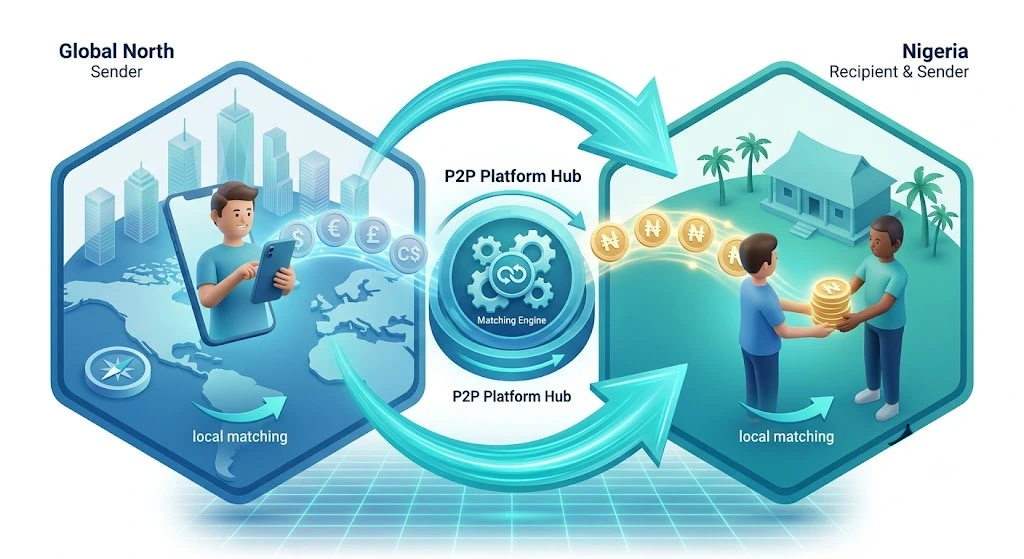
By eliminating cross-border routing delays, local clearing models allow project managers in Nigeria to receive necessary funding almost instantaneously. This agility enables real-time procurement and protects capital against continuous foreign exchange volatility.
A major operational advantage of localized P2P matching is its direct integration with Nigeria's advanced domestic payment ecosystem. Beneficiaries in Nigeria can receive funds through direct local bank transfers into major commercial institutions like Zenith Bank, Access Bank, United Bank for Africa (UBA), and GTBank via NIBSS Instant Payments (NIP), ensuring rapid settlement.
In addition to traditional commercial bank accounts, mobile financial services have experienced massive adoption across Nigeria. Digital wallets and fintech platforms such as OPay and PalmPay provide instant emergency payouts and flexible wallet transfers, allowing project contractors, suppliers, and field staff to access operating capital instantly on their mobile devices. Whether funding large-scale construction or micro-enterprise ventures, combining P2P matching with local digital wallet clearing offers an unprecedented level of speed and convenience for those looking to send money to Nigeria.
Deploying capital via a P2P matching marketplace is designed to be transparent, straightforward, and secure. The execution framework follows five structured steps:
Mobile technology continues to transform global remittance dynamics. For insights into wider fintech developments, review how mobile money transfer apps disrupt fintech ecosystems worldwide.
When transferring large capital sums for enterprise or development projects, maintaining strict financial security is essential. Modern P2P marketplaces integrate institutional-grade data encryption, robust fraud monitoring algorithms, and strict adherence to international Anti-Money Laundering (AML) standards. Reviewing why regulations require identity verification in digital finance provides essential context on how compliance measures protect user funds.
Furthermore, the mandatory double-evaluation protocol ensures that every participant maintains a verified reputation score. This peer-driven accountability mechanism prevents fraudulent behavior and fosters a secure, collaborative financial community. Senders can track transactions in real time, knowing their capital is protected by both technological safeguards and regulatory standards. To understand the foundational ethos guiding this architecture, explore the community manifesto for transparent global finance.
Funding projects in Nigeria no longer requires accepting excessive bank exchange rate markups, unpredictable intermediary fees, or multi-day transfer delays. By leveraging a Peer-to-Peer matching model that utilizes local clearing networks, investors and diaspora members can deliver capital directly into local accounts at GTBank, Access Bank, Zenith Bank, UBA, OPay, or PalmPay while retaining full financial value.
Ready to maximize your project capital with fair interbank exchange rates and low fixed costs? Experience the future of cross-border transfers today. Visit the main CashSwap Club platform portal to test the live exchange rate simulator and start funding your projects with total transparency.
P2P matching applies the true interbank exchange rate without hidden currency markups. Users pay only a minimal, fully disclosed fixed fee upfront before confirming any transaction.
Because payouts in Nigeria are processed locally via instant domestic rails (NIBSS) or digital wallets like OPay and PalmPay, recipients generally receive funds within minutes to a few hours after a P2P match is executed.
Yes. Operations adhere strictly to international AML and KYC regulations. Additionally, platform encryption and mandatory post-transaction mutual ratings ensure high-level security for all transfers.
Yes. Payouts can be cleared directly into major Nigerian commercial bank accounts (such as Zenith Bank, Access Bank, UBA, and GTBank) or digital mobile wallets like OPay and PalmPay.

Our peer-to-peer currency exchange and money transfer platform is currently under development. We are preparing a solution that will allow you to exchange currencies with a seamless and secure experience.
To be among the first to know and not miss anything about the launch, join the club by subscribing to our newsletter.
Visuals disclosure : In the interest of transparency, please note that the images illustrating this article were created using artificial intelligence (AI) generation tools.
© CashSwap Club 2026 - All rights reserved
Designed with ❤️ in Paris • Made in France 🇫🇷
 French