
The economic landscape in Lebanon has undergone unprecedented transformations over the past few years, fundamentally altering how individuals manage finances, interact with banking institutions, and support their families from abroad. For the global Lebanese diaspora, the imperative to send money to Lebanon has shifted from a routine financial task to a critical lifeline ensuring the economic survival of relatives back home. In a system characterized by strict capital controls and volatile currency valuations, navigating the financial corridors requires a deep understanding of new monetary rules, specifically the concept of "Fresh Dollars," and the adoption of modern, secure channels.
Traditional banking avenues have proven increasingly inefficient, burdened by exorbitant costs and systemic blockages. As a result, innovative financial technologies, particularly Peer-to-Peer (P2P) matching marketplaces, have emerged as the most viable alternatives. Platforms like CashSwap Club represent a paradigm shift in international remittances, prioritizing transparency, security, and the preservation of capital. This comprehensive guide explores the structural flaws of legacy banks, the vital nature of Fresh Dollars, and the precise mechanisms through which P2P matching operates to provide the best possible conditions for international money transfers.
For decades, legacy banking institutions and traditional wire transfer operators held a monopoly on cross-border financial flows. However, the systemic financial crisis in Lebanon exposed the severe vulnerabilities and inherent inequalities of this model. Major Lebanese financial institutions, including Audi Bank, Blom Bank, and Byblos Bank, were forced to implement draconian capital controls. These restrictions effectively locked millions of depositors out of their foreign currency accounts, creating a profound crisis of trust between the population and the banking sector.
When individuals attempt to send money through traditional bank wires, the funds must navigate the SWIFT (Society for Worldwide Interbank Financial Telecommunication) network. SWIFT is a global messaging system that instructs banks to transfer funds. While secure, this legacy system involves multiple intermediary or "correspondent" banks. Each correspondent bank extracts a fee for processing the transaction, resulting in highly unpredictable final amounts. Furthermore, these institutions often apply disadvantageous, inflated exchange rates that do not reflect the true market reality, silently siphoning wealth away from the sender and the recipient.
The lack of transparency in standard international transfers is a significant burden for the diaspora. Senders are rarely informed of the exact amount that will land in the recipient's account, nor are they provided with a clear breakdown of intermediary fees. In a volatile economic environment like Lebanon, where every dollar holds immense purchasing power, winning the battle against hidden transfer fees imposed by legacy institutions is an absolute necessity. Traditional banks have demonstrated an inability to adapt to the urgent, low-cost requirements of modern remittances, pushing individuals toward more agile and transparent technological alternatives.
Moreover, physical remittance branches, while offering cash pickup services, are notorious for their high flat fees and wide spreads on exchange rates. These operators capitalize on the urgency of the sender, charging premiums that disproportionately affect those sending smaller, regular amounts for daily sustenance. By analyzing the financial ecosystem, it becomes evident that avoiding these physical intermediaries is crucial for wealth retention.
To comprehend the current Lebanese financial ecosystem, one must understand the fundamental distinction between pre-crisis bank deposits and newly injected foreign currency. Deposits made prior to the economic collapse in 2019 are locally referred to as "Lollars" (Lebanese Dollars). These funds are trapped within the banking system, subject to severe withdrawal limits, and can only be accessed at highly unfavorable exchange rates mandated by the central bank. They hold virtually no purchasing power in the real, cash-based economy that dictates daily life in Lebanon.
Conversely, "Fresh Dollars" refer to new, hard foreign currency—specifically US Dollars—transferred into Lebanon from abroad after the onset of the crisis. According to regulatory frameworks established to encourage the influx of foreign capital, Fresh Dollars are exempt from capital controls. They can be withdrawn in cash at their full face value, transferred internationally without restriction, and are the primary currency used to price real estate, imported goods, fuel, and essential services.
For a family residing in Beirut, Tripoli, or the Bekaa Valley, receiving Fresh Dollars is a matter of economic survival. The local currency, the Lebanese Pound (LBP), has suffered historic hyperinflation, rendering salaries paid in LBP insufficient to cover basic nutritional and healthcare needs. The diaspora’s ability to inject non-restricted USD directly into the hands of their loved ones is the solitary mechanism keeping vast segments of the population above the poverty line. In an environment where the local currency's value changes daily, understanding why exchange rates fluctuate and how individuals can beat the market empowers senders to maximize the impact of their hard-earned money.
Local reception of these funds typically occurs through two primary channels: physical withdrawal of cash in Fresh Dollars via certified networks of local agencies, or receiving Lebanese Pounds converted directly at the true, parallel market rate rather than the artificially suppressed official rate. While Audi Bank, Blom Bank, and Byblos Bank do offer "Fresh Accounts" to receive incoming international wires, the associated inbound transfer fees and the lingering mistrust of the banking sector drive many toward decentralized, alternative distribution networks.
The traditional model of physically moving money across borders is obsolete. The technological answer to high transfer fees and poor exchange rates is the Peer-to-Peer (P2P) matching marketplace. CashSwap Club operates on this exact paradigm, redefining the architecture of international value exchange. In this highly efficient model, money never actually crosses international borders. Instead, the platform facilitates a synchronized swap of liabilities between users operating in different geographic locations.
To achieve this, the platform equips users with multi-currency digital wallets (supporting EUR, USD, GBP, and CAD). When an individual in France wishes to send euros to a relative in Lebanon, the system does not wire euros to the Middle East. Instead, the matching engine searches for a counterparty—for instance, a Lebanese export business holding Fresh Dollars or LBP who needs euros in Europe to pay suppliers. The platform perfectly matches these two independent intents. The transactions are executed exclusively between wallets of the same currency directly within the platform's secure environment. The corresponding local currency flows (such as delivering Fresh Dollars or LBP in Lebanon) are managed off-platform via local national bank transfers, mobile money, or certified local agency cash pickups.
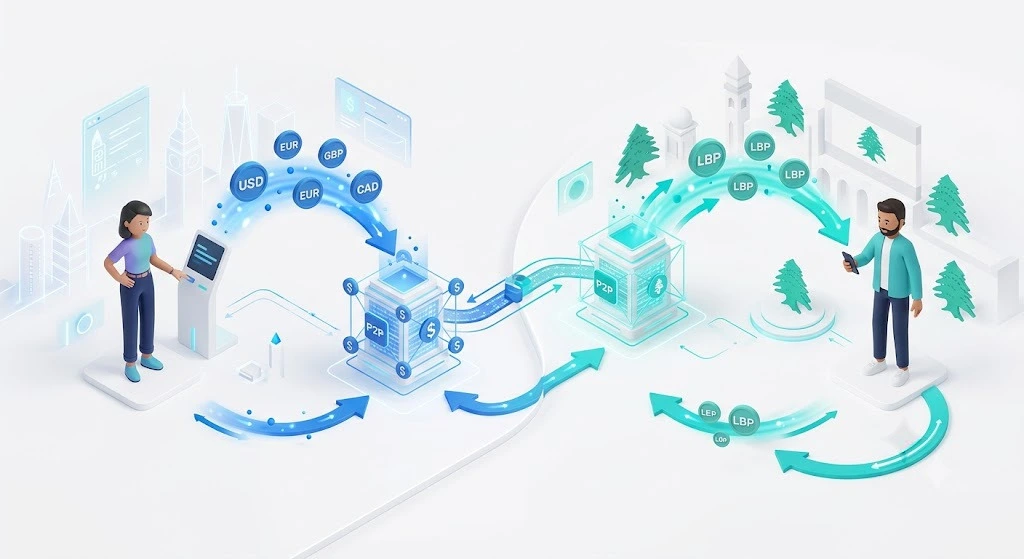
This architectural brilliance eliminates the need for SWIFT networks, correspondent banks, and foreign exchange brokers. By removing intermediaries, the platform can offer the true interbank exchange rate—the actual, real-time market value of the currency—accompanied only by minimal, fully transparent fixed fees. For individuals searching for the best money transfer app, the mathematical reality is that analyzing why choosing a P2P system for money transfers is the most logical financial decision inevitably leads to matching marketplaces. It represents a democratization of finance, restoring purchasing power to the users rather than padding the profit margins of legacy financial institutions.
Furthermore, this system vastly outperforms physical remittance operators. By keeping the matching digital and facilitating local settlement, the operational overhead is drastically reduced. Users interested in optimizing their remittances will find that evaluating the real savings on money transfers compared to physical local branches highlights the undeniable superiority of the P2P matching methodology.
Transitioning from traditional banking to a P2P marketplace requires an understanding of the operational workflow. The process is designed to be highly intuitive, ensuring that even users with limited technical expertise can execute secure transactions swiftly.
Step 1: Account Verification and Wallet Funding
The journey begins with the creation of a secure account. Due to strict financial regulations, all users must complete a rigorous identity verification process before accessing the multi-currency wallets. Once verified, the sender funds their platform wallet (e.g., depositing Euros or USD via a local European or American bank transfer). Because this initial deposit is a domestic transfer, it incurs no international fees.
Step 2: Defining the Transfer Parameters
The sender navigates to the transfer interface and inputs the desired amount and the target destination (Lebanon). The platform’s algorithm immediately calculates the matching parameters based on real-time market exchange rates. Transparency is paramount here: the exact amount of Fresh Dollars or LBP that the recipient will collect is displayed clearly, alongside the minimal fixed fee.
Step 3: The Matching Engine at Work
Once the order is confirmed, the platform's matching engine pairs the request with an opposing demand within the ecosystem. The matching occurs instantaneously if liquidity is high, pairing the sender's EUR/USD with a local holder's Fresh Dollars or LBP.
Step 4: Off-Platform Settlement and Mandatory Rating
The counterparty in Lebanon facilitates the local settlement, delivering the funds to the intended recipient via local bank transfer (to a Fresh Account at Audi, Blom, or Byblos Bank) or through a certified cash withdrawal agency. The transaction is only finalized when both parties confirm receipt. Crucially, the platform enforces a mandatory dual-rating system. Both the sender and the receiving party must evaluate the transaction at its conclusion. This step is not optional; it is the cornerstone of community integrity. For a deeper dive into this security mechanism, understanding the mechanics of robust trust rating systems in P2P platforms reveals how mandatory feedback loops mathematically eliminate bad actors from the network.
A common concern when abandoning traditional banks in favor of digital marketplaces is the security of funds and personal data. CashSwap Club addresses these concerns through institutional-grade compliance frameworks and innovative trust mechanisms designed specifically for the P2P environment.
First and foremost is the implementation of strict KYC (Know Your Customer) protocols. KYC is a mandatory regulatory requirement designed to verify the identity of every individual using the platform. This involves the submission of government-issued identification and biometric verification. Coupled with robust AML (Anti-Money Laundering) algorithms, the platform ensures that the ecosystem remains hermetically sealed against illicit activities. While the platform operates on a decentralized P2P matching philosophy, it adheres strictly to the regulatory compliance standards expected of top-tier financial institutions.
The true innovation in security, however, lies in the mandatory dual-rating system mentioned earlier. In a P2P marketplace, trust cannot be entirely centralized; it must be distributed among the users. By forcing both participants to rate every single transaction, the platform builds an immutable, public reputation ledger for every user. Accounts that attempt to delay local settlement, provide poor communication, or violate the terms of service are swiftly identified by the community and permanently restricted by the system's automated moderation protocols. This creates a self-regulating ecosystem where optimal behavior is mathematically incentivized.
Furthermore, because the fiat currency does not cross borders and transactions occur between platform wallets, exposure to interception or arbitrary freezing by intermediary correspondent banks is completely eliminated. The architecture itself is designed to protect the user's capital from systemic banking failures. Users are encouraged to explore the fundamental values and operational framework of the platform to fully grasp the commitment to financial sovereignty and secure value exchange.
The ability to send money to Lebanon efficiently is no longer a luxury; it is a fundamental requirement for the preservation of families navigating one of the most severe economic crises in modern history. The traditional banking sector, hindered by legacy technology like SWIFT, excessive correspondent fees, and restrictive capital controls, has proven inadequate for the needs of the modern diaspora.
Fresh Dollars represent the vital currency of survival, and delivering them securely requires an evolution in financial infrastructure. P2P matching marketplaces like CashSwap Club provide this evolution. By utilizing multi-currency wallets, matching local demands, and enforcing a mandatory dual-rating system, the platform guarantees the real market exchange rate, eliminates hidden fees, and fosters a secure, community-driven ecosystem.
The transition toward decentralized matching platforms marks a definitive shift in power, returning financial control to the individuals who earn the money. Do not let outdated banking systems diminish the value of hard-earned capital. Discover the true power of P2P matching and ensure that every cent intended for loved ones in Lebanon reaches its destination safely and efficiently. Take control of international transfers today by testing the live rate simulator on the platform.
Because P2P matching bypasses international SWIFT networks, transactions are incredibly rapid. Once the wallets are funded and the matching engine pairs the transaction, the off-platform local settlement (whether via a local Fresh Account transfer at banks like Audi or Byblos, or through a certified cash agency) typically completes within a few hours, rather than the 3 to 5 business days required by traditional banks.
No. Transparency is the core operating principle of a matching marketplace. The platform operates on the true interbank exchange rate without any hidden spreads or markups. Users are charged a single, clearly displayed fixed fee prior to confirming the transaction. The exact amount of Fresh Dollars to be received in Lebanon is guaranteed at the moment of execution.
Yes, it is entirely legal. The platform operates under strict financial regulations and mandates rigorous KYC (Know Your Customer) and AML (Anti-Money Laundering) checks for all users. The P2P mechanism simply optimizes how the currency is exchanged locally, ensuring full compliance with international financial laws while providing a superior service.
The platform secures the transaction through a combination of verified multi-currency wallets and community enforcement. Funds within the platform's ecosystem are securely allocated during the matching phase. Crucially, the mandatory dual-rating system ensures that any user failing to complete the off-platform local settlement accurately and promptly is immediately flagged, penalized, and removed from the marketplace, creating an environment of absolute trust and accountability.

Our peer-to-peer currency exchange and money transfer platform is currently under development. We are preparing a solution that will allow you to exchange currencies with a seamless and secure experience.
To be among the first to know and not miss anything about the launch, join the club by subscribing to our newsletter.
Visuals disclosure : In the interest of transparency, please note that the images illustrating this article were created using artificial intelligence (AI) generation tools.
© CashSwap Club 2026 - All rights reserved
Designed with ❤️ in Paris • Made in France 🇫🇷
 French